
Blog
Distributor to Brand Owner: Why Ayurvedic Distributors Are Launching Their Own Labels

If you run an Ayurvedic medicine distributor business, you already own the hardest asset to build in this industry: a supply chain that reaches retailers every week. Chemists, Ayurvedic stores, general stores and clinics trust you to deliver on time. Yet the margin you earn for that work keeps getting thinner, while the brands you distribute keep the long-term value.
This guide explains why distributor margins are shrinking, why a new generation of distributors is leveraging its network to build its own label, how the margin changes when you move from trading to brand ownership, which Ayurvedic categories sell best through distribution, and how Herbal Hills supports distributors with ready products, labelling, packaging and low starting quantities.
Why Are Distributor Margins Shrinking?
Across consumer goods, distributors are being squeezed from both sides. Costs for fuel, transport, warehousing, staff and credit keep rising, while brand-set margins stay flat or are restructured. The Federation of All India Distributors Associations has said distributor margins have stayed largely unchanged for more than 20 years even as operating costs rose three- to five-fold. In 2026, the All India Consumer Products Distributors’ Federation, which represents over 4.5 lakh distributors, warned that the current margin structure is no longer sustainable.
At the same time, large companies are reaching more retailers directly, and B2B apps and online marketplaces compete for the same stores. For a distributor, every one of these trends means more work for the same or lower margin.
| Pressure on Distributors | What It Means for Your Business |
|---|---|
| Flat brand-set margins | Earnings per order stay the same while costs rise |
| Rising operating costs | Fuel, staff, warehousing and credit eat into a thin margin |
| Direct-to-retailer models | Brands bypass distributors for part of their outlets |
| B2B apps and online platforms | Retailers compare your price with app and marketplace offers |
| Brand concentration | A few principals control most of your turnover and terms |
Why Is a New Generation of Distributors Building Its Own Label?
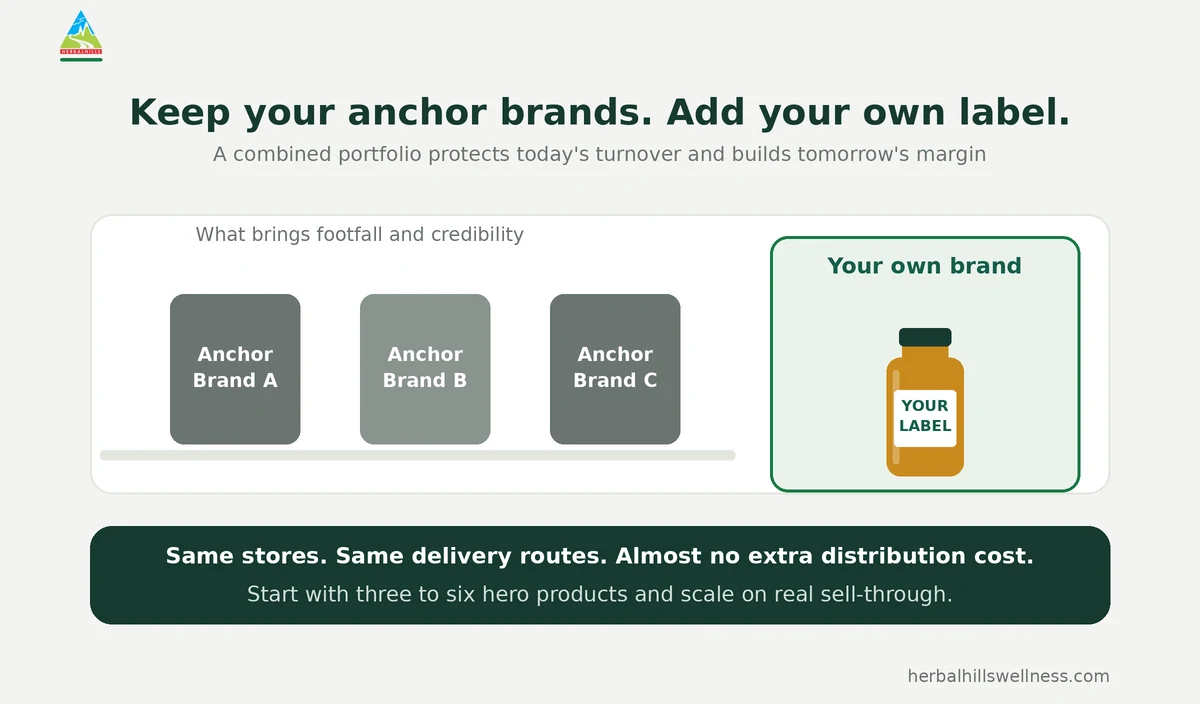
Many distribution businesses are now run by a younger generation that sees the network differently. Instead of treating it only as a delivery service for other companies, they treat it as a launchpad. A distributor who already supplies hundreds or thousands of retail outlets can introduce products under its own brand to the same stores, on the same delivery routes, with almost no extra distribution cost.
What is a super stockist, and can a super stockist launch its own brand?
A super stockist buys stock in bulk from a manufacturer or brand and supplies it to distributors or large retailers in a defined territory. Super stockists already handle inventory, credit and regional logistics, so they are well placed to launch their own Ayurvedic label and push it through the distributors and stores they serve.
Distributor Margin vs Brand Owner Margin: What Changes?
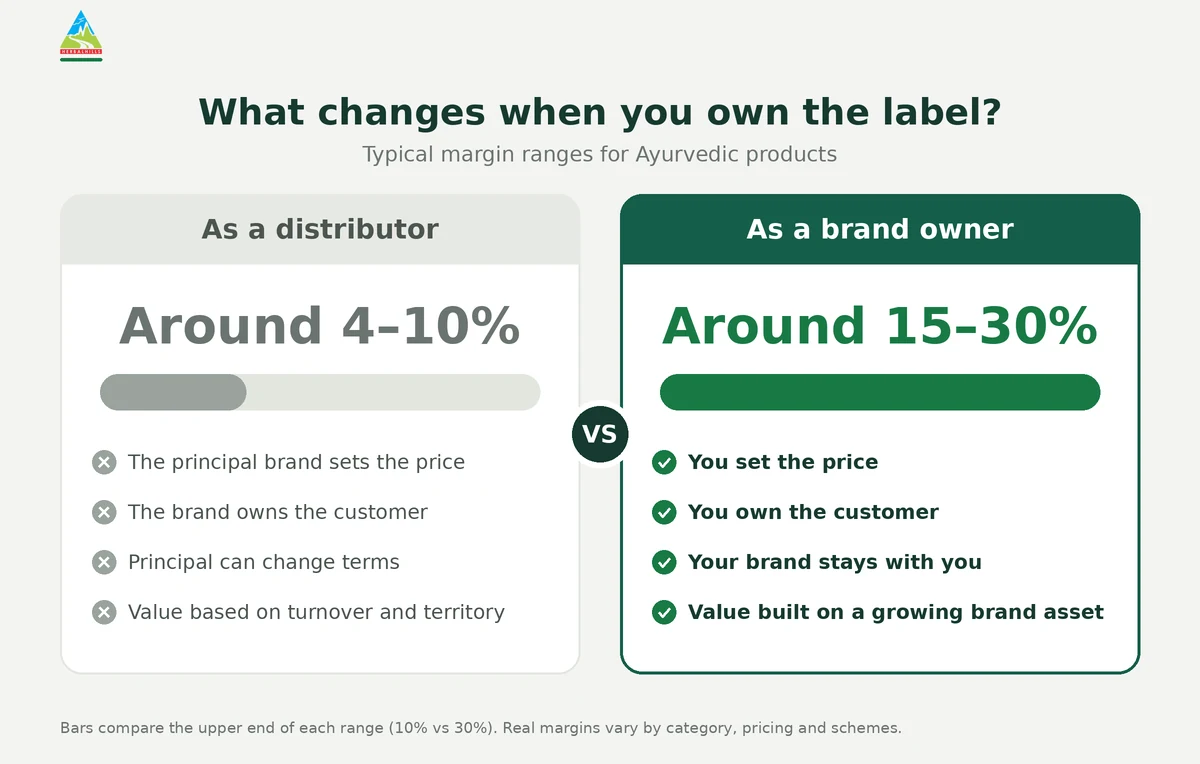
For an Ayurvedic medicine distributor, the single biggest reason to launch your own label is margin. As a distributor of other companies’ products, you typically earn a margin of around 4–10% on what you sell. As the owner of a private label brand, you control the price and can typically earn 15–30% on your own products, because the margin that used to go to the brand now stays with you.
Bars compare the upper end of each range (10% vs 30%). Real margins depend on category, pricing, schemes and credit terms.
| Factor | As a Distributor | As a Brand Owner |
|---|---|---|
| Typical margin | Around 4–10% | Around 15–30% on own-brand products |
| Who sets the price | The principal brand | You |
| Who owns the customer relationship | The brand | You |
| Risk of losing the business | Principal can change terms or appoint others | Your brand stays with you |
| Business value | Based on turnover and territory | Built on a brand asset that grows |
How much difference does own-brand margin make? An illustrative example
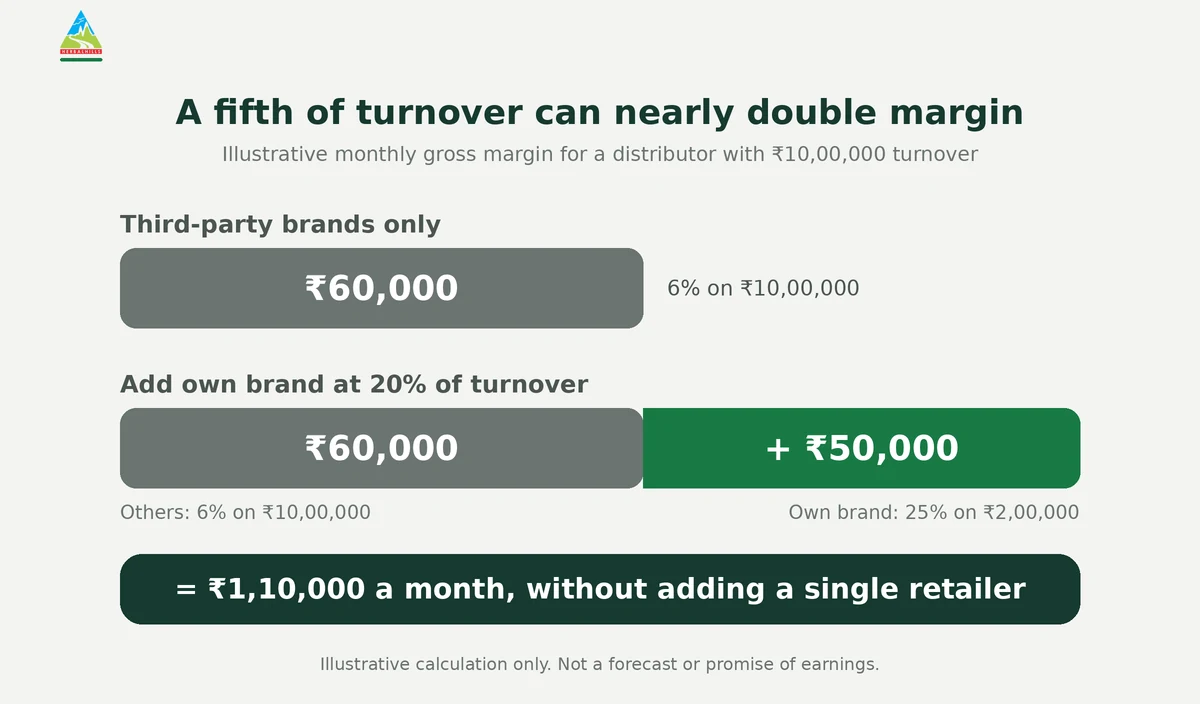
The figures below are hypothetical and only show how the margin shift works. Your real margins depend on category, pricing, schemes and credit terms.
| Scenario | Monthly Turnover | Margin | Monthly Gross Margin |
|---|---|---|---|
| Third-party brands only | ₹10,00,000 | 6% | ₹60,000 |
| Add own brand at 20% of turnover | ₹2,00,000 own brand + ₹10,00,000 others | 25% own brand, 6% others | ₹50,000 + ₹60,000 = ₹1,10,000 |
In this example, an own-brand range equal to just a fifth of existing turnover nearly doubles monthly gross margin, without adding a single new retailer.
Illustrative calculation only. It is not a forecast or promise of earnings.
Which Ayurvedic Categories Sell Best Through Distribution?
Retailers ask distributors for products in categories with steady, repeat demand. These are the categories where Herbal Hills supports distributor brands most often:
| Category | Why It Works for Distributors | Popular Formats |
|---|---|---|
| Joint care | Steady demand across age groups, strong repeat purchase | Capsules, tablets, oils |
| Hair care | High retail visibility and impulse purchase | Hair oils, capsules, kits |
| Healthy sugar balance support | Long-term daily-use category | Tablets, juices, herbal shots |
| Stress and sleep support | Fast-growing modern wellness need | Capsules, tablets |
| Liver care | Established Ayurvedic category with loyal buyers | Syrups, tablets |
| Digestive and bowel comfort | Everyday need with frequent reorders | Churna, tablets, capsules |
Many of these products are research-based formulations, which gives your sales team a stronger story at the retail counter.
How Does Herbal Hills Support Distributor Brands?
Herbal Hills’ QuickLabel™ programme is built for businesses that already have customer reach and want their own Ayurvedic range without building a factory. Depending on product selection and availability, support includes:
Starting quantities, packaging and timelines differ by product, and are confirmed before you place an order.
How Do You Launch Your Own Ayurvedic Brand as a Distributor?
🗺️Map Your Network
List the outlets you serve and the categories retailers ask you for most.
🎯Pick Three to Six Hero Products
Start with high-demand categories such as joint care, hair care or digestive comfort.
🧴Request Free Trial Samples
Show them to a few trusted retailers for feedback.
🏷️Finalise Brand Name, Label and Packaging
Use Herbal Hills’ label support to prepare compliant, shelf-ready packs.
📦Place a Starter Order
Order small quantities and launch through your existing routes.
📈Track, Reorder and Scale
Track sell-through and reorders, then add products and scale quantities for the winners.
What Should Distributors Avoid When Launching Their Own Brand?
Why Distributors Choose Herbal Hills
From Distributor to Brand Owner
As an Ayurvedic medicine distributor, your network is already doing the hard work of reaching retailers every week. Launching your own Ayurvedic label lets you keep more of the value that network creates, protect your business from shrinking margins and build a brand asset for the next generation. According to Herbal Hills, the distributors who start small, focus on repeat-purchase categories and scale on real sell-through build the most sustainable own brands.
Request the Distributor Brand Kit — Product List, MOQ & Free Samples →
Frequently Asked Questions
Can an Ayurvedic distributor launch its own brand without a manufacturing licence?
Yes. Under third-party manufacturing, products are made under Herbal Hills’ manufacturing licences in its certified facility. Your company appears on the label as the brand owner or marketer, so you can build your own Ayurvedic range without setting up a factory or applying for your own manufacturing licence.
What margin can a distributor earn on its own brand?
Distributors typically earn around 4–10% on third-party brands. On an own-brand range, where you set the price, margins of around 15–30% are common. Your actual margin depends on the product, packaging, retail price, schemes and credit terms you offer to your retailers.
Do I have to stop distributing other brands?
No. Most distributors keep their anchor brands, which bring footfall and credibility, and add their own label gradually in categories where retailers want a reliable option. A combined portfolio protects existing turnover while the own-brand share and margin grow over time.
What is the minimum order quantity for a distributor brand?
With QuickLabel™, selected SKUs start from around 50 pieces, so you can test a category in a few outlets before scaling. Starting quantities differ by product and packaging, and the Herbal Hills team confirms the exact minimum for each item before your order.
Which products should a distributor launch first?
Start with three to six products in high-demand, repeat-purchase categories such as joint care, hair care, digestive comfort or daily wellness. Choose categories your retailers already ask for, test them with free trial samples, and expand the range once sell-through and reorders confirm demand.
Does Herbal Hills help with labels and packaging?
Yes. QuickLabel™ includes standard label design support, packaging coordination and labelling guidance, so your products carry the required information. If you already work with a designer, they can create the artwork and Herbal Hills will help check that the label is complete.
How quickly can I get my own-brand stock?
Ready QuickLabel™ products are prepared in approximately seven working days after payment, label approvals and order confirmation. Your total launch time also depends on finalising your brand name and artwork. Custom formulations take longer because they need development and quality evaluation.
Can a super stockist or C&F agent launch its own Ayurvedic brand?
Yes. Super stockists and C&F agents already manage inventory, credit and regional logistics, which makes them well suited to own-brand distribution. They can launch a focused Ayurvedic range and supply it through the distributors and retailers they already serve, with Herbal Hills handling manufacturing.