

Blog
Classical (Shastrokta) vs Proprietary Ayurvedic Formulations: Which Should Your Brand Launch?

Every new Ayurvedic brand faces the same early decision: launch with the well-known classical medicines everyone already recognises, or launch with proprietary formulations that nobody else sells. The choice decides what you can call your product, what the licensing authority will ask for, how customers compare you with competitors and, in the end, how much you can charge.
This guide explains what classical and proprietary Ayurvedic medicines are under Indian law, why classical products are hard to price well when you are a new brand, how proprietary formulations change that, and how Herbal Hills helps brands launch either route.
What Is a Classical (Shastrokta) Ayurvedic Formulation?
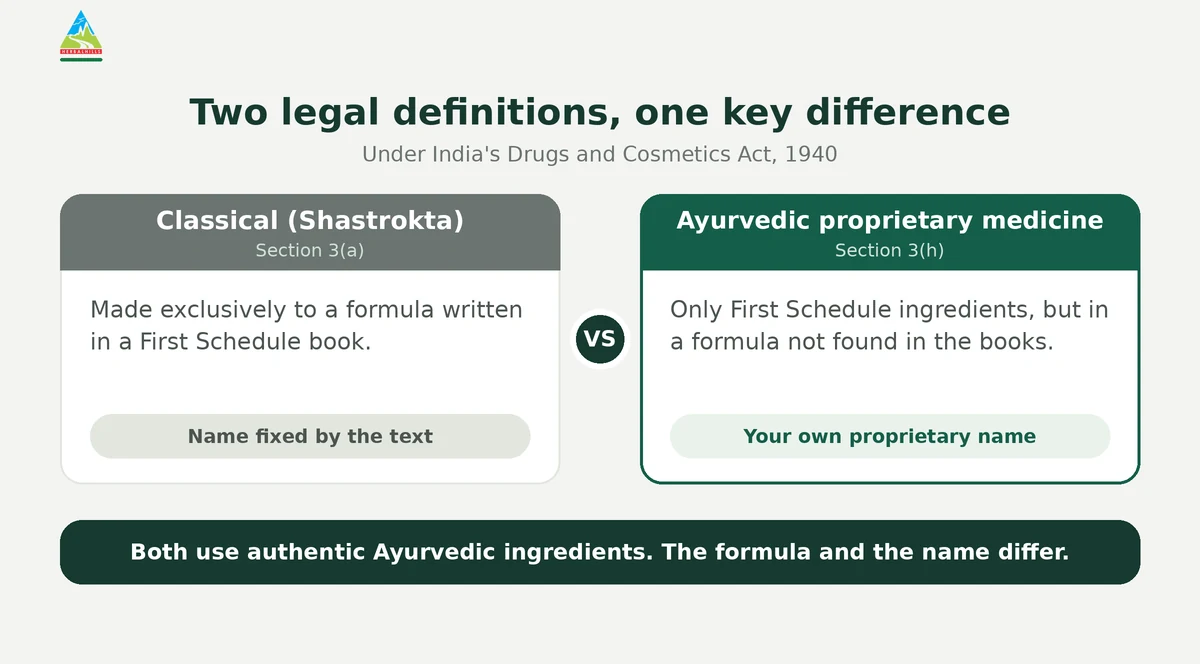
Shastrokta means “as stated in the shastras”, the classical texts of Ayurveda. A classical or Shastrokta formulation is made exactly to a recipe written in one of the authoritative books listed in the First Schedule of the Drugs and Cosmetics Act, 1940. Section 3(a) of the Act defines an Ayurvedic drug as a medicine manufactured exclusively according to the formulae in those books.
Because the formula comes from the text, so does the name. Ashwagandharishta, Triphala Churna, Chyawanprash, Dashmoolarishta and Mahanarayan Taila are all classical medicines, and every manufacturer that makes them uses the same name and the same ingredients in the same proportions.
Which texts count as authoritative books?
The First Schedule lists the books the law recognises. Well-known examples include:
A State Licensing Authority for Ayurvedic drugs, called the FDA in Maharashtra, grants the licence to manufacture each product. For a classical medicine, the textual reference itself is the main evidence of its use.
What Is an Ayurvedic Proprietary Medicine?
An Ayurvedic proprietary medicine is a formulation that contains only ingredients mentioned in the formulae of the authoritative books, but whose overall formula is not itself one of the formulations described in those books. That is the definition of a “patent or proprietary medicine” in Section 3(h) of the Drugs and Cosmetics Act. It also excludes anything given by injection.
In practice, a proprietary formulation is a new combination built from classical ingredients: a classical formula with additional supporting herbs, a different proportion, a standardised extract in place of a crude powder, or a completely new combination designed by an R&D team. Because it is not a text-named formula, it is sold under its own proprietary name, and its label identifies it as an Ayurvedic proprietary medicine.
Proprietary medicines are licensed by the same State Licensing Authority, but the manufacturer has to provide more. Rule 158-B of the Drugs and Cosmetics Rules, 1945 sets out the safety and effectiveness evidence needed for each category of Ayurvedic drug, and the Ministry of Ayush has clarified that effectiveness can be based on textual rationale and published literature, with a pilot study needed in some cases. Products also need stability data, and the factory must follow Schedule T Good Manufacturing Practices.
This route is widely used. In parliamentary replies, Uttarakhand alone reported licensing roughly 2,500 to 3,000 Ayurvedic patent and proprietary products a year between 2019-20 and 2022-23.
Classical vs Proprietary Ayurvedic Medicine: Side-by-Side Comparison
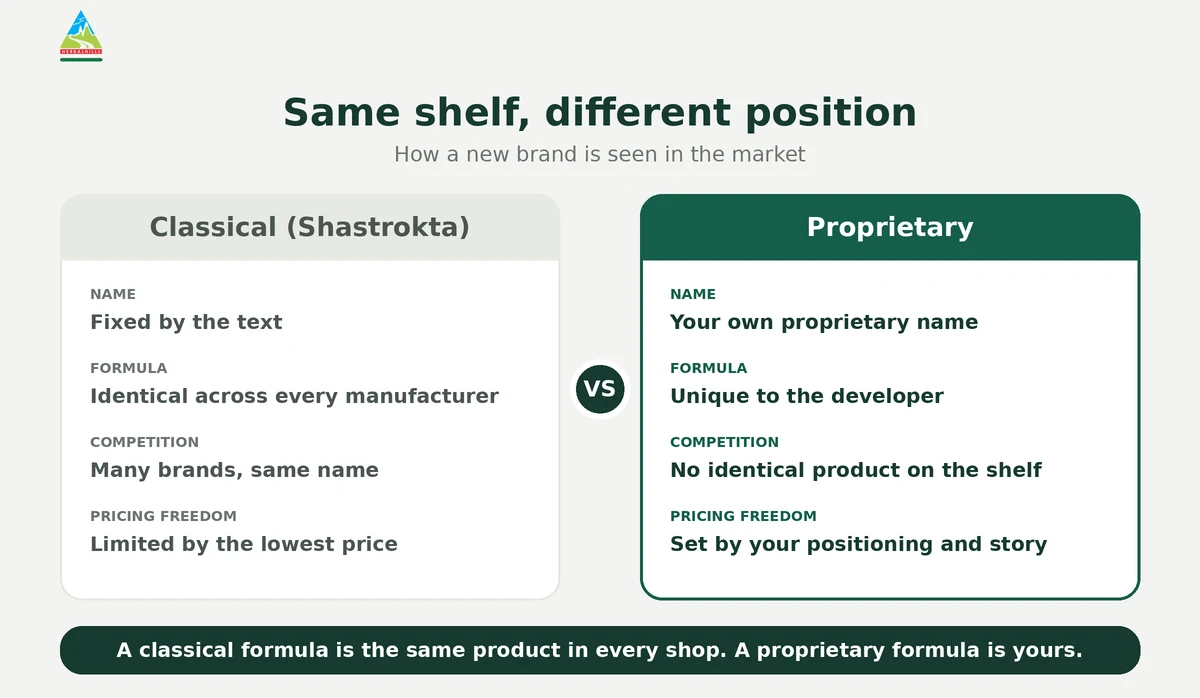
| Factor | Classical (Shastrokta) | Ayurvedic Proprietary Medicine |
|---|---|---|
| Legal definition | Section 3(a): made exclusively to a formula in a First Schedule book | Section 3(h): only First Schedule ingredients, but a formula not found in the books |
| Product name | Fixed by the text (e.g. Ashwagandharishta) | Your own proprietary name |
| Formula | Identical across every manufacturer | Unique to the developer |
| Licensing evidence | Textual reference | Textual rationale or published literature; pilot or safety study where Rule 158-B requires it; stability data |
| Time to launch | Fast | Fast with a ready formulation; longer for a new one |
| Competition | Many brands sell the same product under the same name | No identical product on the shelf |
| Price comparison | Direct, like for like | Hard to compare directly |
| Pricing freedom | Limited by the lowest-priced competitor | Set by your positioning and story |
| Best suited to | Practitioner prescriptions, pharmacy and generic distribution | New D2C, e-commerce, clinic and premium wellness brands |
Both routes are legitimate, regulated and fully Ayurvedic. The difference is not quality or authenticity. It is how the product is named, licensed and compared in the market.
Why Is It Hard for a New Brand to Price a Classical Formulation?
A classical medicine is, by law, the same product wherever it is made. When a customer searches for Ashwagandharishta or Triphala Churna on a marketplace, they see dozens of brands with the same name, the same ingredients and the same dose, and many of those brands are large manufacturers with established distribution. For the customer, the easiest way to choose is price.
For a new brand, that creates three problems:
No Apples-to-Apples Advantage
Your product is directly comparable with every other version of the same formula.
Price Pressure
You are measured against the lowest MRP in the category, often set by manufacturers with much larger volumes.
Weak Brand Recall
The customer remembers the classical name, not your brand, so the next purchase may go to someone else.
None of this makes classical products a bad choice. They are trusted, easy to license and easy for practitioners to prescribe. But a brand that launches only with classical medicines is usually competing on distribution and price, not on what makes it different.
Why Can a Proprietary Formulation Support a Higher MRP?
When the formula and the name belong to your product alone, the customer cannot line it up against an identical product at a lower price. The comparison becomes one of benefit, story and trust instead of rupees per bottle. That gives a brand room to set its MRP according to its positioning.
A higher MRP still has to be earned. Packaging, positioning, customer experience and honest communication all matter. A proprietary formulation simply removes the biggest obstacle a new brand faces: being one of many identical products.
How Does Herbal Hills Develop Proprietary Formulations From Classical Bases?
Herbal Hills’ R&D team, including MD (Ayurveda) doctors, starts from classical formulations and refines them using only ingredients recognised in the authoritative texts. Each refined formulation is given its own proprietary name, licensed as an Ayurvedic proprietary medicine and made available to brands for private label and third-party manufacturing.
Typical refinements include:
- Adding supporting herbs from the classical texts that complement the base formula
- Adjusting proportions to suit a modern daily-wellness dose
- Using standardised herbal extracts in place of crude powders for more consistent batches
- Moving from hard-to-use formats such as decoctions or large powder doses to tablets, capsules or soft gels
- Improving taste and convenience so customers are more likely to keep using the product
The aim is a formulation that respects its classical roots while being more consistent, more convenient and more distinctive. Herbal Hills has sponsored clinical studies on eight of its formulations, and the study summaries are published on the Herbal Hills clinical research page. Herbal Hills offers proprietary formulations for private label within a wider portfolio of more than 400 private label products and over 300 research-based formulations.
Why Is This a Win-Win for Brands and Customers?
The Customer
A formulation designed to be more consistent and easier to take every day, with supporting evidence on selected products.
The Brand Owner
A unique product under its own name, with more freedom to set its MRP and stronger repeat purchase.
The Market
More choice and better-developed products instead of many identical copies of the same formula.
Proprietary does not mean untested or non-traditional. Every ingredient comes from the classical texts, every product is licensed under the Drugs and Cosmetics Act, and every batch is made under GMP in the same facility as classical medicines.
Classical or Proprietary: Which Should Your Brand Launch?
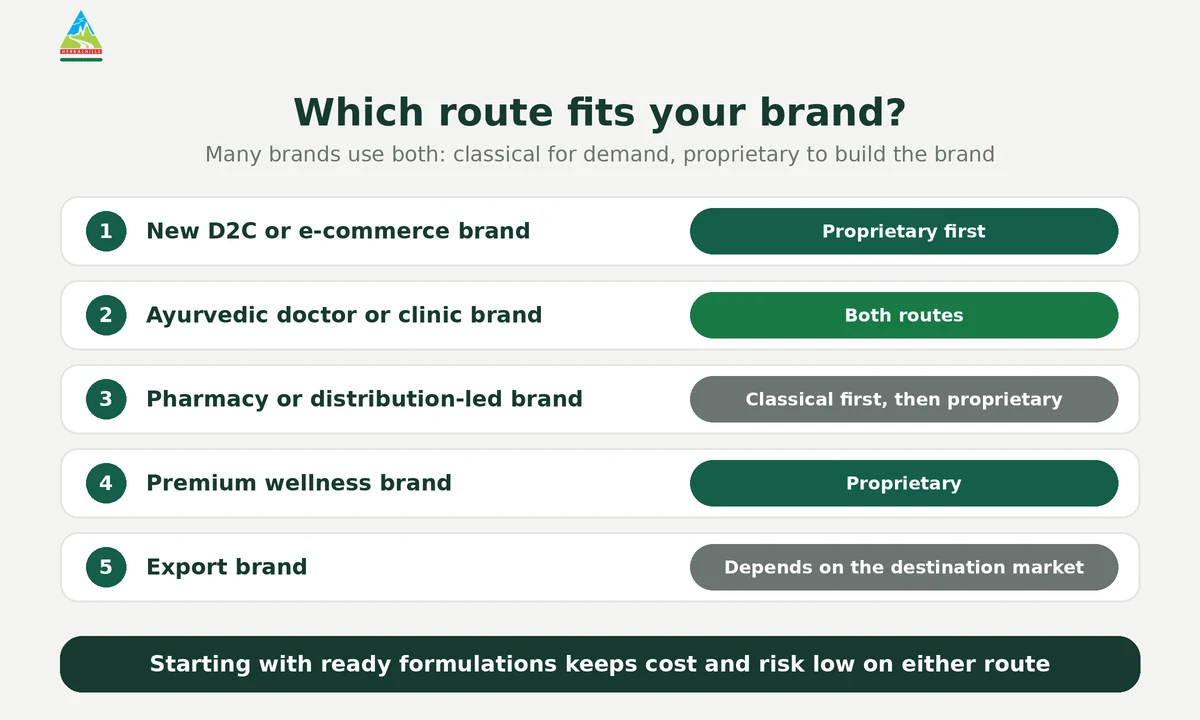
The right route depends on who you sell to and how you plan to compete. Many brands use both: classical medicines for practitioner and pharmacy demand, and proprietary formulations as the products that build the brand.
| Your Situation | Recommended Route | Why |
|---|---|---|
| New D2C or e-commerce brand | Proprietary first | Avoids marketplace price comparison and builds brand recall |
| Ayurvedic doctor or clinic brand | Both | Classical medicines for prescriptions; proprietary products for a recognisable clinic range |
| Pharmacy or distribution-led brand | Classical first, proprietary to grow margin | Classical names move fast through existing channels |
| Premium wellness brand | Proprietary | Positioning and story matter more than familiarity |
| Export brand | Depends on the destination market | Each country’s import rules decide what can be sold |
Whichever route you choose, starting with ready formulations keeps cost and risk low. Herbal Hills offers both classical and proprietary formulations, so a brand can test both routes with one manufacturing partner.
How to Launch a Proprietary Ayurvedic Formulation With Herbal Hills
🌿Choose
Select ready proprietary formulations from the Herbal Hills range, or brief the R&D team on a new one.
🧴Sample
Request free trial samples to check the product, taste and format.
🏷️Name and Brand
Pick your product name and check that it is not misleading and does not resemble a classical formula name; run a trademark search.
📋Label
Herbal Hills reviews label content for Drugs and Cosmetics Act and Drugs and Magic Remedies Act compliance.
🏭Produce
Start from about 50 pieces on selected QuickLabel™ formulations, with stock in around 7 working days.
🚀Launch and Grow
Add more formulations to build a brand family once the first products sell.
Can my brand give the proprietary formulation its own name?
Herbal Hills’ regulatory team confirms how your product name is approved and what you need to provide before development starts. Choose a name that is not misleading and does not resemble a classical formula name, and run a trademark search early.
What Can You Say About a Proprietary Ayurvedic Product?
A proprietary formulation gives you a better story, but not freedom to make medical claims. Ayurvedic products in India are covered by the Drugs and Magic Remedies (Objectionable Advertisements) Act, 1954, and advertisements must not claim to cure the diseases and conditions that Act lists. Describe what the formulation contains, how it was developed and how it fits into daily wellness. Where a product has been studied, report what was studied accurately and do not call it “clinically proven”.
Accurate wellness language
“Developed by our R&D team from a classical Ayurvedic base”, “contains herbs described in classical Ayurvedic texts”, “supports daily wellness”.
Overclaiming
“Better than the classical medicine”, “cures” any disease, “guaranteed results”, “clinically proven”.
Frequently Asked Questions
What is a classical (Shastrokta) Ayurvedic medicine?
A classical or Shastrokta Ayurvedic medicine is made exactly to a formula written in one of the authoritative Ayurvedic books listed in the First Schedule of India’s Drugs and Cosmetics Act, 1940. It is sold under the name given in the text, so every manufacturer’s version has the same name and the same formula.
What is an Ayurvedic proprietary medicine?
An Ayurvedic proprietary medicine uses only ingredients mentioned in the authoritative Ayurvedic books, but its overall formula is not one of the formulations described in those books. It is defined in Section 3(h) of the Drugs and Cosmetics Act and can be sold under its own proprietary name.
What is the difference between classical and proprietary Ayurvedic medicine?
A classical medicine follows a text formula exactly and carries the text’s name. A proprietary medicine uses classical ingredients in a new formula with its own name. Classical medicines are identical across brands; proprietary medicines are unique to the developer.
Is an Ayurvedic proprietary medicine the same as a patent medicine?
The law uses the phrase “patent or proprietary medicine” for both. In everyday use, an Ayurvedic patent medicine and an Ayurvedic proprietary medicine mean the same thing: a licensed formulation that is not a text-named classical formula.
What licence is needed for an Ayurvedic proprietary medicine?
Each product is licensed by the State Licensing Authority for Ayurvedic drugs. For proprietary medicines, Rule 158-B asks for evidence of effectiveness, such as textual rationale or published literature, plus safety data where required and stability data. Herbal Hills handles this for its own formulations.
Can I charge a higher price for a proprietary Ayurvedic product?
Often, yes. Because no identical product exists, customers cannot compare it like for like with cheaper versions. Your MRP still depends on positioning, packaging and trust, but a proprietary formulation gives you much more room to price on value.
Does Herbal Hills make both classical and proprietary formulations?
Yes. Herbal Hills manufactures classical Ayurvedic formulations and proprietary formulations its R&D team has developed from classical bases. Brands can launch either route, or both, under their own label.
Can I start with a small quantity?
Yes. Selected QuickLabel™ formulations start from about 50 pieces, with stock in around 7 working days, and free trial samples are available before you order.
Launch the Formulation Only Your Brand Can Sell
Classical Ayurvedic medicines are trusted and easy to start with, but a new brand selling the same formula under the same name as everyone else will usually compete on price. An Ayurvedic proprietary medicine changes that: it keeps the classical roots, adds R&D-led refinement and gives your brand a product no one else can sell. According to Herbal Hills, brands that launch with proprietary formulations and add classical products for practitioner demand build the strongest, most defensible ranges. With more than 25 years of GMP and ISO-certified manufacturing in Lonavala, Maharashtra, Herbal Hills supports both routes from one facility.
Explore Ready Proprietary Formulations →