

Blog
Ghrita as a Formulation Base: R&D Opportunities in Medicated Ghee-Based Products

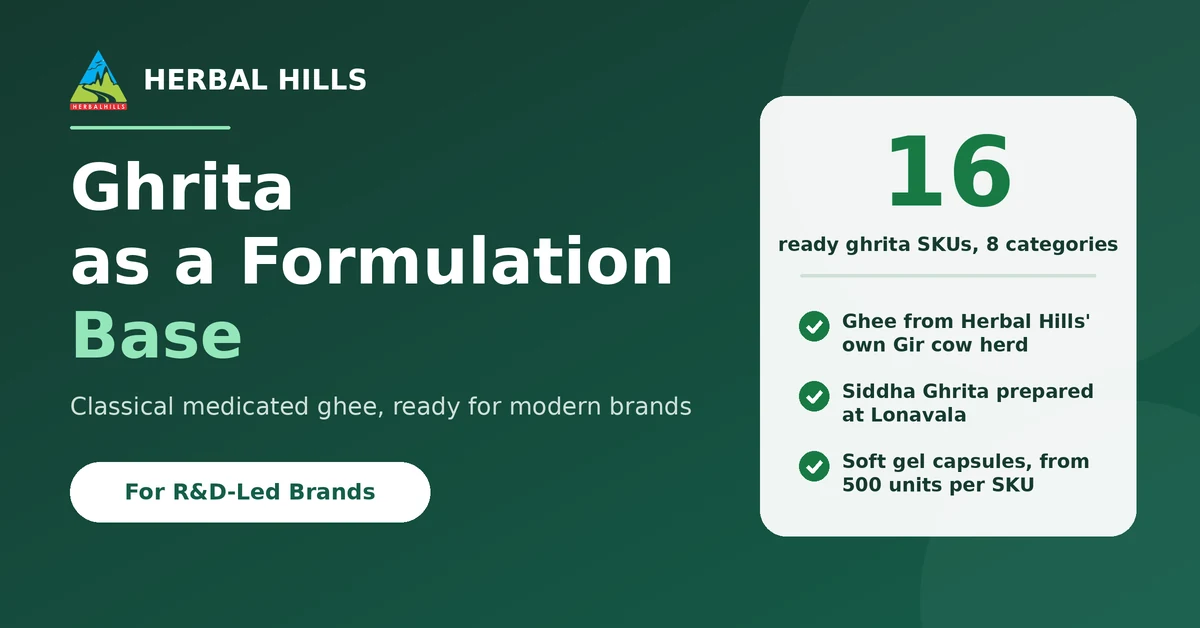
Most Ayurvedic brands sell the same three formats: tablets, capsules and powders. They are easy to make and easy to copy. Ghrita is different. It is one of the most respected preparations in classical Ayurveda, few manufacturers can make it well, and almost none can put it into a convenient modern format. For a brand that wants something its competitors cannot easily match, ghrita is one of the most interesting formulation bases available.
This guide explains what ghrita is, how Siddha Ghrita is prepared, why Ayurveda uses ghee as a carrier, why the source of the ghee matters, and how Herbal Hills turns classical ghrita into ready soft gel products and custom R&D projects for brands.
What Is Medicated Ghee in Ayurveda (Ghrita)?
Ghrita is the Sanskrit word for ghee. In Ayurveda, a medicated ghee or Siddha Ghrita is ghee that has been slowly cooked with a herbal paste (kalka) and a liquid such as a herbal decoction (kwatha) until all the water evaporates. The finished ghee holds the herbs’ oil-soluble and water-soluble constituents. Ghrita belongs to Sneha Kalpana, the classical group of fat-based preparations.
Classical texts describe four main snehas, or fats: ghee, oil, muscle fat and marrow. Among these, the Charaka Samhita singles out ghee as the best, because it takes on the properties of whatever it is processed with without losing its own. That idea is the foundation of every ghrita formulation.
How is Siddha Ghrita prepared?
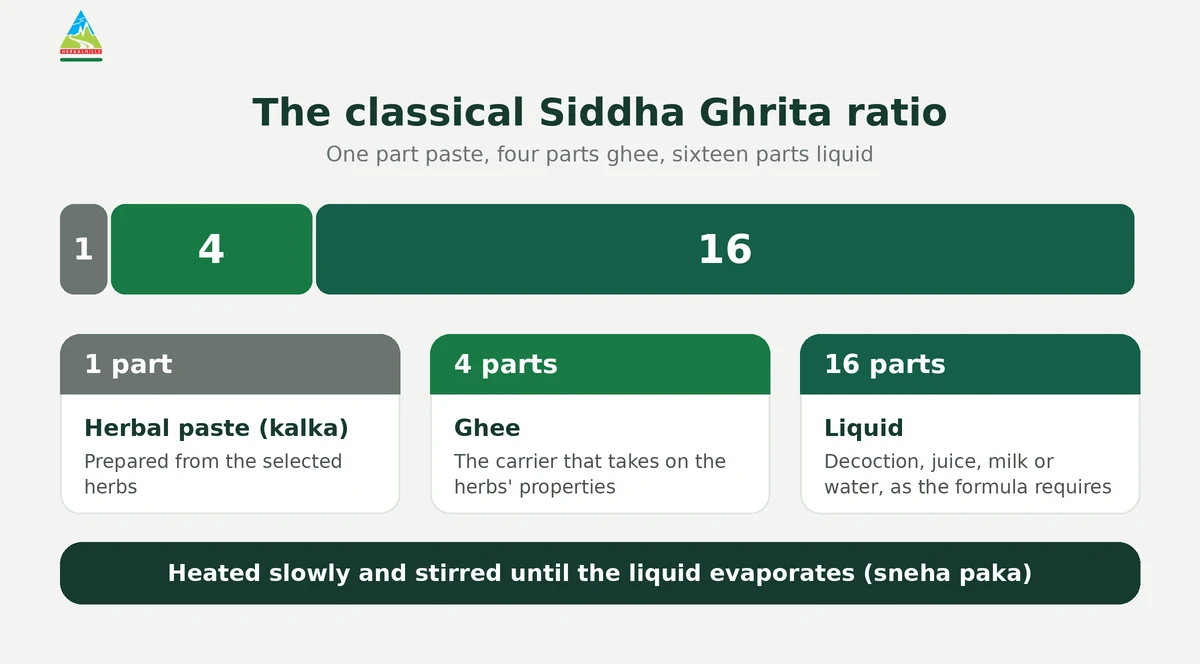
The classical rule, described in texts such as the Sharangadhara Samhita, uses one part herbal paste, four parts ghee and sixteen parts liquid. The mixture is heated slowly and stirred for hours until the liquid evaporates and the paste reaches the correct stage, which is judged by set tests.
🌿Prepare the Herbal Paste
Prepare the herbal paste (kalka) from the selected herbs.
💧Prepare the Liquid
Herbal decoction, juice, milk or water, as the formula requires.
⚖️Combine in Classical Proportion
Combine paste, ghee and liquid in the classical proportion.
🔥Heat Slowly (Sneha Paka)
Heat slowly on a low flame, stirring continuously, until the liquid evaporates.
✅Check the End Point
Use classical tests, such as the paste rolling into a wick and no crackling sound from moisture.
🧪Filter, Test and Store
Filter the medicated ghee, test it and store it for filling.
Why Does Ayurveda Use Ghee as a Formulation Base?
Ayurveda describes ghee as yogavahi, a carrier that takes on the qualities of the herbs it is processed with and helps deliver them. From a formulation point of view, ghee also has practical advantages: it dissolves fat-soluble plant constituents that water cannot extract, and it is stable when made correctly. The table below summarises how classical texts describe ghee and what each idea means for a product developer.
| Classical Description | What It Means | Why It Matters to a Formulator |
|---|---|---|
| Yogavahi (carrier) | Ghee takes on the properties of the herbs processed in it | One base can carry many different herb combinations |
| Best of the snehas | Classical texts rank ghee above other fats for internal use | A traditional, respected base practitioners already recognise |
| Samskara (processing) | The herbs’ constituents are transferred during slow cooking | Both water-soluble and fat-soluble constituents end up in one product |
| Rasayana association | Ghee is part of many classical rejuvenating preparations | Fits premium daily-wellness positioning |
These are classical Ayurvedic descriptions of ghee as a base, not claims that a finished product treats any condition.
Which classical ghrita formulations are well known?
| Classical Ghrita | Main Herbs | Traditional Wellness Area |
|---|---|---|
| Brahmi Ghrita | Brahmi, Vacha, Kushtha, Shankhapushpi | Memory and mental clarity |
| Triphala Ghrita | Haritaki, Bibhitaki, Amalaki | Eye wellness |
| Panchagavya Ghrita | Five cow products: milk, curd, ghee and others | Mind and nervous wellness in classical use |
| Phala Ghrita | Manjishtha, Kushtha, Triphala and others | Women’s wellness |
| Ashwagandha Ghrita | Ashwagandha | Strength and vitality |
Why Does the Source of the Ghee Decide the Quality of the Ghrita?
A ghrita can only be as good as the ghee it starts with. Ghee that is blended, made from cream by industrial separation, or bought from many suppliers varies in aroma, colour and fat profile from batch to batch. Those differences carry straight into the finished medicated ghee.
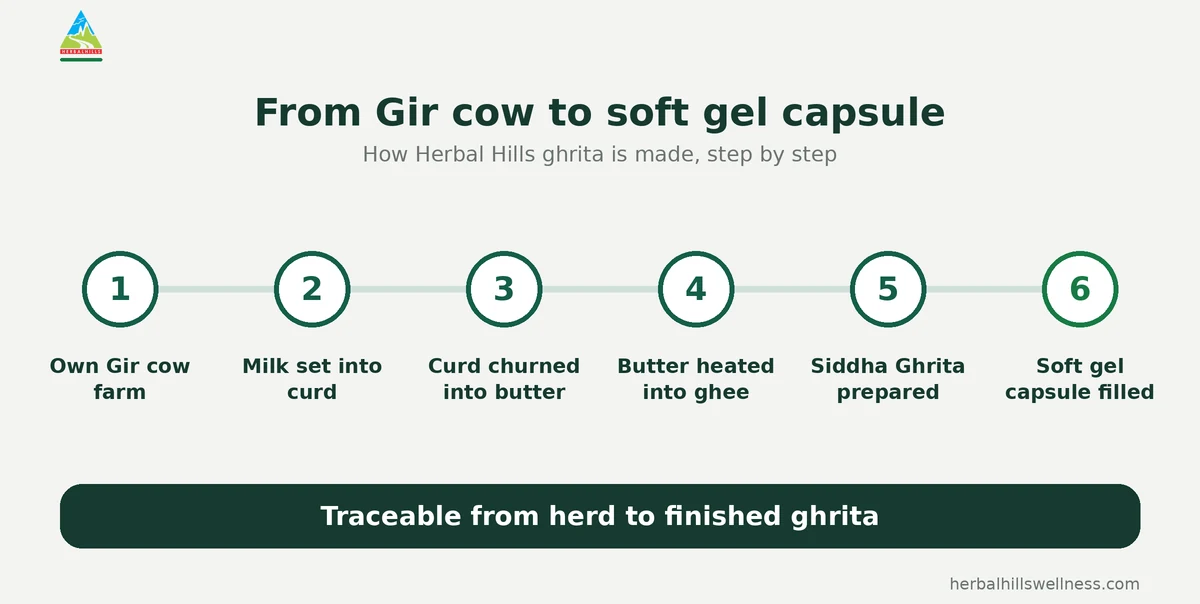
Herbal Hills makes the ghee for its ghrita formulations from milk produced on its own Gir cow farm. Gir is an indigenous Indian breed. The milk is set into curd, the curd is churned into butter and buttermilk, and the butter is slowly heated into ghee, the traditional curd-churning method often called bilona. The same ghee then goes into Siddha Ghrita preparation at the company’s facility in Lonavala, Maharashtra.
| Factor | Typical Bought-In Ghee | Herbal Hills Farm Ghee |
|---|---|---|
| Source | Mixed suppliers, often unknown herd | Own Gir cow farm |
| Method | Cream separation, industrial heating | Milk → curd → churned butter → ghee |
| Traceability | Limited | From herd to finished ghrita |
| Batch consistency | Varies with supplier | One controlled source |
| Fit with classical texts | Not always | Follows the classical curd-to-ghee sequence |
Herbal Hills runs both its own Gir cow farm and its own organic herb farm, so the two main raw materials of a ghrita can be traced to the same group.
Why Has Ghrita Been Hard to Turn Into a Modern Product?
Classical ghrita is a semi-solid ghee taken by the spoon, often with warm milk or water. Practitioners value it, but many modern customers find it difficult to use: the dose is hard to measure, the taste is strong, the jar is messy to travel with, and the product is easy to contaminate once opened. That is why ghrita has stayed mostly inside clinics and has rarely become a mainstream retail product.
| Format | Advantages | Limitations |
|---|---|---|
| Traditional ghrita in a jar | Classical form, flexible dosing for practitioners | Taste, measuring, mess, contamination once opened |
| Ghrita soft gel capsule | Exact dose, no taste, travel-friendly, sealed from air | Needs specialised encapsulation; higher custom MOQ |
The soft gel capsule solves most of these problems. The liquid ghrita is sealed inside a capsule shell, so each capsule carries a measured amount, the customer never tastes the ghee, and the contents are protected from air and moisture until use.
What Ready Ghrita Products Does Herbal Hills Offer?
Herbal Hills already has a ready ghrita range: 16 SKUs across 8 wellness categories. Each category has a soft gel capsule in a 30-count bottle and an FP capsule in a 60-count bottle, labelled as Ayurvedic Proprietary Medicine. Every SKU can be made under your brand, with a starting quantity of 500 units per SKU.
| Wellness Category | Soft Gel Capsule (30 Count) | FP Capsule (60 Count) |
|---|---|---|
| Joint care | Arthroplus Soft Gelatin Capsule | Arthro FP Capsule |
| Memory support | Smruti Plus Soft Gelatin Capsule | Smruti FP Capsule |
| Stress management | Calm Plus Soft Gelatin Capsule | Calm FP Capsule |
| Men’s wellness | Vitoplus Soft Gelatin Capsule | Vito FP Capsule |
| Women’s wellness | Femoplus Soft Gelatin Capsule | Femo FP Capsule |
| Immunity support | Immunoplus Soft Gelatin Capsule | Immuno FP Capsule |
| Eye care | Occu Plus Capsule | Ocu FP Capsule |
| Skin care | Glowplus Soft Gelatin Capsule | Glo FP Capsule |
Have Herbal Hills ghrita formulations been clinically studied?
Herbal Hills has sponsored clinical studies on eight of its Ayurvedic formulations, conducted at Vishwanand Kendra, Pune. One of them is the joint care capsule sold under Herbal Hills’ own brand as the Arthrohills Capsule, which was evaluated in a CTRI-registered 90-day clinical study in 33 adults (CTRI/2017/06/008786) and a separate 21-day safety study in 30 adults, with no adverse effects reported in the safety study. All studies were single-group (open-label) studies without a placebo group. The full summaries are on the Herbal Hills clinical research page.
These studies were conducted on Herbal Hills brand formulations under their original product names. A private label product is not, by that fact, an independently tested product, and the studies may not be used in another brand’s labelling or advertising without the required regulatory approvals. Ask the R&D team how a ready private label formula relates to the studied formulation.
Ready Ghrita or Custom Ghrita: Which Should You Choose?
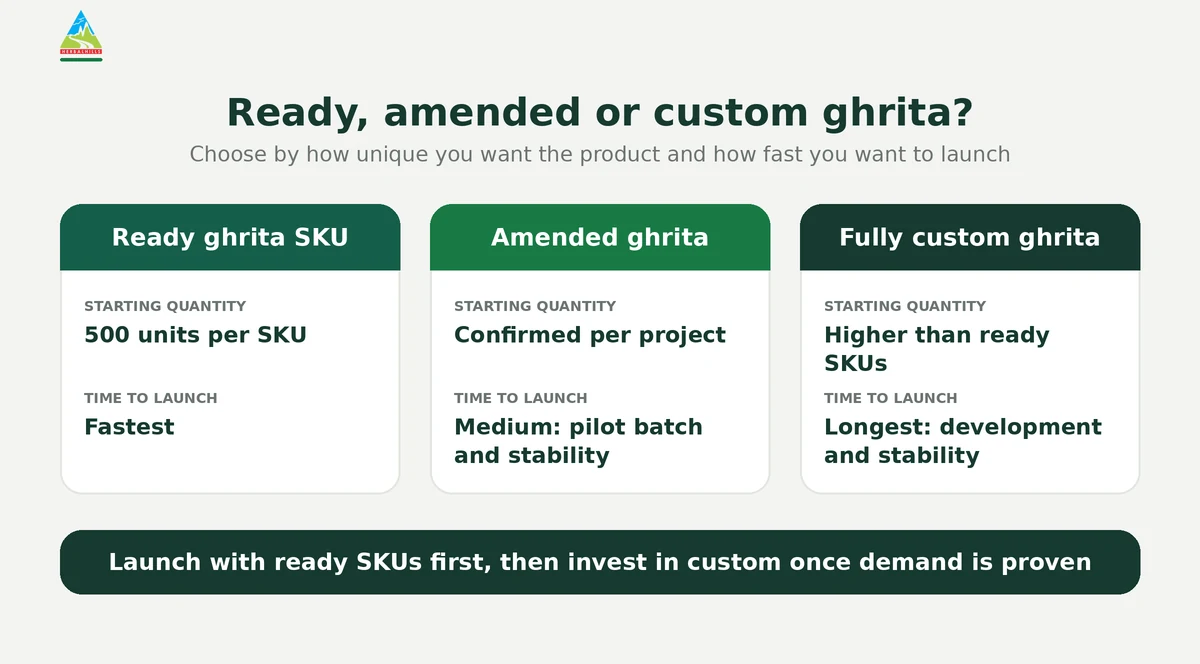
You can start with a ready ghrita formulation, ask the R&D team to amend one, or commission a completely new ghrita built around your own brief. The right choice depends on how unique you want the product to be, how much time you have and how much stock you can commit to.
| Option | What You Get | Starting Quantity | Time to Launch | Evidence |
|---|---|---|---|---|
| Ready ghrita SKU | An existing Herbal Hills ghrita under your label | 500 units per SKU | Fastest | Clinical studies exist for selected Herbal Hills formulations; using them on your label needs approvals |
| Amended ghrita | A ready base with adjusted herbs or proportions | Confirmed per project | Medium: pilot batch and stability | Needs fresh evaluation |
| Fully custom ghrita | A new formulation developed to your brief | Higher than ready SKUs; confirmed per project | Longest: development and stability | Built from the start |
How Does Custom Ghrita R&D Work at Herbal Hills?
A custom ghrita is a real development project, not a relabel. The Herbal Hills R&D team, including MD (Ayurveda) doctors, works through the formulation, the classical preparation and the capsule format before anything is scaled up.
📝Brief
You share the wellness area, target customer, positioning and any herbs you want to include.
🌿Formulation
R&D selects herbs, proportions and liquids, with classical references where they apply.
🔥Pilot Batches
Small Siddha Ghrita batches are prepared and tested for the correct paka stage.
💊Encapsulation Trials
The ghrita is filled into soft gels and checked for fill weight, leakage and appearance.
🧪Stability and Testing
The product is tested over time to confirm shelf life before scale-up.
🏷️Labelling and Launch
Label wording is reviewed for compliance, then commercial production begins.
Why is the minimum order higher for a custom ghrita soft gel?
A custom ghrita needs its own dedicated Siddha Ghrita batch, prepared over many hours from fixed ingredient ratios, and soft gel encapsulation runs efficiently only above a certain batch size. Both steps make very small runs impractical, so custom ghrita soft gels carry a higher minimum order than ready SKUs. For many brands, the best path is to launch with ready SKUs first and invest in a custom ghrita once demand is proven.
Who Should Consider a Ghrita-Based Product?
Questions to Ask a Ghrita Manufacturer
- Where does your ghee come from, and can you trace it to the herd?
- Do you prepare Siddha Ghrita by the classical method, and how do you confirm the paka stage?
- Can you fill ghrita into soft gel capsules in-house?
- Which ghrita formulations do you already have, and have any been clinically studied?
- What is the shell material, and is a vegetarian option available?
- What is the MOQ for ready and for custom ghrita products?
- What stability and batch testing do you carry out, and will I receive a Certificate of Analysis?
Build Your Brand on a Classical Base
Medicated ghee in Ayurveda is one of the most respected preparations and one of the hardest for competitors to copy. Herbal Hills combines ghee from its own Gir cow farm, classical Siddha Ghrita preparation, in-house soft gel filling and an R&D team that can build new formulations. Brands can start with a ready ghrita and move to a custom formulation when they are ready. According to Herbal Hills, the brands that do best with ghrita are the ones that launch with a proven formula and build their own once their customers come back for more.
Explore the Ghrita Range or Start a Custom Project →
Or contact the sales team directly
Frequently Asked Questions
What is ghrita in Ayurveda?
Ghrita is the Sanskrit word for ghee. A medicated ghee, or Siddha Ghrita, is cow ghee slowly cooked with herbal pastes and decoctions until the water evaporates, so the ghee carries the herbs’ constituents. It belongs to Sneha Kalpana, the classical group of fat-based Ayurvedic preparations.
Why is ghee used as a base in Ayurvedic formulations?
Classical texts describe ghee as yogavahi, a carrier that takes on the properties of the herbs processed in it without losing its own. Ghee also dissolves fat-soluble plant constituents that water cannot extract, which is why it is used for many classical formulations.
How is medicated ghee prepared?
The classical rule uses one part herbal paste, four parts ghee and sixteen parts liquid such as a decoction. The mixture is heated slowly and stirred until the liquid evaporates and the paste passes classical end-point tests, then the ghee is filtered and tested.
Where does Herbal Hills get the ghee for its ghrita?
Herbal Hills makes its ghee from milk produced on its own Gir cow farm. The milk is set into curd, churned into butter and slowly heated into ghee, which is then used to prepare Siddha Ghrita at the company’s facility in Lonavala, Maharashtra.
Can medicated ghee be made into capsules?
Yes. Herbal Hills fills ghrita into soft gel capsules, which give an exact dose, hide the taste and protect the ghee from air. Its ready range includes soft gel and FP capsule versions across eight wellness categories.
Can I launch a ghrita product under my own brand?
Yes. You can choose from 16 ready ghrita SKUs across eight categories, with a starting quantity of 500 units per SKU, and launch them under your own label, packaging and pack size.
Can Herbal Hills develop a custom ghrita formulation?
Yes. The R&D team can develop a new ghrita to your brief, including herb selection, classical preparation, soft gel encapsulation and stability testing. Custom ghrita soft gels have a higher minimum order than ready SKUs.
Are Herbal Hills ghrita formulations clinically studied?
Herbal Hills has sponsored clinical studies on eight of its Ayurvedic formulations. They include the Arthrohills Capsule, which was evaluated in a CTRI-registered 90-day study and a 21-day safety study. All studies were open-label without a placebo group, and the summaries are on the Herbal Hills clinical research page. Whether a study can be cited for a private label product depends on the required regulatory approvals.