
Blog
Nutraceutical Brands Going Ayurvedic: How to Add Herbal Credibility to Your Supplement Line Without Building a Factory

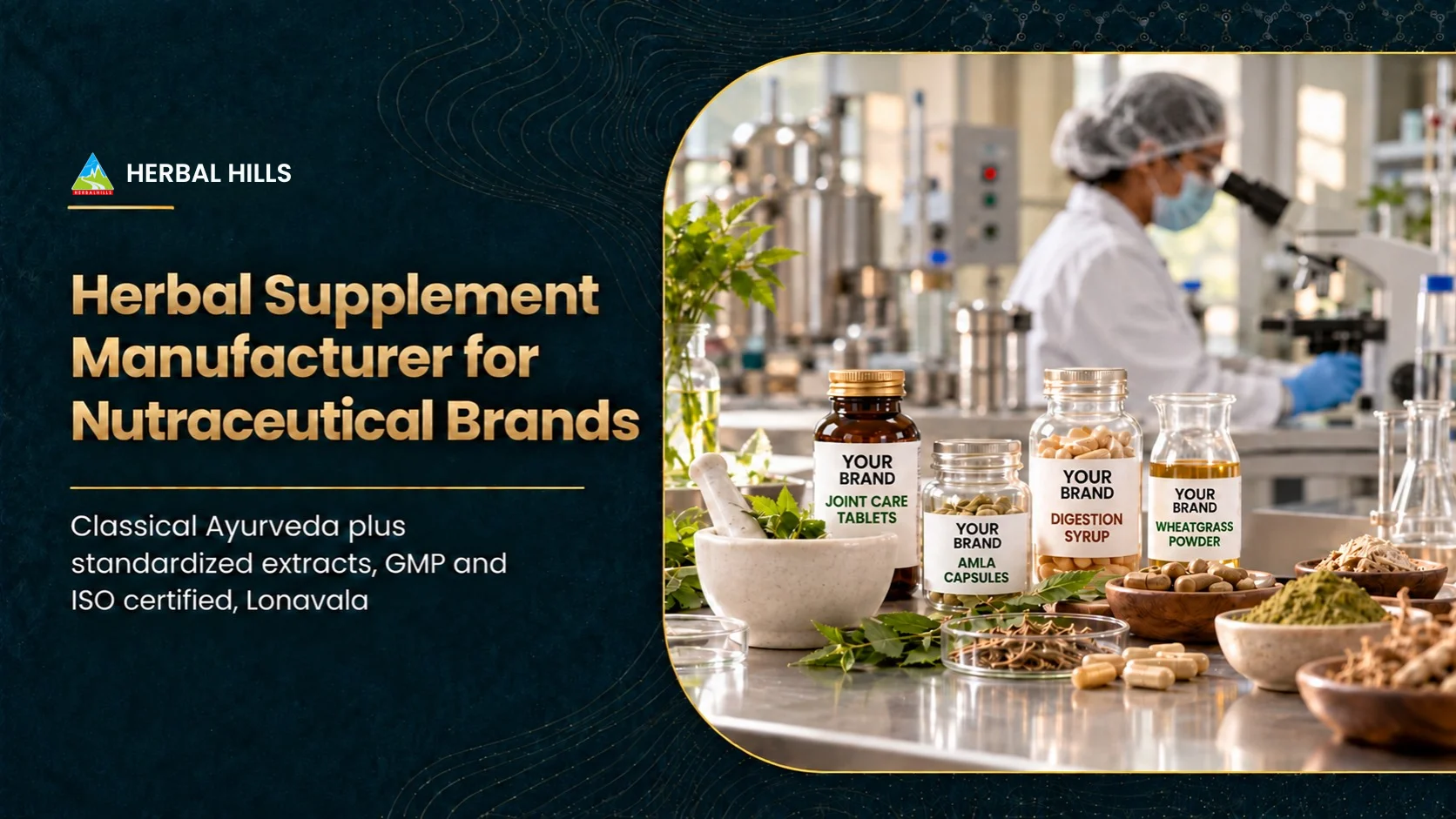
Ayurveda has moved from the wellness shelf to the centre of the supplement market. Consumers now look for herbs they recognise, such as Ashwagandha, Shatavari, Tulsi, Triphala and Moringa, on the labels of the products they buy.
For nutraceutical brands, and for nutraceutical manufacturers whose plants are built for vitamins, minerals and proteins, the opportunity is clear: add an Ayurvedic line and give your supplement range the credibility of a 5,000-year-old system.
The practical question is how to do it without building a new factory. The answer is to work with a herbal supplement manufacturer that already has the licences, the herbal expertise and the capacity.
This guide covers how fast Ayurveda and Ayush products are growing, why the fusion of Ayurveda and nutraceuticals is the next big category, the regulatory routes available, why a nutraceutical plant cannot simply add Ayurvedic products, and how Herbal Hills works with nutraceutical companies as their Ayurvedic manufacturing partner.
How Fast Is the Ayurvedic and Ayush Market Growing?
How big has India’s Ayush sector become?
According to Invest India, the Ayush sector grew from USD 2.85 billion in 2014 to USD 18.1 billion in 2020, more than six times larger in six years. Nutraceuticals made up about 24.65% of that Ayush market, the second-largest share after herbal plants. In other words, Ayurveda and nutraceuticals already overlap more than most brands realise.
The 2014 bar is USD 2.85 billion, drawn to scale.
How fast are Ayurvedic wellness products growing now?
IMARC Group estimates India’s Ayurvedic wellness market at USD 11.9 billion in 2025 and projects USD 43.2 billion by 2034, a compound annual growth rate of about 14.9%. That growth rate is well ahead of the broader supplement market, which is why so many nutraceutical brands are adding Ayurvedic SKUs.
Is international demand growing too?
Yes. Exports of Ayush and herbal products rose 6.11% to USD 688.89 million in 2024-25, according to the Commerce Ministry. In December 2025, the Ministry of Ayush also launched the Ayush Quality Mark to strengthen quality assurance and global recognition of Ayush products, which will make certified Ayurvedic manufacturing an even stronger selling point abroad.
| Indicator | Figure | Source |
|---|---|---|
| Ayush sector size, 2014 → 2020 | USD 2.85 billion → USD 18.1 billion | Invest India |
| Nutraceuticals share of Ayush market | About 24.65% | Invest India |
| India Ayurvedic wellness market, 2025 → 2034 | USD 11.9 billion → USD 43.2 billion (~14.9% CAGR) | IMARC Group |
| Ayush and herbal exports, FY 2024-25 | USD 688.89 million (+6.11%) | Ministry of Commerce |
| Ayush Quality Mark | Launched December 2025 | Ministry of Ayush / AYUSHEXCIL |
Why the Fusion of Ayurveda and Nutraceuticals Is the Next Big Category
What are Ayurvedic nutraceuticals?
Ayurvedic nutraceuticals, sometimes called herbal nutraceuticals, are supplements that bring together two strengths. From Ayurveda, they take herbs and formulation logic documented in classical texts over centuries. From modern nutraceutical science, they take standardized extracts, precise dosing, modern formats such as capsules, effervescent tablets and powders, and batch-level testing. The result is a product that feels traditional to the consumer and dependable to the buyer.
Why does Ayurveda add credibility to a supplement line?
A vitamin or protein product competes mainly on price and dose. An Ayurvedic product carries a story: a herb with centuries of documented traditional use, a classical formulation reference, and a clear link to India’s heritage.
What does “classical texts plus standardized extracts” mean in practice?
It means every product has two layers of evidence:
Layer 1: Traditional
The herb or combination is documented in authoritative Ayurvedic texts.
Layer 2: Analytical
The herbal extract is standardized to a defined level of key constituents, and each batch is tested to confirm it.
Herbal Hills’ R&D team, which includes MD (Ayurveda) doctors, builds both layers into every formulation.
Which Regulatory Route Should Your Ayurvedic Line Follow?
One of the biggest advantages of an experienced Ayurvedic partner is choosing the right regulatory route for each product. There are three main options.
AYUSH Licence (Ayurvedic Medicine)
Covers: classical and proprietary Ayurvedic medicines.
Typical products: churnas, vatis, Ghrita, Asavas, proprietary formulations.
Key point: manufactured under an AYUSH manufacturing licence with Ayurvedic GMP.
FSSAI Health Supplements and Nutraceuticals
Covers: supplements using permitted herbs and nutrients.
Typical products: herbal extract capsules and supplements using permitted herbs and nutrients.
Key point: closest to a nutraceutical brand’s existing range.
FSSAI Ayurveda Aahara
Covers: foods made to recipes, ingredients or processes in authoritative Ayurvedic texts.
Typical products: Ayurvedic food and nutrition products.
Key point: has its own logo; requires FSSAI licence or approval.
What is Ayurveda Aahara, and why does it matter for nutraceutical brands?
The Food Safety and Standards (Ayurveda Aahara) Regulations, 2022 created a dedicated food category for products prepared according to recipes, ingredients or processes described in authoritative Ayurvedic texts. These products carry a special Ayurveda Aahara logo and are sold only after FSSAI licence or approval. In August 2025, FSSAI, in consultation with the Ministry of Ayush, released a definitive list of recognised Ayurveda Aahara preparations. For nutraceutical brands, this gives a clear, food-regulated way to launch authentic Ayurvedic nutrition products. Herbal Hills’ regulatory team advises on the right route for each product.
Can a nutraceutical plant simply start making Ayurvedic products?
Usually not. Ayurvedic medicines require a separate AYUSH manufacturing licence and compliance with Ayurvedic good manufacturing practice under Schedule T of the Drugs and Cosmetics Rules. Many classical processes, such as preparing medicated ghee and oils, decoctions and repeated herbal processing, need dedicated equipment and experienced staff. Herb authentication and tests such as heavy metal and pesticide residue analysis also call for specialist expertise. Building all of this in-house takes significant capital and time.
Build Your Ayurvedic Line Without Building a Factory
What does a nutraceutical company gain by using a third-party Ayurvedic manufacturer?
Ayurvedic contract manufacturing gives your brand the full capability of a specialist Ayurvedic plant without any of the setup cost.
Which Ayurvedic products fit best alongside an existing nutraceutical range?
These are the private label herbal supplements that sit most naturally beside an existing nutraceutical range.
| Category | Examples | Why It Fits a Nutraceutical Brand |
|---|---|---|
| Single-herb standardized extracts | Ashwagandha, Tulsi, Turmeric, Gokshura capsules | Familiar format, easy first launch |
| Classical combinations | Triphala and other classical formulations | Adds Ayurvedic authenticity and depth |
| Green foods | Spirulina, Wheatgrass, Moringa | Bridges nutrition and Ayurveda naturally |
| Plant protein | Plant protein powders | Extends a protein range into plant-based |
| Effervescent and tea tablets | Herbal effervescent tablets, Ayurvedic tea tablets | Modern formats that stand out on shelf |
| Herbal juices and shots | Herbal juices and daily shots | Daily-use ritual products |
| Ghrita soft gel and granules | Medicated cow ghee in modern formats | A rare Ayurvedic format few brands offer |
| Men’s and women’s wellness | Vitality and Shatavari-based ranges | High-demand, repeat-purchase categories |
Can you combine Ayurvedic herbs with nutraceutical ingredients?
Yes, within regulatory limits. Standardized Ayurvedic extracts can be combined with other permitted ingredients in FSSAI-regulated health supplements. Herbal Hills’ R&D team designs these fusion formulations and confirms the right regulatory route before development.
How Herbal Hills Works with Nutraceutical Companies
🗂️Portfolio Review
Share your current range, channels and target consumers. Herbal Hills identifies the Ayurvedic gaps worth filling.
🧭Route and Formulation
Choose ready formulations or develop fusion products, and confirm the AYUSH or FSSAI route for each.
🧪Samples and Technical Evaluation
Your QA and product teams evaluate trial samples and specifications.
🏷️Label and Claims Review
Labels and claims are checked for compliant, wellness-focused language.
🏭Commercial Manufacturing
Production in a GMP and ISO-certified facility with in-house testing.
🚚Supply
Stock delivered to your warehouse or export destination with batch documentation.
Why Nutraceutical Brands Choose Herbal Hills
Add Ayurvedic Credibility to Your Nutraceutical Range
The Ayush sector has grown several times over in a decade, and Ayurvedic nutraceuticals are where tradition and modern supplement science meet. With a specialist herbal supplement manufacturer, your nutraceutical brand can enter this market without the cost, licences and time of building an Ayurvedic plant. According to Herbal Hills, nutraceutical brands that begin with two or three single-herb standardized extracts and one classical combination build credibility in the category fastest. Request the Herbal Hills Ayurvedic nutraceutical catalogue to plan your range.
Request the Ayurvedic Nutraceutical Catalogue →
Frequently Asked Questions
Can a nutraceutical company launch Ayurvedic products without an AYUSH licence?
Yes. Under third-party manufacturing, Ayurvedic products are made under Herbal Hills’ licences, and your company appears on the label as the brand owner or marketer.
Should our Ayurvedic line be registered under AYUSH or FSSAI?
It depends on the product. Classical and proprietary Ayurvedic medicines follow the AYUSH route, supplements with permitted herbs follow FSSAI’s health supplement rules, and text-based Ayurvedic foods can follow FSSAI’s Ayurveda Aahara regulations. Herbal Hills advises on each product.
What are standardized herbal extracts?
They are herbal extracts processed and tested to contain a defined level of key constituents, so each batch delivers consistent quality. Herbal Hills uses standardized extracts wherever a formulation depends on constituent levels.
Can you match our existing brand’s quality standards?
Yes. Specifications, testing requirements and release criteria are agreed in advance, and every batch ships with a Certificate of Analysis.
What is the minimum order quantity for a new Ayurvedic line?
Herbal Hills offers low MOQs so you can test a small Ayurvedic range before scaling. The exact quantity depends on the product and format and is confirmed once the formulation and packaging are finalised.
Will our custom fusion formulation be exclusive to us?
Yes. Custom formulations are covered by a non-disclosure agreement and are not offered to other customers.
How long does it take to launch?
Ready formulations reach dispatch sooner than custom ones, because development work is already done, after sample approval. Custom and fusion formulations take longer because of development and evaluation. Your Herbal Hills contact confirms the schedule for your specific products.
Can we export our Ayurvedic line?
Yes. Herbal Hills supplies export-quality products with documentation to buyers in 30+ countries.