

Blog
What Quality Checks Are Completed Before an Ayurvedic Batch Is Released?

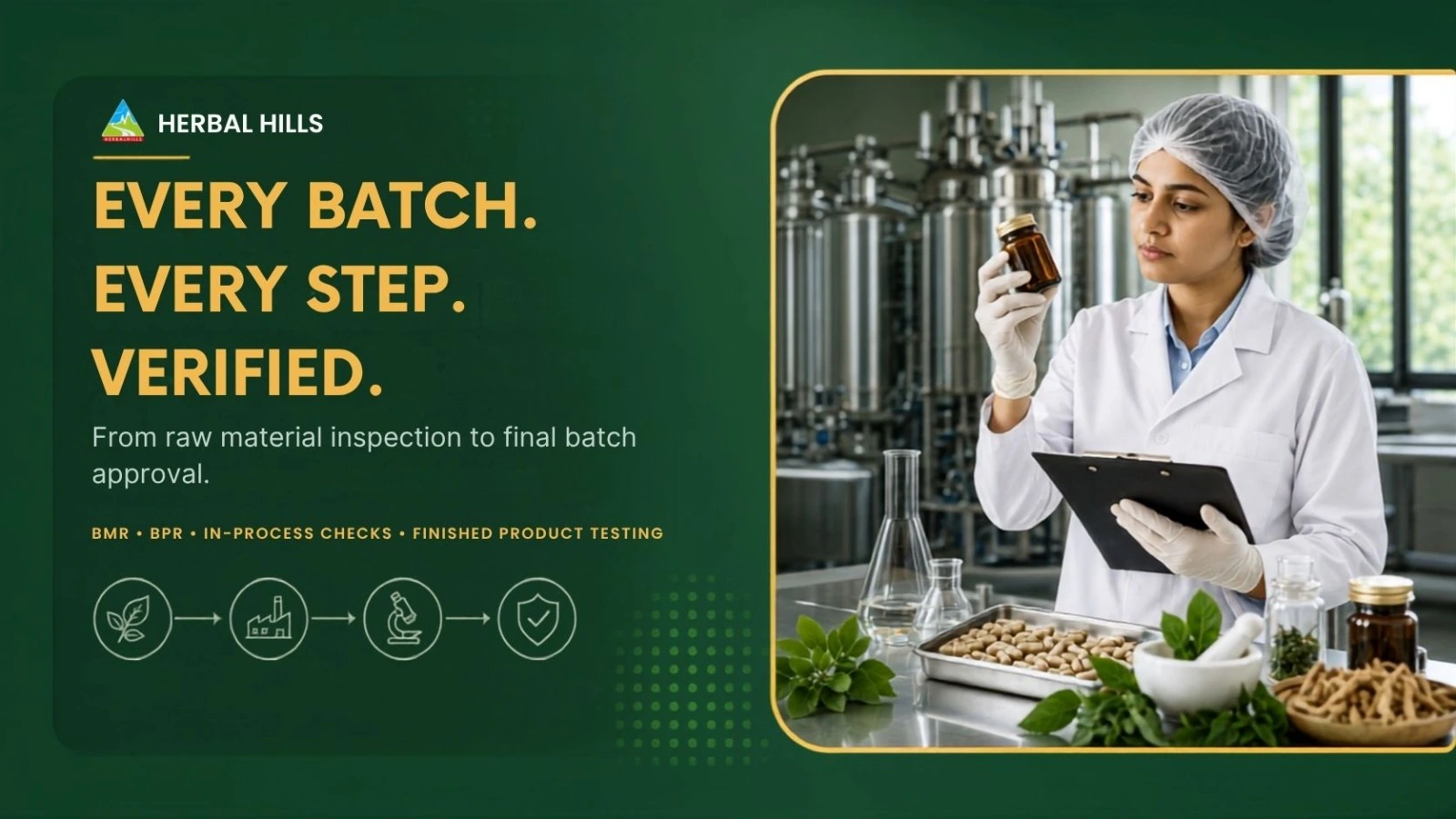
Quality checks before an Ayurvedic batch is released decide whether a product is ready to reach your customers. One of the most important questions every brand owner should ask a manufacturer is:
“How do you ensure that every batch leaving your factory is safe, consistent and manufactured correctly?”
Many people think quality testing begins only after the product is manufactured.
In reality, quality begins much earlier.
It starts from the moment raw materials enter the factory and continues until the finished product is packed, documented and approved for dispatch.
Every responsible Ayurvedic manufacturer should have a structured quality system that documents every stage of production.
Two of the most important documents in this process are:
These documents are not simply paperwork.
They are the backbone of GMP manufacturing.
Let’s understand how they help ensure product quality.
Quality Begins with Raw Material Inspection
The first quality check happens before manufacturing even starts.
Every incoming raw material is verified according to the company’s quality procedures.
Typical checks may include:
Only approved raw materials move to production.
What Is a Batch Manufacturing Record (BMR)?
A Batch Manufacturing Record (BMR) is one of the most important documents in pharmaceutical and Ayurvedic manufacturing.
Think of it as the complete manufacturing history of one production batch.
It records exactly how that batch was manufactured.
Every significant activity during production is documented.
Although formats differ from company to company, a typical BMR generally includes:
In short, the BMR creates complete traceability for every batch that is manufactured.
Why Is the BMR So Important?
The BMR ensures that:
- The correct ingredients were used.
- The correct quantities were weighed.
- Approved procedures were followed.
- Every manufacturing step was documented.
- Quality checks were completed during production.
- The batch can be traced at any time in the future.
Without proper documentation, maintaining manufacturing consistency would be extremely difficult.
In-Process Quality Checks
Quality is not checked only at the end.
Throughout manufacturing, quality personnel monitor critical process parameters.
Depending on the dosage form, these checks may include:
Tablets
- Weight variation
- Hardness
- Thickness
- Disintegration
- Appearance
Capsules
- Fill weight
- Locking quality
- Appearance
- Uniformity
Powders
- Blend uniformity
- Appearance
- Moisture (where applicable)
These in-process checks help identify any variation before the batch is completed.
Finished Product Testing
Once manufacturing is completed, the finished product undergoes quality evaluation before release.
Depending on the product and applicable specifications, testing may include:
Only after the batch complies with the approved specifications is it considered for release.
What Is a Batch Packing Record (BPR)?
Manufacturing is only one part of quality.
Packaging is equally important.
The Batch Packing Record (BPR) documents everything related to packing the finished product.
It records how the product moved from the bulk stage into the final market-ready pack.
A typical BPR may include:
The objective is to ensure that the correct product goes into the correct package with the correct label.
Why Is the BPR So Important?
Many Ayurvedic tablets and capsules look very similar.
Without proper packaging controls, the risk of mix-ups increases.
The Batch Packing Record helps ensure:
- Correct labels are applied.
- Correct bottles are used.
- Correct batch numbers are printed.
- Manufacturing and expiry dates are accurate.
- Packaging materials are fully accounted for.
- Every finished product is completely traceable.
This documentation is an essential part of GMP manufacturing.
Why Documentation Matters
Some people think documentation is simply a regulatory requirement.
In reality, documentation protects both the manufacturer and the customer.
Good documentation provides:
In quality manufacturing, if an activity is not documented, it is considered not to have been performed.
That is why documentation is taken so seriously.
The Herbal Hills Approach to Quality
At Herbal Hills, we certainly follow the documentation and quality systems required under applicable GMP and other regulatory standards.
But our commitment goes beyond regulatory compliance.
We believe quality is not simply a requirement imposed by an authority.
It is a responsibility towards every customer who trusts our products.
For this reason, our internal quality systems place strong emphasis on:
For us, these systems are not maintained merely because regulations require them.
They reflect our company’s values.
We are in the health and wellness industry.
Every bottle that leaves our factory may become part of someone’s daily healthcare routine.
That responsibility demands precision, discipline and consistency.
Our philosophy is simple:
Zero compromise on quality.
Not because regulations expect it.
But because our moral and ethical commitment to consumers expects it.
Final Thoughts
Quality is not created by one laboratory test at the end of production.
It is created through hundreds of carefully controlled activities carried out throughout the manufacturing journey.
From raw material inspection to Batch Manufacturing Records, from in-process quality checks to Batch Packing Records, every step contributes to one objective:
Delivering safe, consistent and reliable Ayurvedic products.
At Herbal Hills, documentation is more than compliance.
It is a reflection of our commitment to transparency, accountability and consumer well-being.
When you are manufacturing products that support people’s health, there can be only one acceptable standard—doing every batch right, every single time.
Related Reading
Frequently Asked Questions
What is a Batch Manufacturing Record (BMR)?
A Batch Manufacturing Record is a document that records every important step involved in manufacturing a specific production batch, including ingredients, equipment, processing, quality checks and approvals.
What is a Batch Packing Record (BPR)?
A Batch Packing Record documents the complete packaging process, including packaging materials, labels, batch coding, reconciliation and final approvals before dispatch.
Why are BMR and BPR important?
They provide complete traceability, help maintain manufacturing consistency, reduce the risk of errors and demonstrate that approved procedures were followed throughout manufacturing and packaging.
Is product testing done only after manufacturing?
No. Quality checks begin with raw material inspection, continue during manufacturing through in-process controls and conclude with finished product testing before batch release.
How does Herbal Hills approach quality?
Herbal Hills follows structured quality systems, detailed documentation and batch-wise quality controls not only to meet regulatory expectations but also because we believe protecting consumer health is our ethical responsibility.
Related reading: see the certifications Herbal Hills holds, our private label product catalogue, or contact our team. For the food-safety regulator’s own guidance, see the official FSSAI website.
Quick Answers on Quality Checks
What quality checks are done before an Ayurvedic batch is released?
Generally raw-material verification, in-process monitoring, finished-product testing and a documented quality sign-off. Herbal Hills tests every batch in-house for purity, potency and safety.
Does Herbal Hills test every batch?
Yes. In-house lab testing for purity, potency and safety is carried out on every batch.
Do I receive test reports?
Discuss the documentation available for your order through the Contact Us page.
Are raw materials tested too?
Yes. Raw material from our own farm and from suppliers is tested before it enters production.
What certifications does the facility hold?
Herbal Hills holds GMP, ISO, FSSAI, USFDA, USDA Organic (NOP), IMO (NPOP), Halal, APEDA, FIEO, AYUSHEXCIL and Export Inspection Council approvals. See our certifications page for details.