

Blog
How Is Pricing Calculated for Ayurvedic Contract Manufacturing Orders?

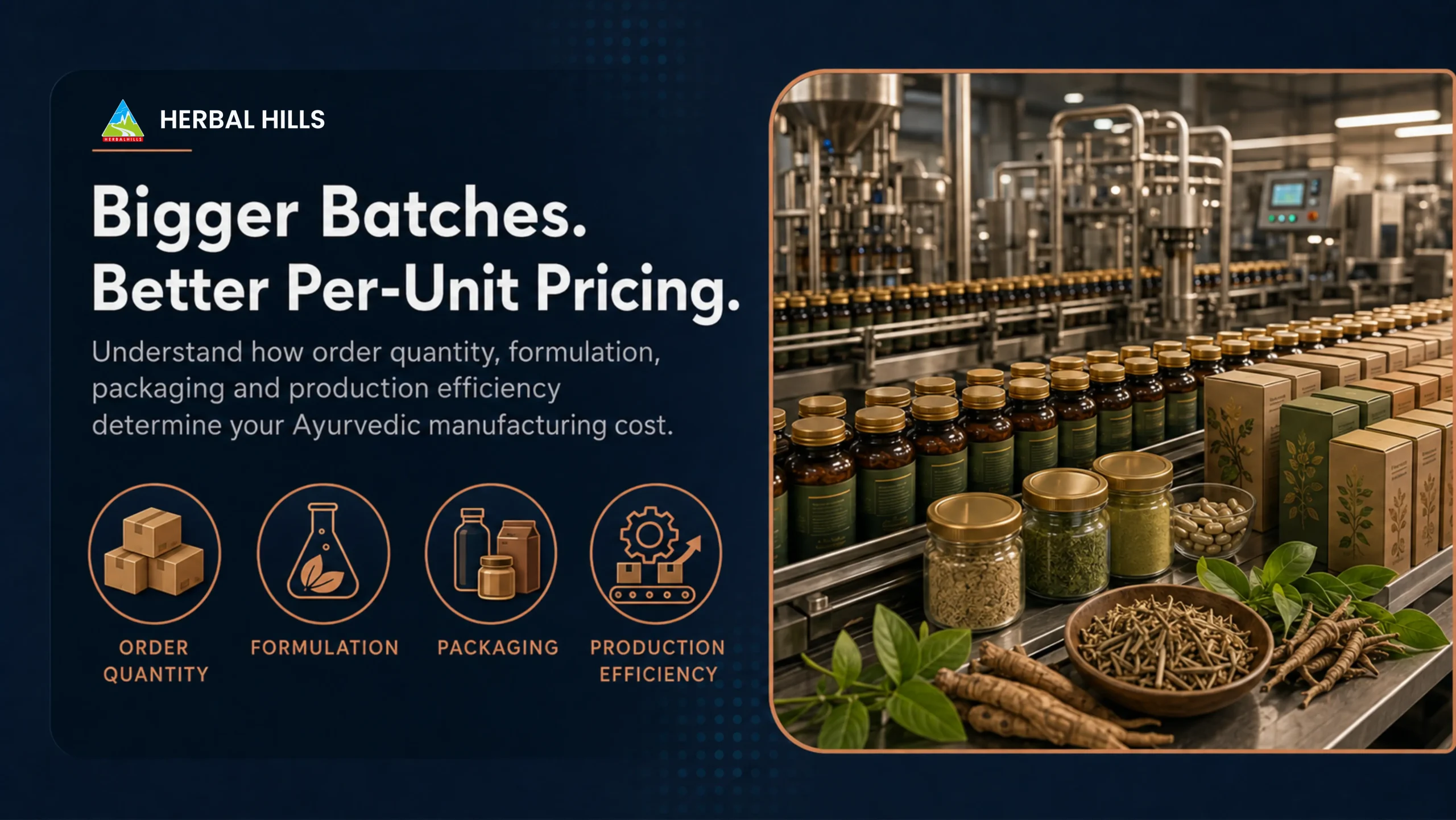
Contract manufacturing pricing is built from raw material, processing, packaging, testing and overhead. One of the most common questions we receive from entrepreneurs is:
“Why does the price change so much when I increase my order quantity?”
Another common question is:
“Why is your quotation for 5,000 bottles much lower than for 1,000 bottles?”
The simple answer is: Ayurvedic manufacturing follows the principle of economies of scale. The larger the production volume, the lower the manufacturing cost per unit.
Many entrepreneurs believe the only factor affecting pricing is the cost of herbs. In reality, the cost of manufacturing an Ayurvedic product is made up of many different components.
Understanding these components will help you make smarter business decisions and plan your investment more efficiently.
What Determines the Cost of an Ayurvedic Product?
The final manufacturing cost is influenced by several factors. These include:
Each of these contributes to the final price. However, one factor has the biggest influence on cost: production quantity.
Why Quantity Makes Such a Big Difference
Every manufacturing process has two types of costs.
Variable Costs
These increase as production increases.
- Herbs
- Bottles
- Labels
- Cartons
- Caps
- Packaging materials
Fixed Manufacturing Costs
These remain almost the same regardless of batch size.
- Machine setup
- Batch documentation
- Quality checks
- Equipment cleaning
- Production planning
- Line preparation
- Staff time
These fixed costs are divided across the total number of units produced. Therefore, the larger the batch, the lower the manufacturing cost per bottle.
Why Small Batches Cost More
Let’s understand with a simple example. Suppose today the production line is manufacturing Triphala Tablets. After completing that batch, the factory cannot immediately begin manufacturing Ashwagandha Tablets.
Before the next batch begins, the entire production line must undergo:
This cleaning and preparation process generally takes considerable time and resources. Whether the previous batch contained 25,000 tablets or 500,000 tablets, the cleaning process remains largely the same.
If this fixed cost is divided among only 25,000 tablets, the cost per tablet is higher. If the same cleaning cost is spread across 500,000 tablets, the cost per tablet becomes much lower. This is one of the biggest reasons why larger production batches are more economical.
The Same Principle Applies to Packaging
Packaging follows exactly the same principle. When one product finishes packaging, the packaging line cannot simply begin the next product immediately. The team must:
These procedures are essential. Many Ayurvedic tablets look similar in size, shape and colour. Proper line clearance helps prevent packaging errors and protects product quality.
Whether the packaging run is for 1,000 bottles or 20,000 bottles, much of the setup effort remains the same. Larger packaging runs therefore reduce the packaging cost per bottle.
Printing Costs Also Reduce with Volume
Packaging suppliers also benefit from larger production quantities. Higher quantities generally reduce the cost of:
Printing machines operate more efficiently with larger print runs. As production volume increases, the cost per printed label or carton generally decreases. These savings are passed on to customers.
Better Utilisation of Manufacturing Equipment
Modern manufacturing facilities are designed for efficient batch production. Larger batches provide:
These efficiencies help reduce overall manufacturing costs while maintaining quality standards.
Why Volume Discounts Are Genuine Manufacturing Savings
Sometimes customers wonder: “How can the price reduce by 10%, 15% or even 20%?”
The answer is simple. The reduction is not because quality has changed. It is because manufacturing has become more efficient.
Larger production quantities reduce:
- Setup costs
- Cleaning costs
- Printing costs
- Packaging costs
- Material procurement costs
- Production handling costs
These are genuine manufacturing efficiencies.
A Typical Illustration
Although every project is different, the following example illustrates how economies of scale work.
| Approximate Order Size | Typical Manufacturing Benefit |
|---|---|
| Around 500–1,000 units | Standard pricing |
| Around 2,000–5,000 units | Volume efficiencies may begin to reduce costs |
| Larger commercial batches | Greater manufacturing efficiencies are often possible |
| Very large production volumes | Significant economies of scale may be achieved |
*Actual pricing depends on the formulation, packaging, ingredients, specifications and production requirements. Every quotation is prepared individually.
Why Herbal Hills Believes in Transparent Pricing
At Herbal Hills, we believe customers should understand why pricing changes. We do not believe in offering unrealistic prices simply to win an order. Instead, we follow a transparent pricing approach.
As production quantities increase, the manufacturing efficiencies achieved through larger batches are reflected in the quotation. In other words, the benefits of economies of scale are shared with our customers. This helps entrepreneurs become more competitive as their businesses grow.
Should You Always Order the Largest Quantity?
Not necessarily. The right production quantity depends on:
For a new brand, it is often sensible to begin with practical quantities, validate market demand and then increase production as sales grow. Once demand becomes predictable, larger batches can provide substantial cost advantages.
Questions You Should Ask Your Manufacturer
Before comparing quotations, ask:
Understanding these answers allows you to compare quotations more intelligently.
Final Thoughts
The price of an Ayurvedic product is not determined by herbs alone. It reflects the entire manufacturing process—from sourcing ingredients and maintaining GMP-compliant facilities to cleaning equipment, testing products, packaging, printing and logistics.
That is why two quotations with different order quantities can vary significantly.
At Herbal Hills, we believe customers deserve to understand how pricing works, not just receive a quotation. Our approach is simple:
When your business grows, manufacturing becomes more efficient. And when manufacturing becomes more efficient, we believe those benefits should be shared with our customers.
Related Reading
Frequently Asked Questions
Why is a quotation for 5,000 bottles cheaper than for 1,000 bottles?
Because many manufacturing, cleaning, setup and packaging costs remain similar regardless of batch size. Larger batches distribute these fixed costs across more units.
Does a lower price for larger quantities mean lower quality?
No. Lower pricing for larger batches is generally the result of manufacturing efficiencies and economies of scale—not lower product quality.
Why does packaging become cheaper in larger quantities?
Larger print runs and packaging volumes reduce the cost per label, carton and bottle, while packaging line setup costs are spread across more units.
Should I order a larger quantity just to reduce cost?
Only if it matches your business plan and expected demand. Manufacturing efficiency should always be balanced with inventory management and cash flow.
How does Herbal Hills calculate pricing?
We calculate pricing based on the complete project—including formulation, ingredients, dosage, packaging, testing, production requirements and order quantity. As production volume increases, we transparently pass on the benefits of manufacturing efficiencies wherever possible.
Contract Manufacturing Quotes: Key Points
- A contract manufacturing quote is built from raw material, processing, packaging, testing and overhead
- Ask the contract manufacturing team which items are included in the quote
- Compare contract manufacturing quotes on the same batch size and pack format
- Check how contract manufacturing quotes treat testing and documentation
- Confirm how contract manufacturing pricing changes if your volume grows
- Share your product idea early so the contract manufacturing quote reflects your real requirements
What Drives Manufacturing Cost: Key Points
- Raw material choice changes the manufacturing cost of every unit
- Batch size spreads fixed setup across more units, which lowers the manufacturing cost per unit
- Packaging format and pack size affect the manufacturing cost
- Testing and documentation scope is part of the manufacturing cost
Related reading: see how pricing works at Herbal Hills, custom formulation support, or contact our team for a quote. For labelling and food-safety requirements, see the official FSSAI website.
Quick Answers on Manufacturing Cost
How is Ayurvedic contract manufacturing priced?
From raw material, processing, packaging, testing and overhead costs, adjusted for volume and complexity.
Does Herbal Hills publish a price list?
No. Pricing depends on the product, dosage form, packaging and volume, and is quoted per project. See our pricing page for how it works.
What information do I need for a quote?
Dosage form, pack size, quantity, branding and packaging needs, formulation choice and destination.
Does a larger order lower the per-unit cost?
Per-unit cost generally changes with volume. Discuss your volume through the Contact Us page for project-specific information.
What is the minimum order quantity?
It starts at 500 units.
Is transport included in the quote?
Transport is quoted according to volume, destination and method, so confirm it directly for your project.