

Blog
Standardized Herbal Extracts for Your Formulation: Why Extract Quality Decides Product Quality

Open almost any modern Ayurvedic or nutraceutical label and you will find the word “extract”. Ashwagandha extract, Tulsi extract, Amla extract. Extracts let a formulation carry more of a herb’s useful constituents in a smaller, more convenient dose.
But two products listing the same extract can perform very differently, because not all extracts are made the same way. For brands comparing herbal extract manufacturers in India, that difference is the whole story.
This guide explains what a herbal extract is, the main types of extracts, how extracts are used in Ayurvedic formulations, and why extract quality ultimately decides product quality. It also explains why Herbal Hills makes many of its key extracts in-house, and what that means for the brands that build products with us.
Sources: Ken Research (herbal extract market, 2025–2032); IMARC Group (herbal supplement market, 2024). Extracts are now a core ingredient across nutraceuticals, Ayurvedic medicines, functional foods and personal care.
What Is a Herbal Extract?
A herbal extract is a concentrated form of a medicinal plant, made by soaking or boiling the raw herb in a solvent such as water or a water–alcohol mix so that its useful constituents move into the liquid. The liquid is then filtered, concentrated and usually dried into a powder that can go into capsules, tablets, syrups or effervescent formats.
The idea is not new to Ayurveda. A classical kwatha (decoction) is essentially a water extract, and ghana preparations are concentrated, dried decoctions pressed into tablets. Modern extraction applies the same principle with controlled equipment, measured timing and laboratory testing, so the result can be repeated batch after batch.
What are the main types of herbal extracts?
| Extract Type | Solvent | What It Captures | Typical Use |
|---|---|---|---|
| Aqueous (water) extract | Water | Water-soluble constituents; closest to classical kwatha | Tablets, capsules, syrups, effervescent tablets, shots |
| Hydroalcoholic extract | Water and ethanol | A broader range, including constituents less soluble in water | Capsules and tablets |
| Oil-based / oleoresin extract | Oil or approved solvent | Fat-soluble constituents and aroma | Soft gels, oils, personal care |
| Ratio extract (e.g. 10:1) | Any of the above | Concentration by weight of herb used | Capsules where a smaller dose is needed |
| Standardized extract | Any of the above | A defined, tested level of a marker constituent | Formulations that need consistent content in every batch |
What is a standardized herbal extract?
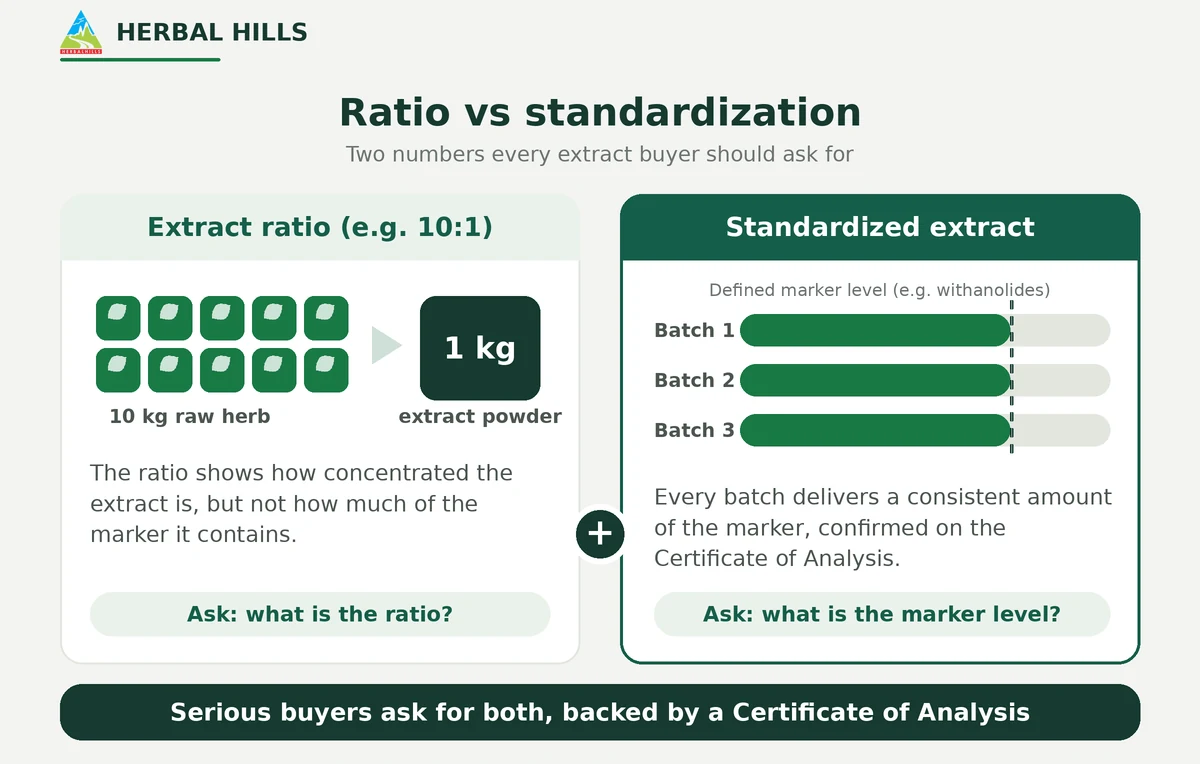
A standardized herbal extract is an extract tested and adjusted to contain a defined level of a marker constituent, such as withanolides in Ashwagandha. Standardization means every batch delivers a consistent amount of that marker, so the formulation behaves the same way from one production run to the next, regardless of seasonal changes in the raw herb.
What does an extract ratio like 10:1 mean?
A 10:1 ratio means roughly 10 kg of raw herb was used to make 1 kg of extract. The ratio tells you how concentrated the extract is, but not how much of the active marker it contains. That is why serious buyers ask for both the ratio and the standardization level, supported by a Certificate of Analysis.
The Ratio Tells You
How concentrated the extract is: about how many kilograms of raw herb went into 1 kg of extract.
Standardization Tells You
How much of the marker constituent each batch contains, confirmed by testing and recorded on the Certificate of Analysis.
How Are Herbal Extracts Used in Ayurvedic Formulations?
In most modern Ayurvedic and nutraceutical products, extracts are a key ingredient rather than the whole product. A capsule may combine a standardized extract with raw herb powder; an effervescent tablet may rely on water-soluble extracts that dissolve cleanly; a classical ghana vati is built on concentrated decoction. Choosing the right extract, in the right amount, is a core part of formulation design.
| Format | How Extracts Help |
|---|---|
| Capsules and tablets | More of the herb’s constituents per dose, so the consumer takes fewer or smaller units |
| Effervescent tablets and herbal shots | Water-soluble aqueous extracts dissolve cleanly and taste more consistent |
| Syrups and juices | Water extracts blend smoothly into liquid bases |
| Ghana vati (classical tablets) | Concentrated decoction is the traditional base of the tablet |
| Oils and personal care | Herbal extracts carry botanical constituents into oils, creams and hair care |
Raw herb powder vs herbal extract: what is the difference?
| Factor | Raw Herb Powder (Churna) | Herbal Extract |
|---|---|---|
| Concentration | Whole herb, including fibre | Concentrated useful constituents |
| Dose size | Larger quantity per serving | Smaller, more convenient dose |
| Batch consistency | Varies with each harvest | Can be standardized to a marker level |
| Solubility | Mostly insoluble fibre | Aqueous extracts dissolve in water |
| Best for | Classical churna formulations | Capsules, tablets, effervescent, shots and syrups |
Both have a place. Classical churna remains the right choice for many traditional formulations, while extracts make modern formats practical. Many of the best formulations combine the two.
Why Does Extract Quality Decide Product Quality?
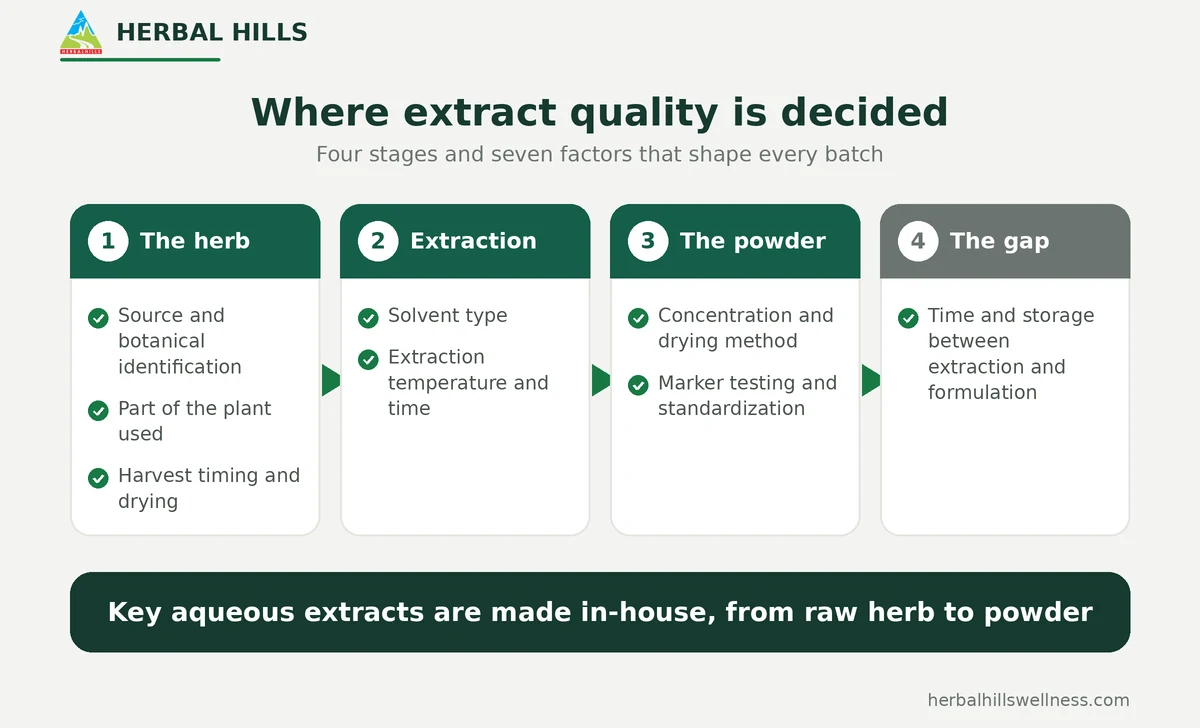
In the herbal supplement and nutraceutical business, the bottom line is the result the consumer experiences. A customer reorders only when a product feels dependable every time, and that dependability is decided long before the capsule is filled. Extract quality varies widely with:
Extracts bought on the open market add another risk: the brand often cannot see how the extract was made, whether the herb was correctly identified, or whether the batch was diluted with fillers. Two products with identical labels can therefore contain very different extracts. For a brand, that inconsistency shows up as uneven customer experience, weaker reviews and fewer repeat orders. Controlling the extract is therefore one of the most reliable ways to protect both product quality and repeat business.
Why Does Herbal Hills Manufacture Herbal Extracts In-House?
Many contract manufacturers buy ready extracts from traders. Among herbal extract manufacturers in India, Herbal Hills takes a different route: many of our key aqueous extracts are manufactured in-house at our Lonavala facility, starting from raw herbs, a share of which come from our own organic farm. Making the extract ourselves lets us control every step that decides quality, and use the extract directly in our own formulations.
Your Herbal Hills contact confirms which extracts are made in-house for the herbs in your formulation.
How does Herbal Hills make an aqueous extract?
The extraction of herbs at Herbal Hills follows eight controlled steps, from raw herb to finished extract powder:
🌱Herb Sourcing
Raw herbs from our own organic farm or qualified suppliers.
🔍Identification and Testing
Each lot is checked for identity and quality before use.
🧹Cleaning and Size Reduction
Herbs are cleaned, dried and cut or coarsely ground.
💧Aqueous Extraction
Herbs are extracted in water under controlled time and temperature.
⚗️Filtration and Concentration
The liquid is filtered and concentrated.
🌫️Drying
The concentrate is dried into extract powder.
📋Testing and Standardization
Each batch is tested and documented on a Certificate of Analysis.
💊Into the Formulation
The extract moves straight into production, with no trading or long storage gap.
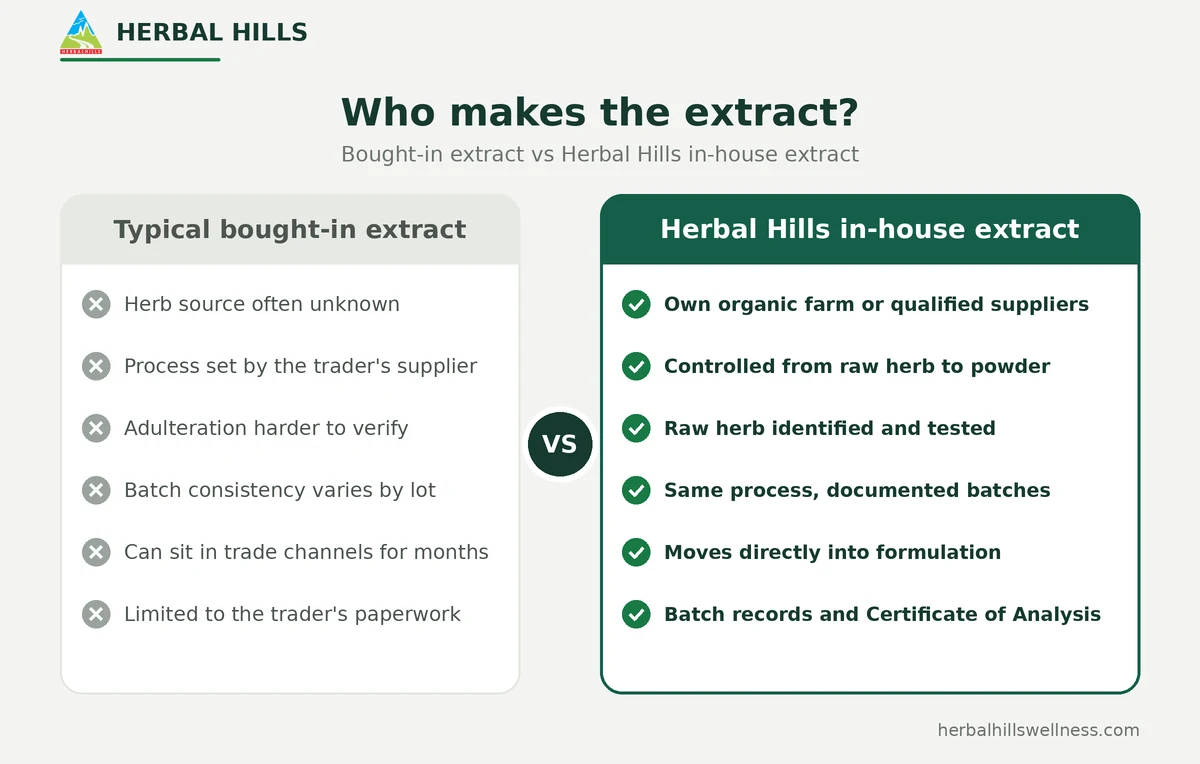
Bought-in extract vs Herbal Hills in-house extract
| Factor | Typical Bought-In Extract | Herbal Hills In-House Extract |
|---|---|---|
| Herb source | Often unknown to the brand | Own organic farm or qualified suppliers |
| Process control | Set by the trader’s supplier | Controlled by Herbal Hills from raw herb to powder |
| Adulteration risk | Harder to verify | Raw herb identified and tested before extraction |
| Batch consistency | Varies between suppliers and lots | Same process, same plant, documented batches |
| Freshness | Can sit in trade channels for months | Extract moves directly into formulation |
| Documentation | Limited to the trader’s paperwork | Batch records and Certificate of Analysis |
Does Extract Quality Really Change Results?
Yes — consistency is where quality extracts show their value. When every batch starts from a well-identified herb and a controlled extraction, the finished product delivers the same experience month after month. In Herbal Hills’ experience, formulations built on our in-house extracts give partners steadier product performance and stronger repeat orders than formulations built on loosely specified, bought-in extracts.
Which Herbal Extracts Can Go Into Your Formulation?
Herbal Hills uses extracts across its range of research-based formulations. Common choices include:
| Herb | Extract Type | Wellness Category | Popular Formats |
|---|---|---|---|
| Ashwagandha | Aqueous / standardized | Stress and vitality support | Capsules, tablets, effervescent tablets |
| Tulsi | Aqueous | Immunity support | Tablets, tea tablets, herbal shots |
| Giloy (Guduchi) | Aqueous / ghana | Immunity support | Tablets, juices |
| Amla | Aqueous | Daily vitality and hair care | Tablets, juices, oils |
| Triphala | Aqueous | Digestive wellness | Tablets, churna blends |
| Shatavari | Aqueous | Women’s wellness | Capsules, granules |
The final extract list, extract type and standardization levels are confirmed per product by the R&D team.
What Should You Ask a Herbal Extract Manufacturer?
Before you approve a formulation, ask your manufacturer these questions about every extract it uses:
- Is the extract made in-house or bought from a trader?
- Where does the raw herb come from, and how is it identified?
- Which part of the plant is used?
- Which solvent is used: water, water–alcohol or oil?
- What is the extract ratio, and is it standardized to a marker?
- Which test method confirms the marker level?
- Are heavy metal, microbial and pesticide residue reports available?
- Will every batch come with a Certificate of Analysis?
How Do You Build a Formulation on Quality Extracts with Herbal Hills?
Share Idea or Pick a Formulation
Agree Extract Specification
Evaluate Free Samples
Label & Packaging
Batch Manufacturing
Dispatch with CoA
- Share your product idea, or choose from 300+ research-based formulations.
- Agree the extract selection, extract type and standardization specification with the R&D team.
- Evaluate free trial samples for quality, taste and format.
- Finalise your label and packaging with our design team.
- Batch manufacturing with in-house extracts in our GMP, ISO and USFDA-certified facility.
- Dispatch with a Certificate of Analysis and batch documentation.
Why Brands Choose Herbal Hills for Extract-Based Formulations
Better Extracts, Better Products, More Repeat Orders
Your customers judge your brand by the result they experience, and that result starts with the extract. By making key extracts in-house and controlling every step from raw herb to finished batch, Herbal Hills gives your formulation the consistency that earns repeat business. When you compare herbal extract manufacturers in India, ask one question first: who makes the extract? According to Herbal Hills, controlling the extract is the single most important quality decision in an extract-based formulation.
Request Extract-Based Formulation List & Free Samples →
Frequently Asked Questions
What is a herbal extract?
A herbal extract is a concentrated preparation made by drawing a herb’s useful constituents into a solvent such as water, then filtering, concentrating and drying it into a powder. Extracts let a formulation carry more of the herb’s constituents in a smaller dose, which makes capsules, tablets and effervescent formats practical.
What is the difference between an aqueous and a hydroalcoholic extract?
An aqueous extract uses only water as the solvent and captures water-soluble constituents, much like a classical kwatha. A hydroalcoholic extract uses a water and ethanol mix to capture a broader range of constituents. The right choice depends on the herb, the target constituents and the finished product format.
Does Herbal Hills make its own herbal extracts?
Yes. Herbal Hills manufactures many of its key aqueous extracts in-house at its Lonavala facility, starting from raw herbs, some grown on its own organic farm. Making extracts in-house gives full control over identification, extraction, drying and testing, and the extracts move directly into Herbal Hills formulations.
Why does extract quality matter for my brand?
In nutraceutical and herbal supplement products, repeat business depends on a dependable consumer experience. Extract quality varies with herb source, process and storage, so a poorly controlled extract can make the same product perform differently from batch to batch. A controlled, documented extract protects consistency, reviews and reorders.
Can I specify a standardization level for my formulation?
Yes. For custom formulations, the R&D team can agree the extract type, ratio and marker standardization level with you before development. Standardization levels depend on the herb and on available test methods, so the specification is confirmed per product and recorded on the Certificate of Analysis.
Are extract-based products stronger than raw herb powders?
Extracts are more concentrated, so a smaller dose can carry more of a herb’s constituents, and they can be standardized for consistency. Raw herb powders remain right for many classical formulations. Many effective products combine both, and the R&D team recommends the best mix for each format.
What documents come with an extract-based formulation?
Every batch ships with a Certificate of Analysis and is backed by batch manufacturing records. Additional reports, such as heavy metal, microbial or pesticide residue testing, are discussed and confirmed per product before the order, so your quality and export teams know exactly what to expect.
Can Herbal Hills supply herbal extracts in bulk on their own?
Herbal Hills primarily uses its in-house extracts in finished formulations that brands launch under their own label. If you need extracts as a standalone ingredient for your own production, contact the team to discuss availability, quantities and specifications for the herbs you need.