

Blog
Ayurvedic Manufacturing Trends in 2026: What Private Label Brands Should Plan For

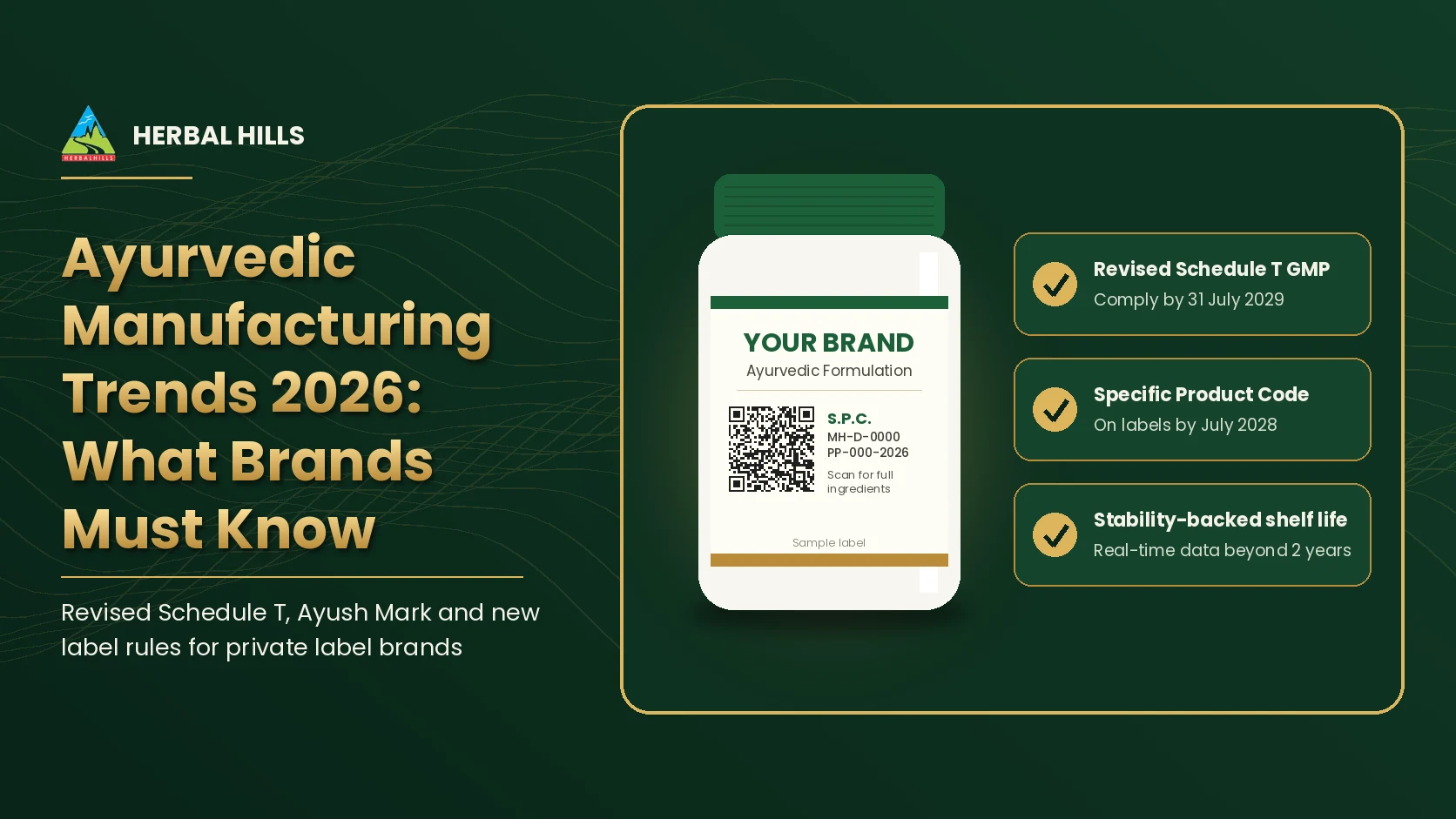
Three changes drive Ayurvedic manufacturing in 2026.
First, the Drugs (Eleventh Amendment) Rules, 2026, notified on 24 July 2026, rewrite Schedule T, the GMP standard for Ayurvedic drugs. Every manufacturer must comply by 31 July 2029. The same rules bring a uniform product code on labels, QR-code labelling and stricter shelf-life evidence.
Second, the Ayush Mark, launched on 19 December 2025, gives Ayurvedic products a national quality recognition at two levels: Standard for India and Premium for international markets.
Third, exports are growing. India exported US$688.89 million of Ayush and herbal products in 2024-25, up 6.11% on the previous year.
For a private label brand, the practical result is simple. Your label, your shelf-life claim and your export plans now depend on how prepared your manufacturer is.
How Big Is the Ayurvedic Manufacturing Sector?
India’s Ayush manufacturing sector grew about six times in seven years, from US$2.85 billion in 2014 to US$18.1 billion in 2020, according to a study by the Research and Information System for Developing Countries (RIS) cited by the Ministry of Ayush in Parliament. The same body of work puts the wider Ayush market at US$23.3 billion in 2022, a compound annual growth rate of about 17% since 2014.
India has more than 8,600 Ayush drug manufacturing units, according to Invest India’s 2023 figures. That scale is why quality standards matter: buyers have many options, and the gap between the best and the weakest units is wide.
Exports are smaller but steady:
| Financial year | Ayush and herbal exports (US$ million) | Change |
|---|---|---|
| 2024-25 | 688.89 | +6.11% |
| 2023-24 | 649.2 | +3.3% |
| 2022-23 | 628.54 | +2.7% |
| 2021-22 | 612.12 | — |
Traditional medicine also now has dedicated annexes in India’s trade agreements with Oman (CEPA) and New Zealand (FTA).
Online reports quote global Ayurveda market sizes from about US$12 billion to over US$100 billion, depending on what each one counts. This article uses only government and RIS figures.
Six Trends Reshaping Ayurvedic Manufacturing
1. GMP is being rewritten: revised Schedule T by 31 July 2029
Schedule T has set GMP for Ayurvedic, Siddha and Unani drugs since 2000. The Eleventh Amendment substantially rewrites it, covering premises, personnel, equipment, quality control, raw materials and records. Every Ayurvedic manufacturer must comply by 31 July 2029.
Specific changes include:
- A quality control section of at least 150 sq ft, staffed by an expert in the relevant system of medicine, a chemist, a botanist or pharmacognosist, and a microbiologist where applicable.
- Colour-coded status labels on stored materials: yellow for under test, green for approved, red for rejected.
- Raw materials stored by category, including metals and minerals, animal-origin materials, fresh and dry herbs, and Schedule E1 ingredients.
- More detailed Batch Manufacturing Records, plus mandatory training and internal audits.
- New supplementary guidance for herbo-mineral (Rasaushadhi) preparations, including how mercury, lead and arsenic are handled.
What it means for you: ask your manufacturer for its revised Schedule T gap plan. A unit that has not started may face disruption before 2029, and so would your supply.
2. Traceability on the label: the Specific Product Code
Every Ayurvedic product will carry a Specific Product Code (S.P.C.) in a uniform national format. It combines the state code, licence type, licence number, system of medicine, product serial and year of approval. Existing codes must be reissued and printed on labels within two years of 24 July 2026.
The rules also allow ingredient lists and other label information to be shown through a QR code, GTIN or barcode when the label is too small.
What it means for you: plan a label revision before mid-2028, and avoid printing large stocks of packaging with old codes.
3. Shelf-life claims need real data
Shelf life based on accelerated stability studies is now capped. A 3-month accelerated study supports a 1-year shelf life, and a 6-month study supports 2 years. Any claim beyond 2 years must rest on real-time stability data, and a real-time report must follow within a year of the granted shelf life ending.
What it means for you: if a manufacturer offers a 3-year shelf life, ask to see the real-time stability data behind it. This matters most for marketplaces and importers, who check expiry closely.
4. Brand naming for single-herb extracts
Single-plant, extract-based Ayurvedic products licensed as patent or proprietary medicines must now carry a name prefix or suffix specific to the licensee, so they are not sold under a bare herb name. The rules give a one-year window from 24 July 2026.
What it means for you: if your range includes single-herb extract products, confirm with your manufacturer how your product names will be registered.
5. National quality recognition: the Ayush Mark
The Ayush Mark was launched on 19 December 2025 at the Second WHO Global Summit on Traditional Medicine. It has two levels: the Ayush Standard Mark for domestic assurance and the Ayush Premium Mark for international markets. AYUSHEXCIL, the Ayush Export Promotion Council, anchors the programme, and the new framework also covers Ayush services.
What it means for you: for export-focused brands, a recognised quality mark can make regulatory reviews and buyer due diligence easier. Ask whether your manufacturer plans to apply.
6. Lighter licensing, heavier documentation
Manufacturing licences are now valid permanently, without periodic renewal. Inspections move to a risk-based approach instead of a fixed schedule.
What it means for you: less paperwork for the manufacturer does not mean less scrutiny. Risk-based inspection means a unit’s records decide how closely it is watched. A partner with clean, complete documentation is a lower-risk partner.
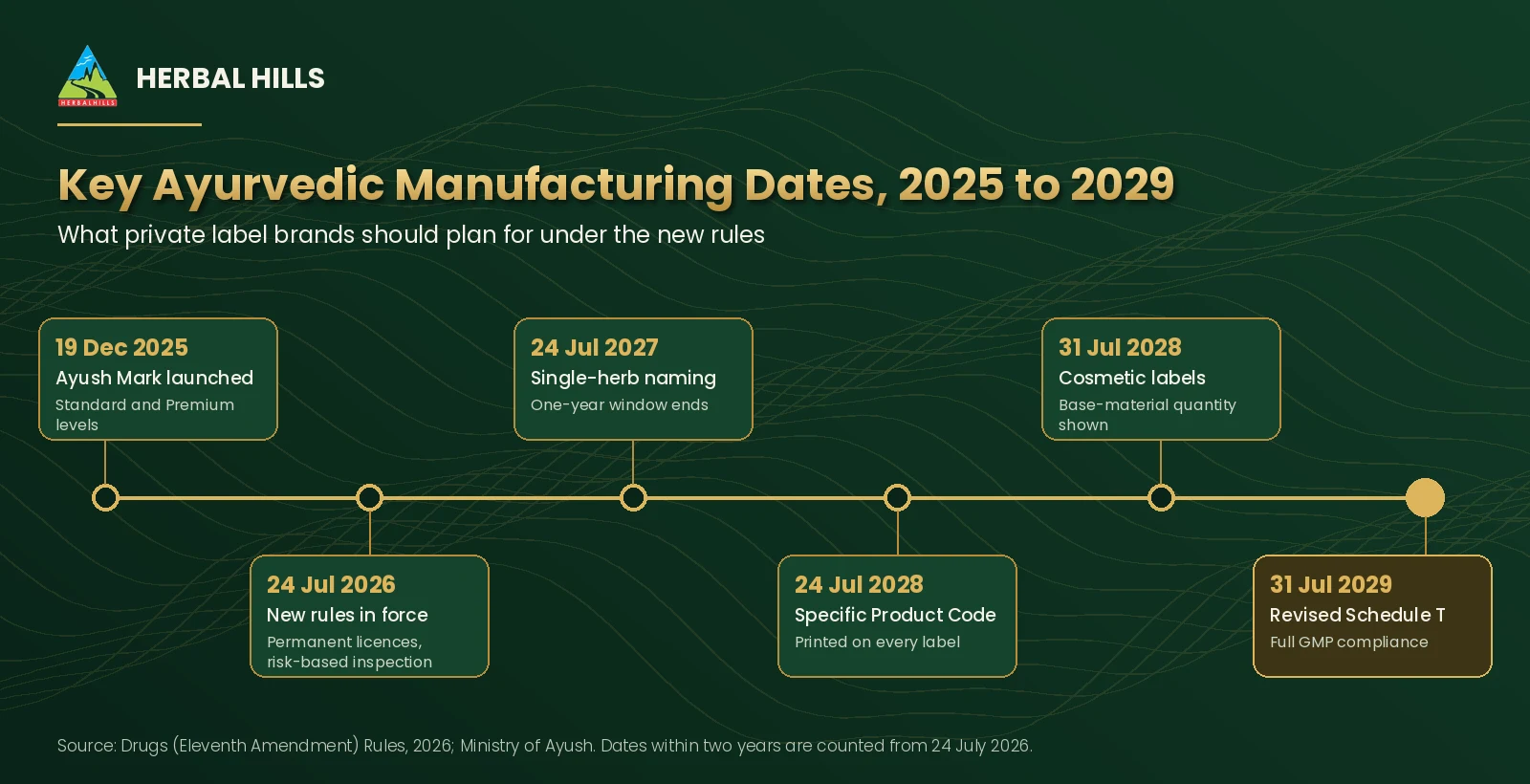
Key dates at a glance
| Date | What changes |
|---|---|
| 19 Dec 2025 | Ayush Mark launched (Standard and Premium levels) |
| 24 Jul 2026 | Drugs (Eleventh Amendment) Rules, 2026 come into force; licences become permanent; risk-based inspection begins |
| By 24 Jul 2027 | One-year window ends for single-herb extract naming |
| By 24 Jul 2028 | New Specific Product Codes issued and printed on labels |
| 31 Jul 2028 | Base-material quantity required on Ayurvedic cosmetic labels |
| 31 Jul 2029 | Full compliance with revised Schedule T GMP |
What Should Buyers Now Expect From a Manufacturer?
The bar a brand should set for its manufacturer has moved. Use this table as a checklist when you compare partners.
| Area | Older normal | What to expect in 2026 |
|---|---|---|
| GMP | A Schedule T certificate on the wall | A plan, with dates, for the revised Schedule T before 31 July 2029 |
| Quality control | Basic in-house checks | A staffed QC section, plus accredited external labs for advanced tests |
| Batch documents | Certificate of Analysis on request | A Certificate of Analysis with every batch and complete batch records |
| Label | Printed ingredient list only | Specific Product Code on the label; QR, GTIN or barcode for full details |
| Shelf life | Claimed from experience | Backed by stability data; real-time data for anything beyond 2 years |
| Single-herb extracts | Sold under a generic herb name | Licensee-specific naming in place |
| Quality recognition | Optional | Ayush Mark (Standard or Premium) is a growing signal, especially for export |
| Export support | Ad hoc | Market-specific documentation planned from the start |
For more on vetting a partner, read what to ask before signing with an Ayurvedic manufacturer and which certifications actually matter.
How Is Herbal Hills Placed for These Changes?
Herbal Hills has manufactured Ayurvedic products since 2004 from four manufacturing units in Lonavala, Maharashtra. Several of the 2026 expectations above are already part of how we work:
Read more about our Ayurvedic third party manufacturing, our manufacturing facility, our product registration support and our export experience.
Review Your Range Against the 2026 Rules →
Frequently Asked Questions
What is the revised Schedule T?
Schedule T is the Good Manufacturing Practice standard for Ayurvedic, Siddha and Unani drugs in India. The Drugs (Eleventh Amendment) Rules, 2026, notified on 24 July 2026, substantially rewrite it. The changes cover premises, quality control staffing, raw-material storage, batch records and internal audits. All manufacturers must comply by 31 July 2029.
What is the Specific Product Code on Ayurvedic labels?
The Specific Product Code (S.P.C.) is a uniform code for every licensed Ayurvedic product. It combines the state code, licence type and number, system of medicine, product serial and year of approval. Existing codes must be reissued and printed on labels within two years of 24 July 2026.
What is the Ayush Mark?
The Ayush Mark is a national quality recognition for Ayush products and services, launched on 19 December 2025. It has two levels: the Ayush Standard Mark for the domestic market and the Ayush Premium Mark for international markets. The Ayush Export Promotion Council (AYUSHEXCIL) anchors the programme for the Ministry of Ayush.
How much does India export in Ayurvedic and herbal products?
India exported US$688.89 million of Ayush and herbal products in 2024-25, up 6.11% from US$649.2 million in 2023-24, according to the Ministry of Commerce. Traditional medicine also has dedicated annexes in India’s trade agreements with Oman and New Zealand.
Can an Ayurvedic product claim a three-year shelf life?
Only with real-time stability data. Under the 2026 rules, accelerated stability studies support at most a two-year shelf life: one year from a three-month study, two years from a six-month study. Any longer shelf life must be backed by real-time stability data.
Sources
- Summary of the Drugs (Eleventh Amendment) Rules, 2026 Gazette notification
- Ayush exports rise 6.11% to US$688.89 million in 2024-25 (IANS, citing the Ministry of Commerce)
- Ayush and herbal exports, 2021-22 to 2024-25 (India Sea Trade News)
- Ayush Mark launch, 19 December 2025 (BioSpectrum India)
- Rajya Sabha answer on Ayush sector growth, 11 February 2025
- Ayush sector snapshot (Invest India)