
Blog
Ayurvedic Supplements from India for the USA: An Importer’s Guide to Choosing a Dietary Supplement Contract Manufacturer

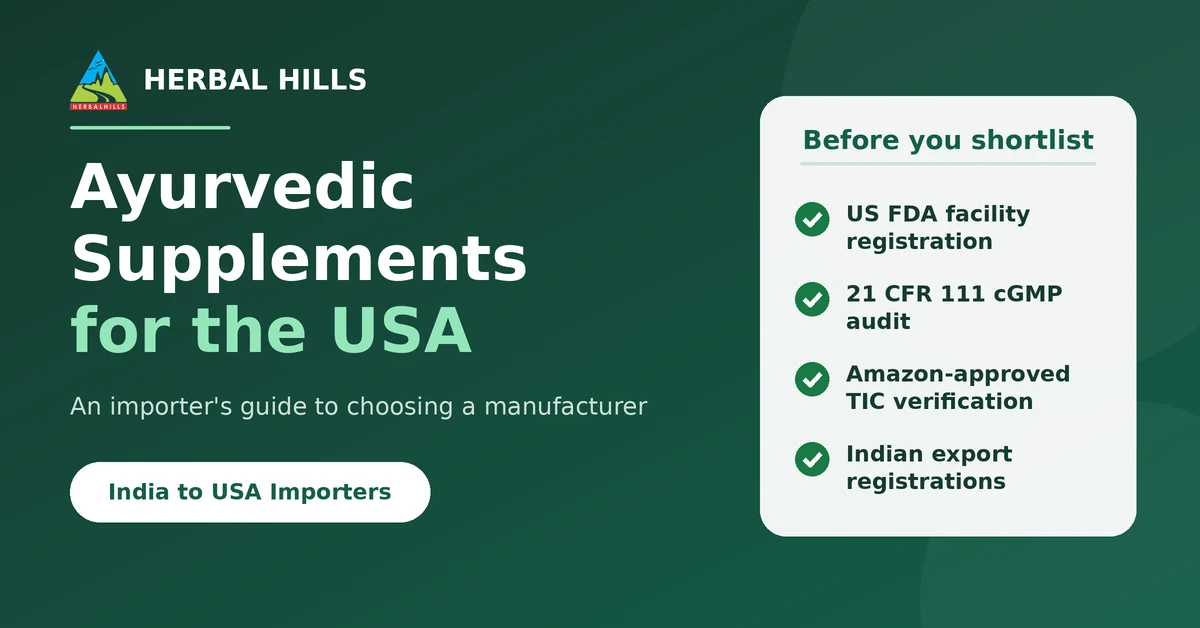
American demand for Ayurvedic herbs such as Ashwagandha, Turmeric, Tulsi and Triphala keeps growing, and India is the natural source. But for a US brand or importer, the hardest part is not finding a supplier; it is finding a dietary supplement contract manufacturer whose facility, quality system and paperwork will stand up to the FDA, US customs and Amazon’s seller requirements.
This guide explains the size of the US herbal supplement market, the certifications and documents a US importer must check before shortlisting an Indian manufacturer, what Amazon now requires before a supplement can be listed, which Ayurvedic formats sell best in the USA, and how Herbal Hills supports US brands from formulation to export dispatch.
Sources: American Botanical Council Herb Market Report (US herbal supplement sales and Ashwagandha ranking); Amazon seller requirements for dietary supplements.
How Big Is the US Market for Ayurvedic and Herbal Supplements?
According to the American Botanical Council’s 2024 Herb Market Report, US retail sales of herbal dietary supplements reached a record $13.231 billion in 2024, a 5.4% rise and the second consecutive year of growth. Turmeric remains a top seller, and Ashwagandha has moved firmly into the mainstream, ranking among the top five herbal supplements in US mainstream retail in 2023. Both are core Ayurvedic herbs, and India is where most of them are grown and processed.
For US brands, this creates a clear opportunity: Ayurvedic ingredients have American consumer recognition, and Indian manufacturers can produce them at scale. The brands that win are the ones that pair that opportunity with a manufacturing partner who meets US quality and compliance expectations from day one.
What Should a US Importer Check Before Shortlisting an Indian Manufacturer?
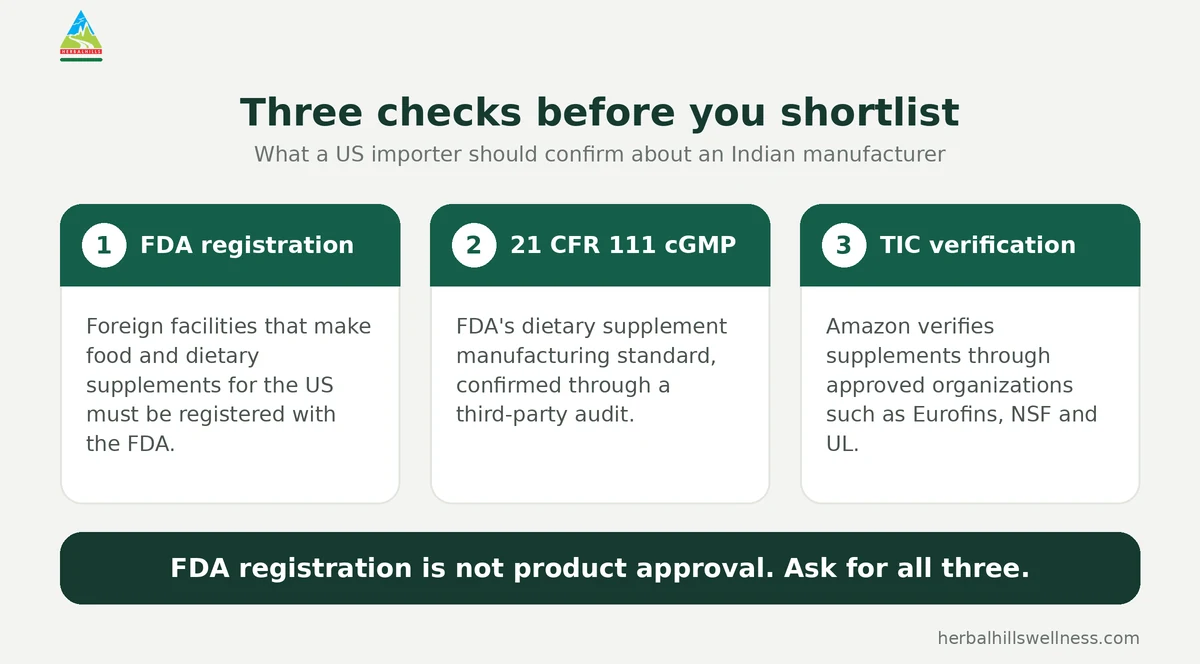
Before you request quotes, confirm that a manufacturer clears these requirements. They decide whether your product can legally enter the US, be listed on Amazon and stay on the shelf.
| Requirement | Why It Matters for a US Importer | What to Ask For |
|---|---|---|
| US FDA facility registration | Foreign facilities that make food and dietary supplements for the US must be registered with the FDA | FDA registration number and validity |
| Dietary supplement cGMP (21 CFR 111) | FDA’s manufacturing standard for dietary supplements; Amazon also requires it | Third-party cGMP audit certificate against 21 CFR 111 |
| Amazon-approved TIC audit (e.g. Eurofins) | Amazon requests verification directly from an approved testing, inspection and certification (TIC) organization | Current audit report or certificate and the TIC organization’s name |
| Indian export registrations | Shows the plant is set up for export documentation and inspection | Export Inspection Council (EIC), APEDA, AYUSHEXCIL registrations |
| GMP and ISO certification | Baseline proof of a documented quality management system | GMP and ISO certificates with issuing bodies |
| Batch testing and Certificate of Analysis | Confirms identity, label content and contaminant limits per batch | Sample CoA including heavy metals, microbial and pesticide results |
Why Is US FDA Registration the First Thing to Check?
Any foreign facility that manufactures, processes, packs or holds food or dietary supplements for consumption in the United States must be registered with the US FDA. Ayurvedic products sold in the US are usually marketed as dietary supplements, so this registration is the first gate. Without it, shipments can be held at the border.
What is 21 CFR 111?
21 CFR Part 111 is the FDA regulation that sets current good manufacturing practice (cGMP) for dietary supplements. It covers personnel, facilities, equipment, raw material identity testing, production and process controls, laboratory testing, batch records, holding and complaint handling. A US importer should only work with a manufacturer that has been audited against it.
What is FSVP, and who is responsible for it?
The Foreign Supplier Verification Program (FSVP) requires US importers of food and dietary supplements to verify that their foreign suppliers produce safely and in line with US standards. The importer, not the Indian manufacturer, is responsible for FSVP. A well-documented manufacturer makes FSVP far easier by sharing audits, certificates and batch records on request.
The Manufacturer
Registers the facility with the FDA and follows 21 CFR 111 dietary supplement cGMP.
The US Importer
Verifies the foreign supplier under FSVP and makes sure labels and claims follow US rules.
Why Does Amazon Require Eurofins or Another TIC Verification?
Amazon is the largest sales channel for many US supplement brands, and it now verifies supplements at the source. Since January 2026, Amazon requires all dietary supplements sold in its US store to show, through an accredited third-party testing, inspection and certification (TIC) organization, that the product was made under cGMP (21 CFR 111 or 117) and meets US labelling standards. Approved TIC organizations include Eurofins, NSF, UL, SGS, Intertek and others listed by Amazon. Without that verification, listings can be suppressed.
For an importer, this changes how a manufacturer must be chosen. A facility that has already been audited by an Amazon-approved TIC organization, such as Eurofins, gives the brand a much faster and lower-risk path to listing, because the facility-level cGMP evidence is already in place. Product-level testing and label checks are then completed for each ASIN.
Herbal Hills’ facility has been audited by Eurofins, supporting US brands that sell on Amazon.
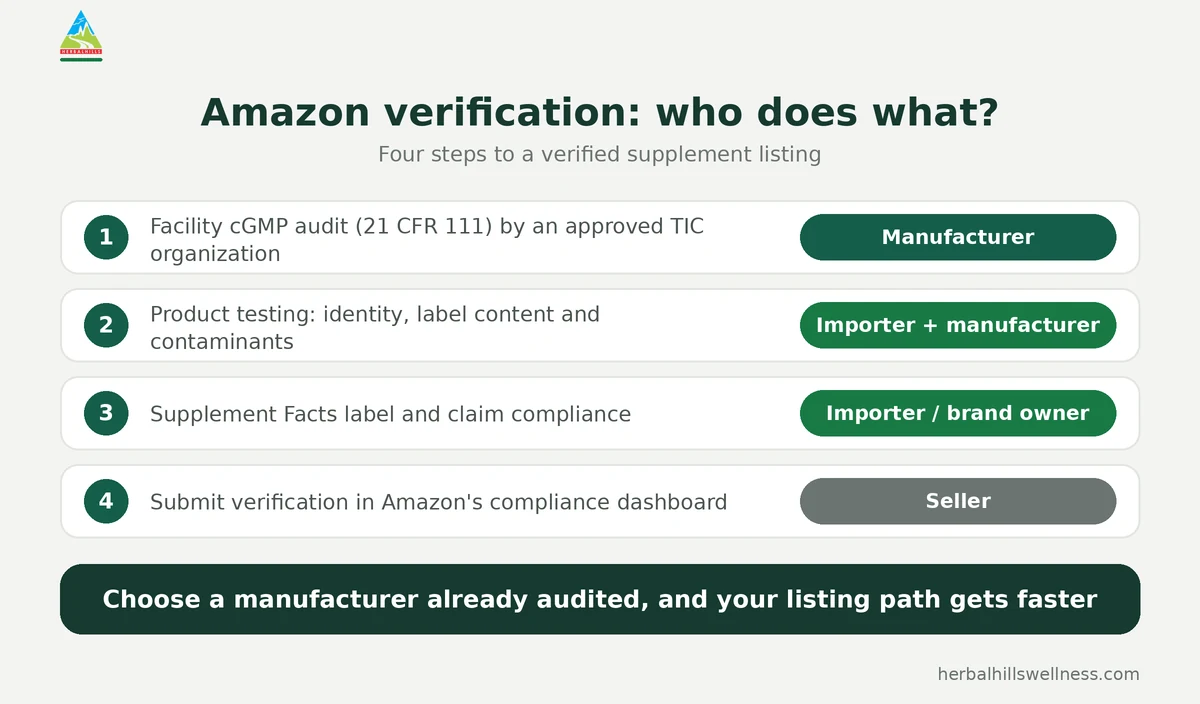
Amazon supplement verification: who does what?
| Step | Responsibility |
|---|---|
| Facility cGMP audit (21 CFR 111) by an approved TIC organization | Manufacturer — Herbal Hills |
| Product testing (identity, label content, contaminants) | Importer selects TIC; manufacturer supplies samples and documents |
| Supplement Facts label and claim compliance | Importer / brand owner, with label support from the manufacturer |
| Submitting verification in Amazon’s compliance dashboard | Seller (importer / brand owner) |
Which Indian Certifications Should US Importers Look For?
Indian export credentials tell a US importer that the plant already handles export documentation, inspections and shipment paperwork. Ask your manufacturer for:
An AYUSH manufacturing licence matters for selling Ayurvedic medicines inside India, but for the US market it is FDA registration and dietary supplement cGMP that decide market access.
What Quality Factors Matter Beyond Certificates?
Certificates open the door; quality keeps the product on the shelf and earns reorders. Once a facility clears the certification phase, US importers should evaluate:
| Quality Factor | What Good Looks Like |
|---|---|
| Raw herb sourcing | Known farms or qualified suppliers, ideally with the manufacturer’s own farm |
| Herb identification | Each raw material lot tested for identity before use |
| Extract quality | Controlled, ideally in-house extraction with standardization where needed |
| Contaminant testing | Heavy metals, microbial and pesticide residue limits suitable for US buyers and California Prop 65 |
| Batch consistency | Batch manufacturing records and a Certificate of Analysis for every batch |
| Stability and shelf life | Shelf life supported by the manufacturer’s stability data |
Heavy metal testing deserves special attention. US retailers and consumers expect herbal products to meet strict limits, and California’s Proposition 65 can require warning labels above certain exposure levels. Ask for heavy metal results on every batch before you ship.
Which Ayurvedic Formats Sell Best in the USA?
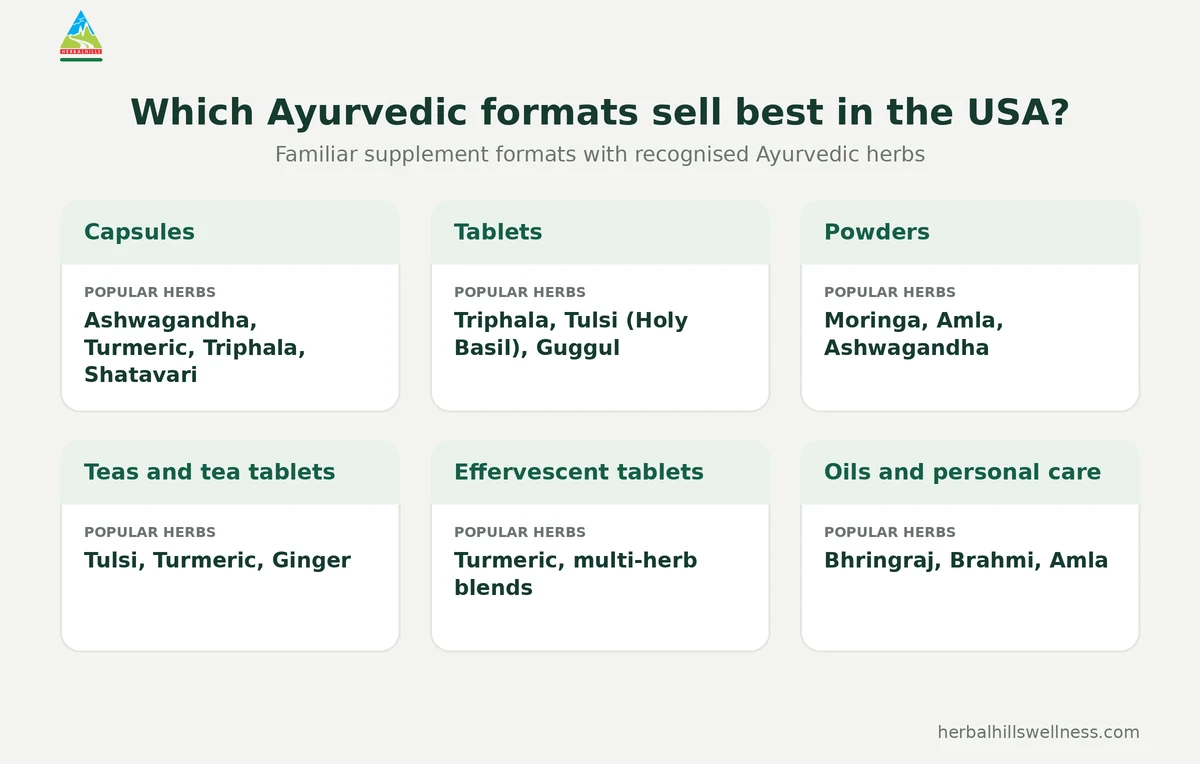
US consumers buy Ayurvedic herbs mainly in familiar supplement formats. Capsules and tablets dominate, while powders, teas and functional formats are growing.
| Format | Why It Works in the US | Popular Ayurvedic Herbs |
|---|---|---|
| Capsules | The most familiar supplement format; easy dosing and Amazon-friendly | Ashwagandha, Turmeric, Triphala, Shatavari |
| Tablets | Cost-efficient, stable, suits multi-herb formulas | Triphala, Tulsi (Holy Basil), Guggul |
| Powders | Smoothie and wellness-routine buyers | Moringa, Amla, Ashwagandha |
| Herbal teas and tea tablets | Ritual-based daily wellness | Tulsi, Turmeric, Ginger |
| Effervescent tablets | Convenient, on-the-go format with growing interest | Turmeric, multi-herb blends |
| Oils and personal care | Ayurvedic self-care and hair-oiling routines | Bhringraj, Brahmi, Amla |
Herbal Hills manufactures across these formats under one roof, so a US brand can launch a capsule line first and add powders, teas or effervescent products later with the same partner.
How Does Herbal Hills Support US Importers?
With certification, documentation and manufacturing handled by Herbal Hills, the US brand owner can concentrate on positioning, Amazon listings and marketing.
How Does the US Import Process Work with Herbal Hills?
💡Share Your Product Idea
Tell us your target channel (Amazon, retail, D2C) and formats.
🧪Choose Ready or Custom Formulations
Pick ready formulations or customise with the R&D team.
📦Receive Samples and the Document Pack
Free trial samples and the facility document pack (FDA registration, cGMP audit, certificates).
🏷️Finalise Labels and Claims
Finalise Supplement Facts labels and claims with your US regulatory adviser.
🏭Production and Batch Testing
Production, batch testing and a Certificate of Analysis for each batch.
🚢Export Dispatch
Dispatch with commercial and quality documents for US customs and your FSVP file.
Source Ayurvedic Supplements for the USA with Confidence
For a US importer, choosing the right dietary supplement contract manufacturer in India decides whether a product clears customs, gets listed on Amazon and earns repeat orders. Look for FDA registration, a third-party cGMP audit by an approved organization such as Eurofins, Indian export registrations and proven batch quality. According to Herbal Hills, importers who verify these four things before shortlisting a vendor spend their time on marketing, not on compliance problems.
Request the US Importer Document Pack & Free Samples →
Frequently Asked Questions
Can Ayurvedic products made in India be sold legally in the USA?
Yes. Ayurvedic products are usually sold in the US as dietary supplements. They must be made in an FDA-registered facility following dietary supplement cGMP (21 CFR 111), carry compliant Supplement Facts labels and avoid disease claims. The US importer also has verification duties under the FDA’s Foreign Supplier Verification Program.
Is Herbal Hills’ facility registered with the US FDA?
Yes. Herbal Hills manufactures in a facility registered with the US FDA in Lonavala, India, and shares registration details with US importers on request. FDA registration is required for foreign facilities supplying food and dietary supplements to the US, but it is not an FDA approval of individual products.
Why does Amazon require a Eurofins or similar audit?
Amazon verifies dietary supplements through approved third-party testing, inspection and certification organizations such as Eurofins, NSF and UL. These organizations confirm cGMP compliance and product testing. A manufacturer already audited by an approved organization makes it faster and less risky for a brand to list supplements on Amazon.
What is the difference between FDA registration and cGMP certification?
FDA registration means the facility is listed with the FDA as a supplier to the US market. A cGMP certificate, issued after a third-party audit against 21 CFR 111, shows the facility actually follows dietary supplement manufacturing practice. US importers and Amazon look for both before trusting a manufacturer.
Who is responsible for US labelling and claims?
The US brand owner or importer is responsible for the final Supplement Facts label and any structure-function claims, which must follow FDA rules and carry the required disclaimer. Herbal Hills supports label design and ingredient information, and we recommend a final review by your US regulatory adviser.
Do you test for heavy metals?
Yes. Heavy metal testing is part of Herbal Hills’ quality checks, and results can be included with the Certificate of Analysis. The full list of tests, including microbial and pesticide residue reports, is confirmed per product before the order so it meets your US retailer and Prop 65 needs.
Which Ayurvedic products sell best in the USA?
Capsules and tablets of well-known Ayurvedic herbs perform best, especially Ashwagandha, Turmeric, Triphala, Tulsi (Holy Basil) and Shatavari. Powders such as Moringa and Amla, herbal teas and effervescent tablets are growing. Herbal Hills manufactures all of these formats under one roof.
Do I need an AYUSH licence to sell Ayurvedic supplements in the USA?
No. An AYUSH licence governs Ayurvedic medicine manufacturing and sale in India. For the US market, what matters is that the manufacturer is FDA-registered and follows dietary supplement cGMP, and that the importer meets FDA labelling and FSVP requirements.