

Blog
Exporting Ayurvedic Products from India: A Private Label Guide for Exporters and Importers

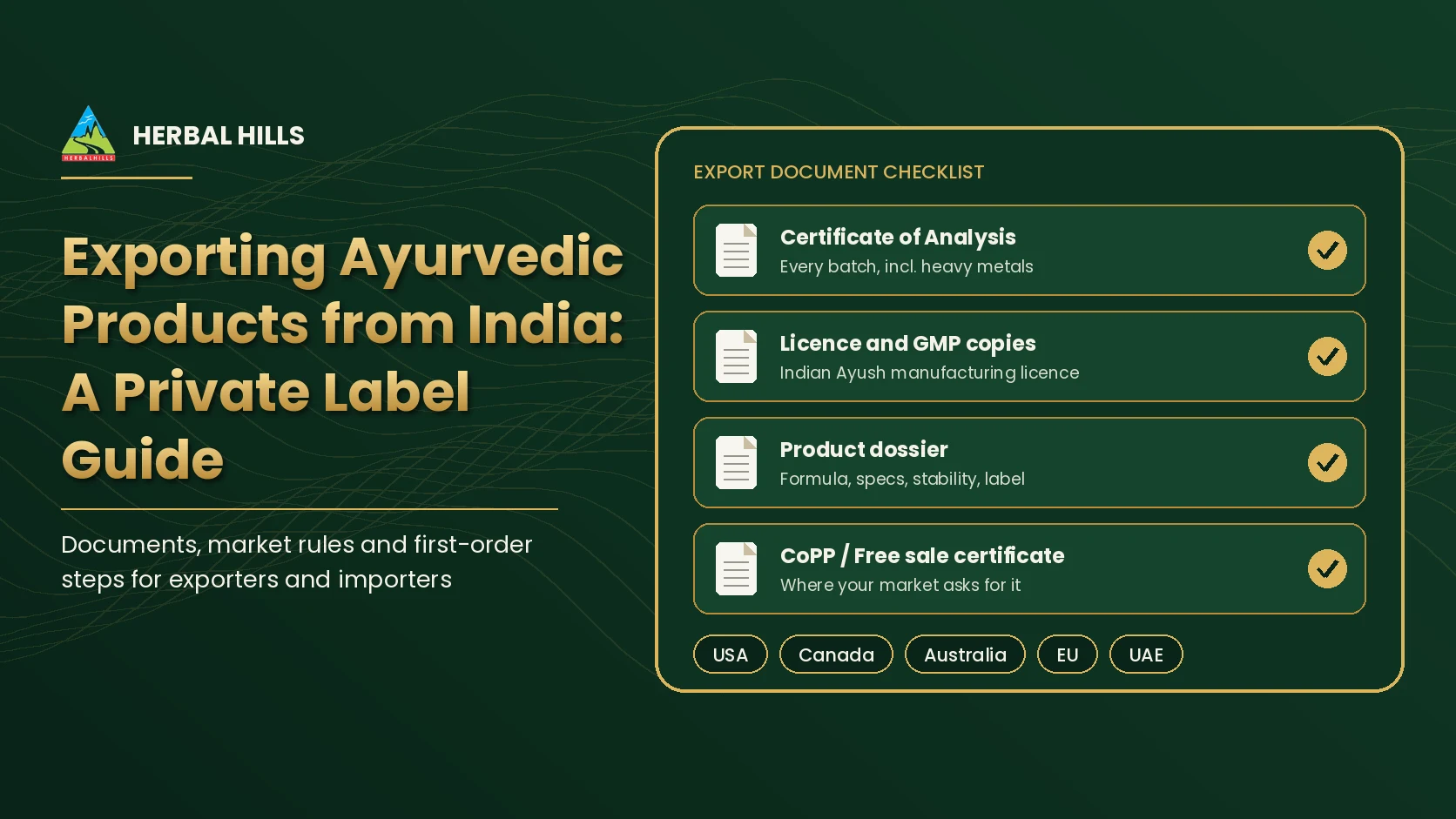
The manufacturer makes the product under its Indian Ayush licence and GMP, and supplies a Certificate of Analysis, licence copies and a product dossier. Depending on the market, you may also need a WHO-GMP Certificate of Pharmaceutical Product (CoPP), a free sale certificate or export registrations.
The destination country decides how your product is classified. The same Ashwagandha capsule can be a dietary supplement in the US, a natural health product needing a licence in Canada, a listed complementary medicine in Australia, or a herbal product needing marketing authorisation in the UAE.
Is There Demand for Ayurvedic Exports?
Yes, and it is growing steadily. India exported US$688.89 million of Ayush and herbal products in 2024-25, up 6.11% from US$649.2 million the year before, according to the Ministry of Commerce.
Government support for exporters is also increasing:
- The Ayush Export Promotion Council (AYUSHEXCIL) supports exporters and anchors the new Ayush Mark.
- The Ayush Premium Mark, launched in December 2025, is designed as a quality signal for international markets.
- The WHO Certificate of Pharmaceutical Product (CoPP), issued by the Central Drugs Standard Control Organization (CDSCO), has been extended to Ayurvedic, Siddha and Unani medicines to support exports.
- Traditional medicine now has dedicated annexes in India’s trade agreements with Oman (CEPA) and New Zealand (FTA).
For an importer or a brand selling abroad, this means more choice of Indian partners, and more ways to check which ones meet international standards.
Which Documents Should an Importer Ask the Manufacturer For?
Your importing authority, customs broker or marketplace will ask for some or all of these. Ask your manufacturer which it can supply before you place the order.
| Document | What it proves | Issued by |
|---|---|---|
| Certificate of Analysis (COA) | The batch meets its specification, including tests such as heavy metals and microbial limits where specified | The manufacturer’s QC laboratory, or an accredited external lab |
| Manufacturing licence copy | The product is made under a valid Indian Ayush manufacturing licence | State Licensing Authority |
| GMP certificate | The facility meets Schedule T Good Manufacturing Practice | State Licensing Authority |
| WHO-GMP Certificate of Pharmaceutical Product (CoPP) | A specific product is made under WHO-GMP and is authorised in India. Granted per product, valid three years or until the licence expires, whichever is sooner | CDSCO |
| Free sale certificate | The product is legally sold in India | State Licensing Authority |
| Product dossier | Formula, specifications, manufacturing process, stability data and label | The manufacturer |
| Export registrations | The exporter is registered with export bodies such as APEDA, FIEO or AYUSHEXCIL | The relevant council |
| Organic or Halal certificates | Claims such as organic or Halal can be printed and checked | Accredited certifying bodies |
Two cautions. First, a CoPP is granted per product, not per factory, so check that your specific product is covered. Second, stability data now matters more: under India’s 2026 rules, any shelf life beyond two years needs real-time stability data.
How Do Major Markets Classify Ayurvedic Products?
The destination country, not India, decides what your product is and what it may claim.
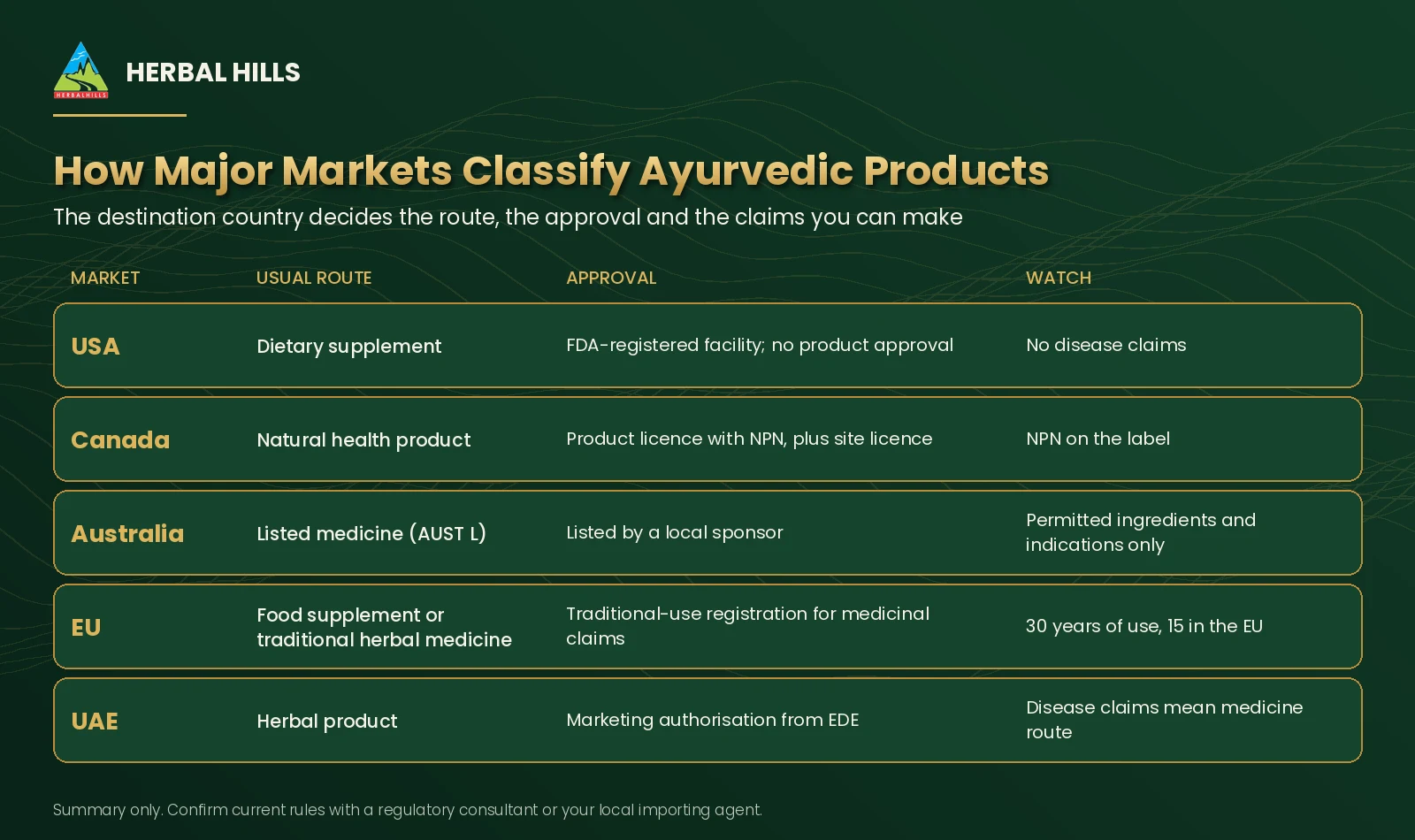
| Market | Usual route | Pre-market approval? | What to watch |
|---|---|---|---|
| United States | Dietary supplement | No product approval, but the facility must be registered with FDA | Structure/function claims only, never disease claims. FDA states there are no FDA-approved Ayurvedic products, and uses import alerts against products with lead, mercury or arsenic. See our US importer’s guide. |
| Canada | Natural health product (NHP) | Yes: product licence with an 8-digit Natural Product Number (NPN), plus site licensing | The NPN must appear on the label; claims must match the licence |
| Australia | Listed complementary medicine (AUST L) | Listed by a local sponsor, not individually evaluated | Only TGA-permitted ingredients and pre-worded permitted indications, including traditional Ayurvedic indications |
| European Union | Food supplement, or traditional herbal medicinal product | For medicinal claims, yes: traditional-use registration | Traditional-use registration needs at least 30 years of medicinal use, 15 of them in the EU. Most Ayurvedic products enter as food supplements with no medicinal claims |
| United Arab Emirates | Herbal product or health supplement | Yes: marketing authorisation from the Emirates Drug Establishment (EDE) for herbal products; manufacturer site registration may also apply | Disease claims push a product into the medicine route |
These routes change. Treat this table as a starting point, and confirm current requirements with a regulatory consultant or your local importing agent before you finalise a formula or label.
How Should You Plan the Product and Label for Export?
Most export problems start at the formulation and label stage, long before shipping. Five decisions matter most.
1. Choose herbal formulations over herbo-mineral ones
Classical herbo-mineral (Rasaushadhi) preparations contain processed metals and minerals. Many markets restrict them, and the US FDA has warned about heavy-metal poisoning linked to some imported Ayurvedic products. For a first export range, plant-based formulations are usually the safer choice.
2. Test for heavy metals on every batch
Ask for lead, mercury, arsenic and cadmium results on each batch’s Certificate of Analysis, against the limits of your destination market. Importers and marketplaces increasingly ask for this before they list a product.
3. Write claims for the destination market
A claim that is acceptable in India may be illegal abroad. In the US, dietary supplements may describe effects on normal body structure or function, but must not claim to treat or prevent disease. In Australia, listed medicines can only use pre-approved indications. Draft the label claims after you know the route, not before.
4. Plan the shelf life with evidence
Importers and marketplaces often set a minimum remaining shelf life on arrival. Under India’s 2026 rules, anything beyond two years needs real-time stability data, so confirm what your manufacturer can support before you agree a shelf life with your buyer.
5. Design labels for two systems
Your label must meet the destination’s rules (language, ingredient format, local licence numbers such as an NPN or AUST L) and India’s export labelling. Under the 2026 rules, Indian labels also move to a uniform Specific Product Code by mid-2028, so plan one artwork revision that covers both. Read more in our Ayurvedic manufacturing trends 2026 guide.
How Does a First Private Label Export Order Work?
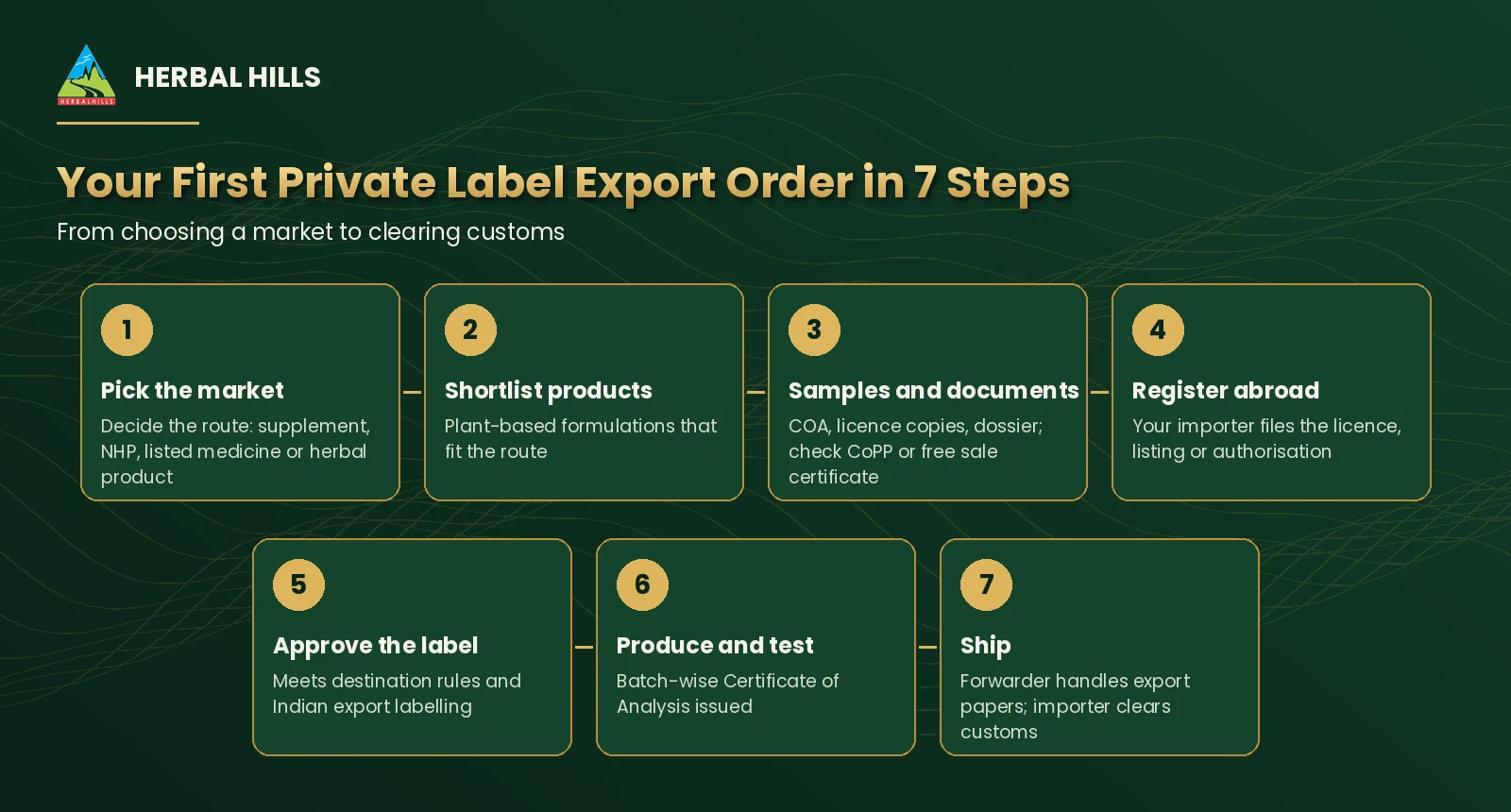
- Pick the market and route. Decide where you will sell and how the product will be classified there: supplement, natural health product, listed medicine or herbal product.
- Shortlist products. Choose formulations that suit that route, ideally plant-based products with a clear ingredient list.
- Request samples and documents. Ask for samples, a Certificate of Analysis, licence copies and the product dossier. Check whether a CoPP or free sale certificate is available for the products you want.
- Register in the destination market. Your importer or local agent files any product licence, listing or marketing authorisation, using the manufacturer’s dossier.
- Approve the label. Finalise artwork that meets both the destination rules and Indian export labelling.
- Produce and test. The manufacturer produces the batch and issues a batch-wise Certificate of Analysis.
- Ship. Your freight forwarder handles the export paperwork, and the importer clears customs with the product documents.
How Does Herbal Hills Support Exporters and Importers?
Herbal Hills manufactures Ayurvedic products from four units in Lonavala, Maharashtra, and has exported to more than 30 countries. For private label export brands, that experience shows up in five ways:
Read more about our export experience and our Ayurvedic third party manufacturing service.
Frequently Asked Questions
Can I export Ayurvedic products from India under my own brand?
Yes. Under private label manufacturing, a licensed Indian manufacturer produces the product under its own Ayush licence and GMP, and your brand appears on the label. You or your importer then handle registration in the destination country, using the manufacturer’s documents such as the Certificate of Analysis, licence copies and product dossier.
What is a CoPP for Ayurvedic products?
A Certificate of Pharmaceutical Product (CoPP) is a WHO-format certificate confirming that a specific product is made under WHO-GMP and authorised in India. For Ayurvedic products, CDSCO grants it per product. It is usually valid for three years or until the manufacturing licence expires, whichever comes first.
Are Ayurvedic products FDA approved in the US?
No. The US FDA states that there are no FDA-approved Ayurvedic products. Most are sold as dietary supplements, which do not need product approval but must come from an FDA-registered facility, carry compliant labels and make no disease claims. FDA uses import alerts against products with harmful heavy metals.
Do Ayurvedic products need a licence to be sold in Canada?
Yes. Health Canada regulates Ayurvedic medicines as natural health products. Each product needs a product licence before sale, and its eight-digit Natural Product Number (NPN) must appear on the label. Site licensing information is also required.
Which Ayurvedic products are easiest to export?
Plant-based formulations with clear ingredient lists are usually the easiest, especially in supplement-style formats such as capsules, tablets and powders. Herbo-mineral preparations face more restrictions in many markets. The final answer depends on the destination’s ingredient lists and claim rules.
Sources
- Ayush exports rise 6.11% to US$688.89 million in 2024-25 (IANS, citing the Ministry of Commerce)
- CoPP for Ayurvedic products under the WHO-GMP Certification Scheme (CDSCO)
- Ministry of Ayush on the Ayush Quality Mark and CoPP for ASU medicines, July 2026
- FDA warning on heavy metals in certain unapproved Ayurvedic products
- Natural health product licensing (Health Canada)
- About listed medicines (TGA, Australia)
- Herbal medicinal products and traditional-use registration (European Medicines Agency)
- Registration of a manufacturer of medical products (UAE Ministry of Health and Prevention)