

Blog
Stress, Sleep & Calm Support: Ayurvedic Formulations for the Modern Wellness Market

Stress used to be something people talked about after a bad week. Today it is a daily condition for millions of working people, and it now has a new source: the fear that artificial intelligence will change or replace their jobs. At the same time, customers are looking for calmer days and better sleep without relying only on prescription medicines.
This guide looks at the scale of the mental wellness challenge, explains how Ayurveda approaches stress and the mind, shows why medicated ghee is a natural fit for this category, and explains how brands can enter the market with ready formulations from Herbal Hills.
How Big Is the Global Mental Health and Stress Challenge?
The numbers are large and still rising. The World Health Organization’s latest data, released in September 2025, shows that more than 1 billion people, roughly 1 in 7, live with a mental disorder, with anxiety and depression the most common. Depression and anxiety among people aged 15 to 29 have increased, and only 9% of people with depression receive adequate treatment.
| Indicator | Figure | Source |
|---|---|---|
| People living with a mental disorder | More than 1 billion (about 1 in 7 people) | WHO, World Mental Health Today, 2025 |
| Annual productivity lost to depression and anxiety | About US$1 trillion | WHO, 2025 |
| Workdays lost each year to depression and anxiety | About 12 billion | WHO and ILO, 2022 |
| Rise in depression and anxiety in the first year of COVID-19 | About 28% and 26% | WHO, World Mental Health Report, 2022 |
| People with depression receiving adequate treatment | 9% | WHO, 2025 |
| Indian employees reporting at least one mental health symptom | About 80% | Deloitte India survey of 3,995 employees, 2022 |
| Annual cost of poor employee mental health to Indian employers | About US$14 billion (Rs 1.1 lakh crore) | Deloitte India, 2022 |
Why is workplace stress rising in the age of AI?
Work has always been a source of stress, but AI has added a new kind of worry: job security. In the American Psychological Association’s 2023 Work in America survey of 2,515 employees, 38% said they were worried AI could make some or all of their job duties obsolete. Among those worried workers, 64% said they felt tense or stressed during the workday, compared with 38% of workers who were not worried about AI. APA’s 2025 survey again linked technology, economic change and job insecurity to higher stress.
In India, the Deloitte survey found that among employees reporting poor mental health, 47% named work-related stress as the biggest factor. Sleep problems, emotional exhaustion and irritability were among the most common symptoms reported. As AI reshapes more roles, many employers and researchers expect pressure on working people to stay high.
Mental Health vs Mental Wellness: Where Do Wellness Brands Fit?
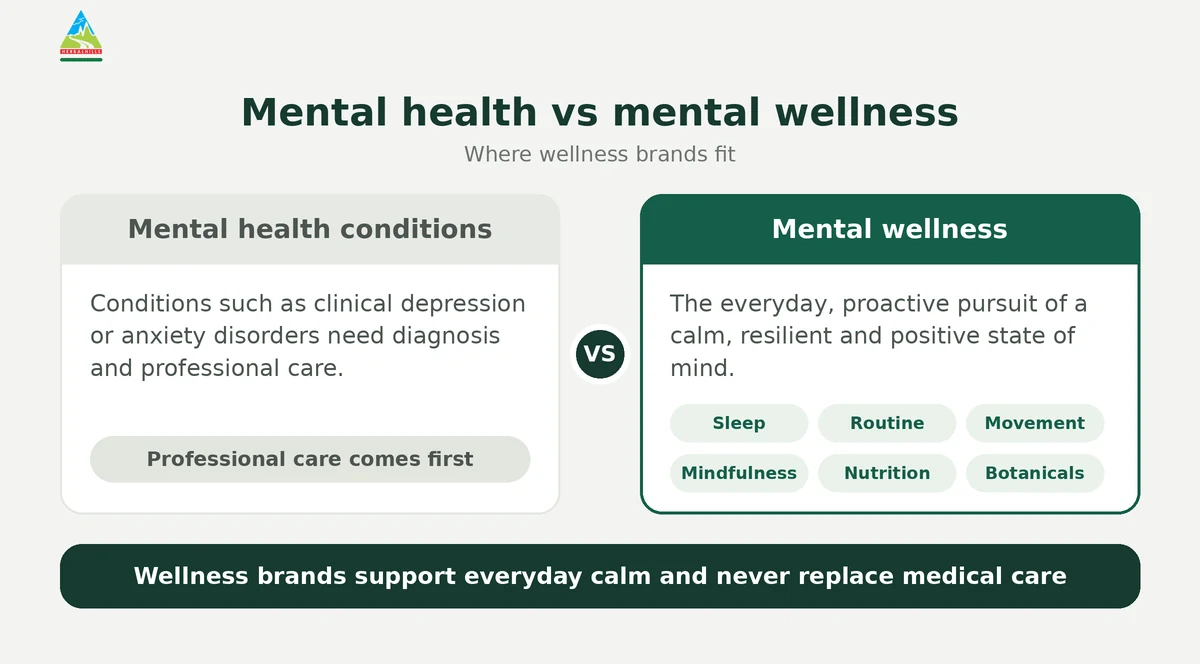
Mental health conditions such as clinical depression or anxiety disorders need diagnosis and professional care. Mental wellness is different. The Global Wellness Institute defines it as the everyday, proactive pursuit of a calm, resilient and positive state of mind, through sleep, routine, movement, mindfulness, nutrition and botanicals.
This is a fast-growing consumer market. The Global Wellness Institute valued the mental wellness economy at US$181 billion in 2022, growing about 11.5% a year since 2019, and projects it to reach about US$330 billion by 2027. When it first sized the market in 2020, brain-boosting nutraceuticals and botanicals alone accounted for US$34.8 billion of consumer spending.
Ayurveda for Mental Health: How Does Ayurveda Approach Stress?
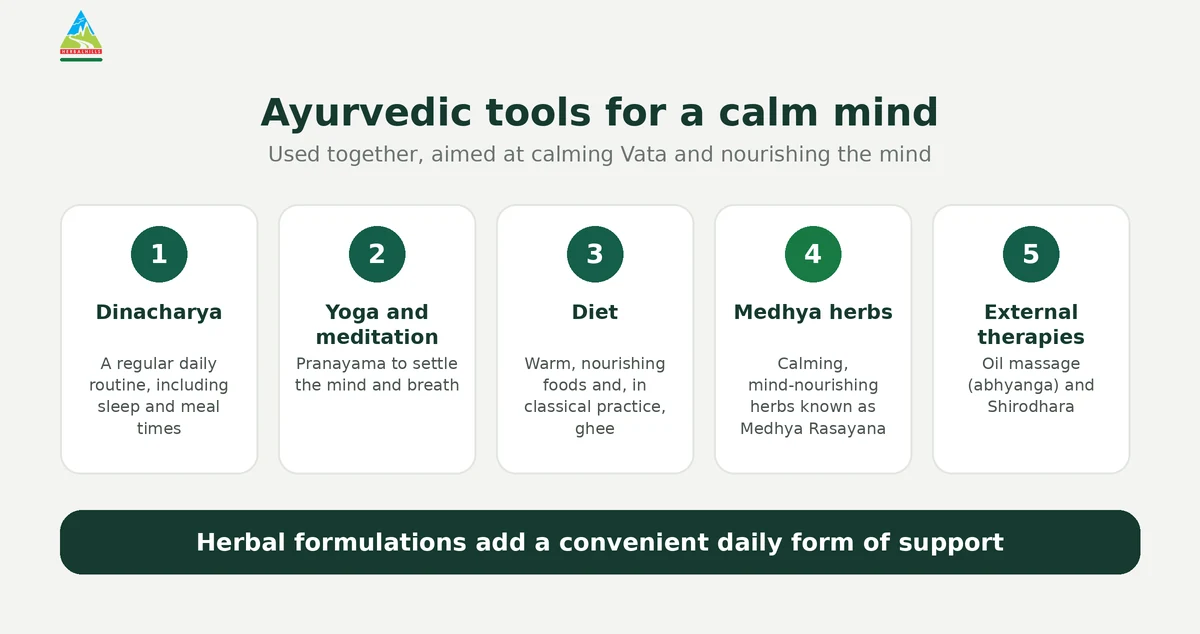
Ayurveda for mental health starts from the idea that mind and body are one system. Classical texts describe the mind (manas) as influenced by three qualities, sattva (clarity), rajas (activity and agitation) and tamas (heaviness and dullness), and link restlessness, worry and poor sleep to an aggravated Vata dosha. The aim of Ayurvedic stress management is to calm Vata, reduce excess rajas and nourish the mind.
Ayurveda does this through several tools used together:
Yoga and meditation are excellent foundations. Herbal formulations add a convenient, daily form of support that fits easily into a busy working day, which is why they are the commercial heart of the Ayurvedic mental wellness category.
What is Medhya Rasayana?
Medhya Rasayana is a group of Ayurvedic herbs described for nourishing the mind (medha means intellect). The Charaka Samhita names four: Mandukaparni, Yashtimadhu, Guduchi and Shankhapushpi. Classical and later texts add herbs such as Brahmi, Jyotishmati and Vacha. These herbs are traditionally used to support memory, focus and a calm, steady mind.
Which Calming Herbs Does Ayurveda Use?
Several Ayurvedic herbs have been used for centuries to support a calm mind and restful sleep, and some now have a growing body of modern research.
| Herb | Traditional Role in Ayurveda | Research Note |
|---|---|---|
| Ashwagandha (Withania somnifera) | Rasayana and adaptogen; supports strength, calm and sleep | Several meta-analyses of randomised controlled trials report lower perceived stress and cortisol versus placebo |
| Brahmi (Bacopa monnieri) | Medhya herb for memory, focus and calm | Studied in controlled trials for memory and attention in healthy adults |
| Shankhapushpi (Convolvulus pluricaulis) | Medhya Rasayana; calming, supports sleep | Mostly traditional and preclinical evidence |
| Jatamansi (Nardostachys jatamansi) | Calming herb traditionally used for restful sleep | Mostly traditional and preclinical evidence |
| Mandukaparni (Centella asiatica) | Medhya Rasayana; supports mental clarity | Some early human studies |
| Tagara (Valeriana wallichii) | Traditionally used for relaxation and sleep | Related valerian species widely studied for sleep |
| Jyotishmati and Vacha | Medhya herbs for memory and alertness | Mostly traditional evidence |
Research notes summarise the general state of evidence for each herb and are not claims about any finished product.
One meta-analysis published in BJPsych Open in 2025 pooled randomised trials and found that Ashwagandha supplementation reduced anxiety scores, perceived stress and cortisol compared with placebo at eight weeks. That kind of evidence is one reason Ashwagandha has become one of the most searched and best-selling herbs worldwide.
Why Ghee? Stress, the Nervous System and Medicated Ghee
Stress is not only a feeling. It is a response of the nervous system and stress hormones, and Ayurveda has long paired calming herbs with a carrier believed to nourish the mind: ghee. Classical texts describe cow ghee as medhya, good for the intellect and memory, and as yogavahi, a carrier that takes on and delivers the properties of the herbs processed in it.
That is why many classical mind-support formulations are ghritas, medicated ghees. Brahmi Ghrita, Kalyanaka Ghrita and Panchagavya Ghrita are among the best known. From a formulation point of view, ghee also dissolves fat-soluble plant constituents that a water extract cannot carry.
What is Brahmi Ghrita?
Brahmi Ghrita is a classical Ayurvedic medicated ghee prepared by slowly cooking cow ghee with Brahmi and other mind-supporting herbs such as Vacha, Kushtha and Shankhapushpi, until the herbs’ constituents pass into the ghee. It is traditionally used to support memory, clarity and a calm mind.
Medicated ghee has one practical problem: taken by the spoon, it is hard to measure, strong-tasting and inconvenient for working people. Herbal Hills solves this by filling ghrita into soft gel capsules, so a classical mind-support preparation becomes a measured, taste-free daily capsule. Read more in our guide to ghrita as a formulation base.
What Calm and Mind-Support Formulations Does Herbal Hills Offer?
Herbal Hills makes its ghrita from ghee produced on its own Gir cow farm, prepares Siddha Ghrita by the classical method at its facility in Lonavala, Maharashtra, and fills it into soft gels in-house. Its R&D team, including MD (Ayurveda) doctors, has developed ready calm and mind-support formulations that brands can launch under their own label.
| Product | Format | Focus Area |
|---|---|---|
| Calm Plus Soft Gelatin Capsule | Ghrita soft gel, 30 count | Stress management |
| Calm FP Capsule | FP capsule, 60 count | Stress management |
| Smruti Plus Soft Gelatin Capsule | Ghrita soft gel, 30 count | Memory and mental clarity |
| Smruti FP Capsule | FP capsule, 60 count | Memory and mental clarity |
The herb list for each formulation, and any herbal tea or sleep-support options, are shared by the Herbal Hills team when you request the catalogue.
Why Is Mental Wellness a Golden Opportunity for Brands?
Demand is rising, the category is still young, and few competitors offer anything beyond a basic Ashwagandha capsule. A brand that launches a well-made calm range now, especially one built on a classical medicated ghee base, can stand out before the market fills up.
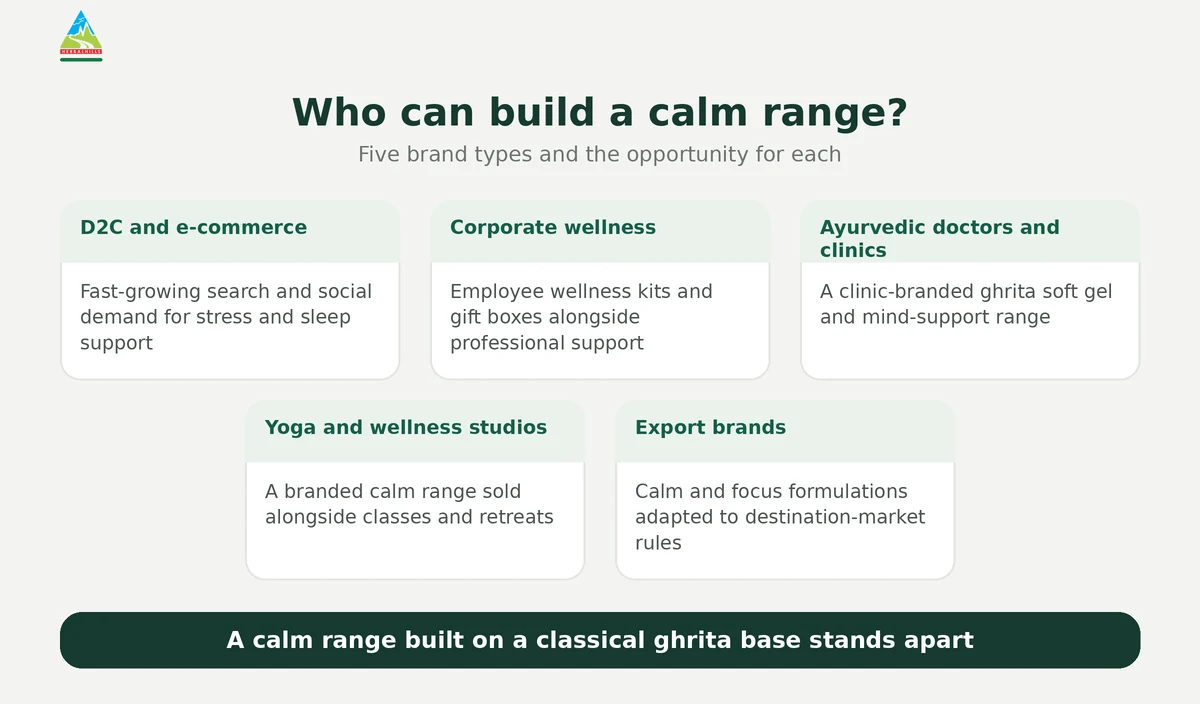
| Brand Type | Opportunity | Product Ideas |
|---|---|---|
| D2C and e-commerce brands | Fast-growing search and social demand for stress and sleep support | Calm soft gel, night-time herbal tea, Ashwagandha-based daily capsule |
| Corporate wellness providers | Employers investing in employee well-being | Employee wellness kits, festive and onboarding gift boxes, desk-side herbal teas |
| Ayurvedic doctors and clinics | Patients asking for everyday stress support | Clinic-branded ghrita soft gel and mind-support range |
| Yoga, meditation and wellness studios | Customers already focused on calm and mindfulness | A branded calm range sold alongside classes and retreats |
| Export brands | Global interest in Ayurvedic adaptogens | Calm and focus formulations adapted to destination-market rules |
How can corporate wellness programmes use Ayurvedic calm formulations?
Corporate wellness programmes already offer counselling, mindfulness sessions and fitness benefits. A private label calm range adds something employees can take home: a branded wellness kit with a calm soft gel, a relaxation tea and a simple daily-routine guide. For a wellness provider, it is a recurring product line. For an employer, it is a visible, practical gesture of care that sits alongside professional support, not in place of it.
How Should a Brand Position a Calm-Support Product Responsibly?
This category sits close to medical conditions, so wording matters. Ayurvedic products in India fall under the Drugs and Cosmetics Act and the Drugs and Magic Remedies (Objectionable Advertisements) Act, and buyers in export markets apply their own rules. Position products for everyday stress, calm and sleep support, and always remind customers that herbal support does not replace professional care for a diagnosed condition.
Wellness language
“Supports a calm mind and everyday stress management”, “supports restful sleep”, “made with Brahmi and Shankhapushpi, traditional Medhya herbs”, “prepared in cow ghee by the classical Siddha Ghrita method”.
Medical claims
“Treats anxiety or depression”, “cures insomnia”, “a replacement for your medication”, “clinically proven to reduce stress”, “works for everyone, guaranteed”.
Ingredient rules also differ by country. Some export markets have restricted certain herbs in food supplements, so check the destination market’s rules for every ingredient before you commit to a formula.
How to Launch a Calm and Sleep Range With Herbal Hills
🌿Choose Your Formulations
Pick from the ready calm, mind-support and herbal tea ranges.
🧴Request Free Trial Samples
Check format, taste and packaging before you commit.
🎯Decide Your Positioning
D2C, corporate wellness, clinic or export.
🏷️Design Label and Packaging
Herbal Hills reviews claims for compliance.
📦Place Your Order
From about 50 pieces on selected QuickLabel products, or 500 units per SKU for ready ghrita soft gels.
🚀Launch and Expand
Add more products to build a complete calm and sleep range.
Bring Calm to a Stressed-Out Market
The world is more stressed than ever, and AI is adding a new layer of worry for working people. Customers want everyday ways to feel calmer and sleep better, and Ayurveda offers a trusted answer: Medhya herbs, a daily routine and classical medicated ghee. Herbal Hills turns that tradition into ready formulations, with ghee from its own Gir cow farm, Siddha Ghrita soft gels and in-house R&D. According to Herbal Hills, brands that build a calm range on a classical ghrita base stand apart from the many single-herb capsules already on the market.
Explore Calm and Mind-Support Formulations →
Frequently Asked Questions
How does Ayurveda support mental health?
Ayurveda for mental health focuses on everyday mental wellness through a daily routine, yoga, meditation, a nourishing diet and calming herbs known as Medhya Rasayana. It aims to calm Vata and settle a restless mind. Herbal support is for everyday wellness and does not replace professional care for a diagnosed condition.
What are Medhya Rasayana herbs?
Medhya Rasayana herbs are Ayurvedic herbs traditionally used to nourish the mind. The Charaka Samhita names Mandukaparni, Yashtimadhu, Guduchi and Shankhapushpi, and later texts add herbs such as Brahmi, Jyotishmati and Vacha for memory, focus and calm.
Which Ayurvedic herbs are used for stress?
Ashwagandha, Brahmi, Shankhapushpi, Jatamansi, Mandukaparni and Tagara are among the herbs most often used in Ayurveda for stress and calm. Ashwagandha has the strongest modern research, with several meta-analyses reporting lower perceived stress and cortisol than placebo.
Why is ghee used in Ayurvedic mind-support formulations?
Classical texts describe cow ghee as good for the intellect and as a carrier that delivers the properties of the herbs cooked in it. Ghee also dissolves fat-soluble plant constituents. That is why classical preparations such as Brahmi Ghrita are made with ghee.
What is Brahmi Ghrita used for?
Brahmi Ghrita is a classical Ayurvedic medicated ghee made with Brahmi and other mind-supporting herbs. It is traditionally used to support memory, clarity and a calm mind. Herbal Hills fills ghrita into soft gel capsules for easier daily use.
Can I launch an Ayurvedic stress-support product under my own brand?
Yes. Herbal Hills offers ready calm and mind-support formulations, including medicated ghee soft gels, that you can launch under your own label and packaging, with free trial samples before you order.
Is there demand for Ayurvedic sleep and stress products?
Yes. The Global Wellness Institute valued the mental wellness economy at US$181 billion in 2022 and expects it to reach about US$330 billion by 2027. Demand for stress and sleep support is growing across D2C, corporate wellness and export markets.
What claims can I make for a calm-support Ayurvedic product?
Use wellness wording such as “supports a calm mind” or “supports restful sleep”. Do not claim to treat anxiety, depression or insomnia, and do not call a product clinically proven. Herbal Hills reviews label and marketing wording for compliance.