

Blog
How Formula Customization Works: Modifying an Existing Ayurvedic Formulation Step by Step

Most brands that launch with ready private label products eventually want something only they can sell. The obvious answer, developing a brand-new formulation from scratch, is slow, expensive and uncertain. There is a better middle path: start from a formulation that already works in production and make it your own.
This guide explains the difference between an existing and a customized formulation, why customization is worth it, why starting from an existing base reduces risk, and exactly what happens at each step when you customize a formula with Herbal Hills. Think of it as a practical guide to Ayurvedic formulation development for brands that want results without starting from zero.
What Is the Difference Between an Existing and a Customized Formulation?
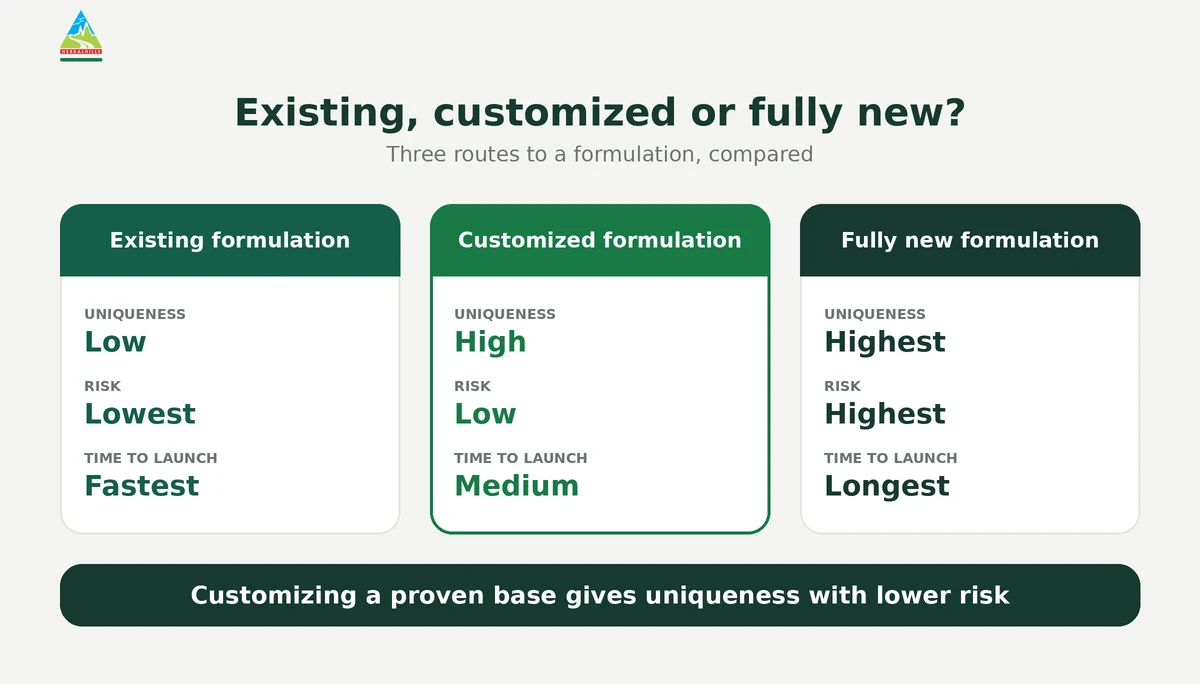
An existing formulation is a ready product that Herbal Hills already manufactures and holds a licence for. You can launch it under your own label exactly as it is, which is the fastest route to market. A customized formulation starts from that existing base and is changed in a defined way, so the result is a new formula with its own identity.
Under India’s Drugs and Cosmetics Act, a new formula built from ingredients in the authoritative Ayurvedic texts, but not itself described in those texts, is an Ayurvedic proprietary medicine. That is what a customized formulation becomes: a new proprietary product that needs its own licence.
| Route | What You Get | Uniqueness | Risk | Time to Launch | Development Effort |
|---|---|---|---|---|---|
| Existing (ready) formulation | A Herbal Hills formula under your label | Low: other brands may sell the same formula | Lowest | Fastest: stock in about 7 working days on selected QuickLabel™ products | None |
| Customized formulation | An existing base modified to your brief | High: a new proprietary formula | Low: built on a known base | Medium | Moderate, shared with R&D |
| Fully new formulation | A formula developed from a blank page | Highest | Highest: everything is new | Longest | High |
If you are still deciding between ready and custom products, read our guide to ready Ayurvedic formulations your brand can customize, which also explains classical vs proprietary medicines.
Why Should a Brand Customize Its Formulation?
Customizing a formulation turns a product you resell into a product that belongs to your brand. The benefits build over time:
Uniqueness
No other brand sells the identical formula, so customers cannot compare you like for like.
Your Own Proprietary Product
A new Ayurvedic proprietary medicine, sold under your product name.
A Long-Term Brand Asset
A formula you can build a whole range, story and reputation around.
Room to Price on Value
Without an identical cheaper product on the shelf, your MRP can reflect your positioning.
A Clear Story
You can explain what was added and why, which customers and practitioners value.
Harder to Copy
Competitors cannot simply order the same formula from the same catalogue.
Why Start Ayurvedic Formulation Development From an Existing Formula?
A brand-new formulation carries many unknowns: will the herbs work well together, will the product stay stable, can it be made consistently at scale, and will it pass licensing? Customizing an existing formula removes most of those questions, because the base has already answered them in real production.
| Question | Fully New Formulation | Customizing an Existing Formulation |
|---|---|---|
| Does the base combination work in production? | Unknown | Known: already manufactured at scale |
| Stability and shelf life | Unknown until tested | Known for the base; only the change needs checking |
| Safety and use history | Has to be built | Established for the base formula |
| Evidence | Starts from zero | Some bases have clinical studies (see the Herbal Hills clinical research page) |
| Development cost | Highest | Lower: fewer variables to test |
| Chance of failure | Highest | Much lower |
What Can Be Changed in an Existing Ayurvedic Formulation?
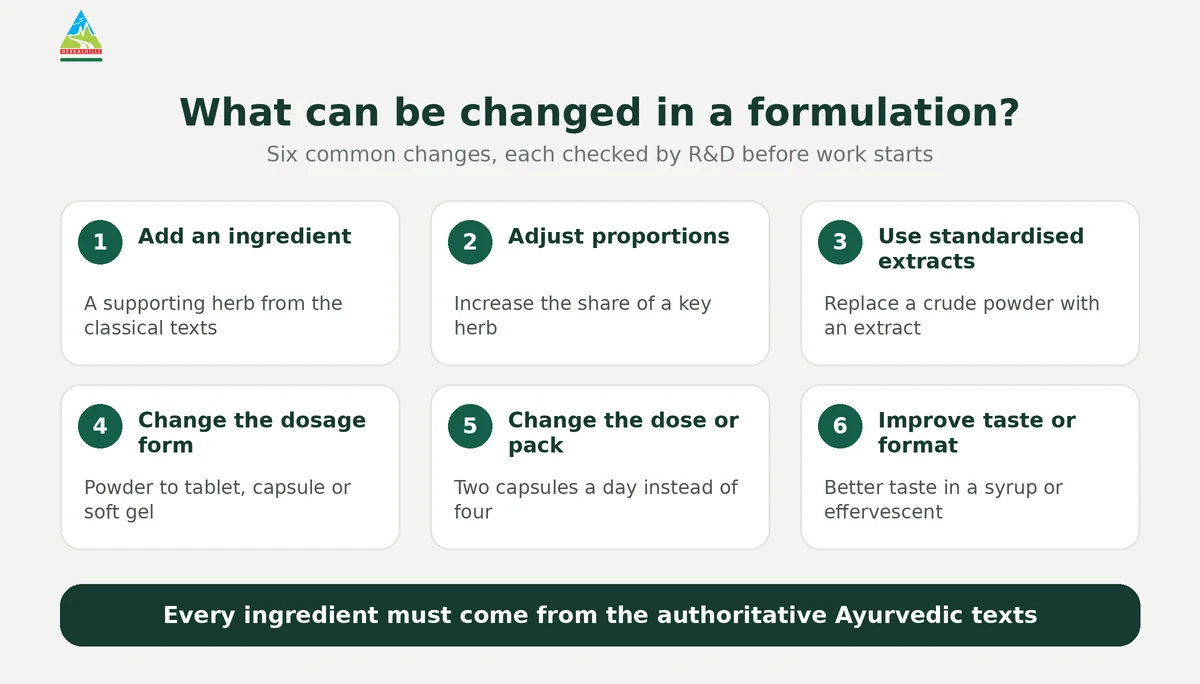
Customization can be small or substantial. The most common changes are:
| Type of Change | Example | What R&D Checks |
|---|---|---|
| Add an ingredient | Add a supporting herb from the classical texts | Compatibility, classical rationale, dose |
| Adjust proportions | Increase the share of a key herb | Balance of the formula, stability |
| Use standardised extracts | Replace a crude powder with a standardised extract | Consistency, equivalence, cost |
| Change the dosage form | Move from powder to tablet, capsule or soft gel | Manufacturability, dose per unit |
| Change the dose or pack | Two capsules a day instead of four | Strength per unit, label directions |
| Improve taste or format | Better taste in a syrup or effervescent tablet | Excipients, stability |
There are limits. For an Ayurvedic proprietary medicine, every ingredient must be one mentioned in the authoritative Ayurvedic books listed in the First Schedule of the Drugs and Cosmetics Act. Some ingredients also trigger extra safety-study requirements under Rule 158-B. Herbal Hills’ R&D team checks every proposed change against these rules before any work starts.
How Does Formula Customization Work at Herbal Hills? Step by Step
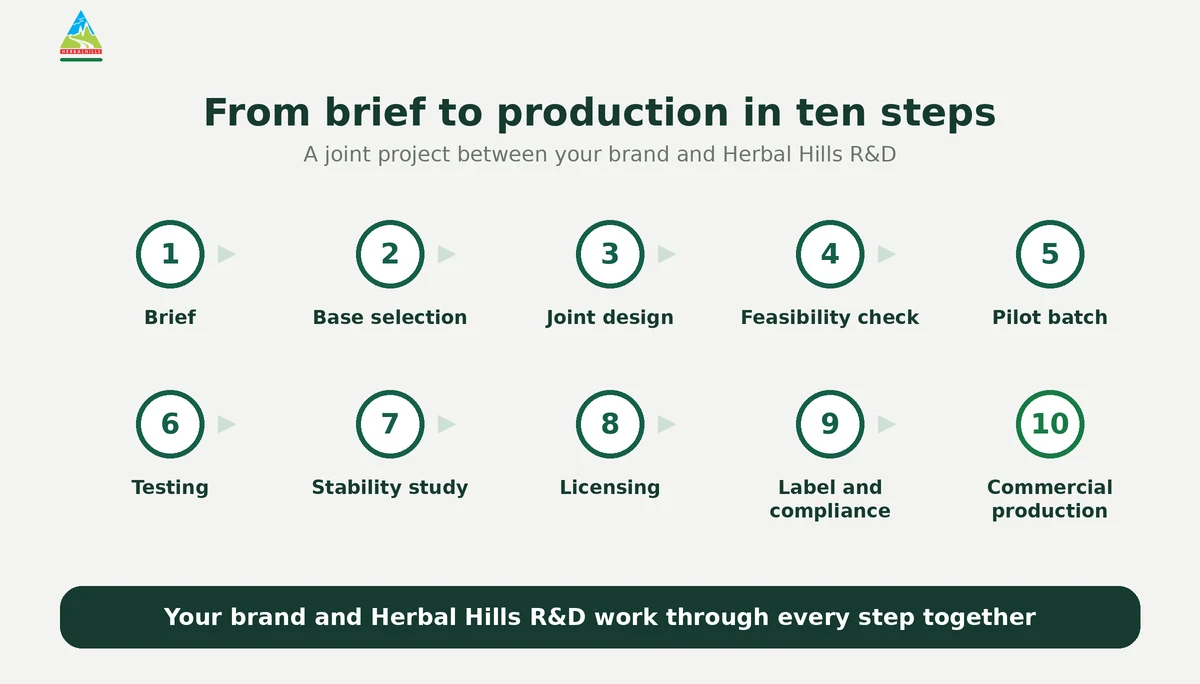
Customization at Herbal Hills is a joint project. You bring your brand, your customers and any ingredient preferences. The R&D team, including MD (Ayurveda) doctors, brings formulation experience, classical references and manufacturing knowledge. Here is how the process runs.
📝Brief
You share your target customer, wellness area, positioning, preferred format, price point and any ingredients you want to include.
🧭Base Selection
R&D recommends one or more existing Herbal Hills formulations that fit your brief, including bases with clinical studies where available.
🤝Joint Formula Design
You and R&D agree the changes. You can propose ingredients, and R&D can suggest additions that strengthen the formula’s intended role, each backed by a classical rationale.
🔍Feasibility Check
R&D confirms every ingredient is permitted, compatible and available, and flags anything that would need extra safety data.
⚗️Pilot Batch
A small batch is made to the new formula to check the process, appearance, taste and consistency.
🧪Testing
The pilot product is tested against its specification, including identity, physical parameters and microbial limits.
📆Stability Study
Samples are stored under defined conditions to confirm shelf life before scale-up.
📜Licensing
Herbal Hills prepares the application for the new proprietary formulation with the State Licensing Authority, including evidence of effectiveness and stability data.
🏷️Label and Compliance
Product name, label text and claims are reviewed against the Drugs and Cosmetics Act and the Drugs and Magic Remedies Act.
🏭Commercial Production
Once the licence is granted, the first full batch is produced under GMP and released with a Certificate of Analysis.
What is a pilot batch?
A pilot batch is a small production run made to the new formula before full-scale manufacturing. It shows whether the formula can be made consistently on real equipment, how it looks, tastes and behaves, and provides the samples needed for testing and stability studies. Problems found at pilot stage are cheap to fix; problems found after a full batch are not.
What is a stability study?
A stability study checks that a product keeps its quality over time. Samples are stored under controlled temperature and humidity and tested at set intervals. Accelerated studies at higher temperature give an early indication; real-time studies confirm the shelf life printed on the label. Stability data is also part of the licensing file for a new proprietary formulation.
How Long Does Customization Take and What Does It Cost?
The timeline depends on the change you choose and the dosage form. Herbal Hills gives you a project timeline after the brief. This table shows who leads each stage.
| Stage | What Happens | Who Leads |
|---|---|---|
| Brief, base selection and formula design | Agree the target customer, the base and the changes | Brand + R&D |
| Pilot batch and testing | Make a small batch and test it against the specification | R&D + QC |
| Stability study | Store samples under defined conditions to confirm shelf life | QC |
| Licensing | Application to the State Licensing Authority | Regulatory |
| Label review and first production | Compliance check, then the first full batch | Regulatory + Production |
Development cost and minimum order for a customized formulation depend on the changes and the dosage form, and are confirmed per project after the brief. As a rule, customized products need a larger minimum order than ready QuickLabel™ products, because each one needs its own dedicated batch.
Who Owns a Customized Formulation?
Ownership and exclusivity of a customized formulation are agreed in writing before development starts. Ask for the written terms to cover who owns the formula, whether it is exclusive to your brand, for how long and in which markets, whose name the licence is held in, and what happens if you later move production elsewhere.
Whatever the ownership terms, your brand name, packaging and trademark are always yours. Register your product name as a trademark early, before you invest in the launch.
Who Does What in a Customization Project?
Your Brand
- Defines the target customer, positioning and price
- Shares ingredient preferences
- Approves the final formula and samples
- Chooses the product name and registers the trademark
- Provides label artwork and marketing
Herbal Hills
- Recommends base formulations and suggests improvements
- Checks every ingredient for permission, compatibility and availability
- Makes pilot batches, runs tests and stability studies
- Prepares the licence application and supporting documents
- Reviews label claims for compliance and manufactures under GMP
Questions to Ask Before You Customize a Formulation
- Which existing formulation is the best base for my brief, and does it have any study data?
- What exactly will change, and what is the classical rationale for each change?
- Are all the ingredients permitted for an Ayurvedic proprietary medicine?
- Will the change need extra safety data under Rule 158-B?
- How long will the pilot batch, stability study and licence take?
- What is the minimum order and are there development charges?
- Who owns the formula, and is it exclusive to my brand?
- What claims will I legally be able to make on the label?
Make a Proven Formula Your Own
Formula customization gives your brand the uniqueness of a new proprietary product without the cost and uncertainty of starting from nothing. You begin with a formulation that is already made at scale, work with an R&D team that knows it inside out, and change only what makes it yours. According to Herbal Hills, customizing a proven base is the lowest-risk route to Ayurvedic formulation development for a growing brand that wants to own its formulations. With more than 25 years of GMP and ISO-certified manufacturing, 300+ research-based formulations and in-house MD (Ayurveda) R&D in Lonavala, Maharashtra, Herbal Hills runs every step of the process with you.
Start Your Custom Formulation →
Frequently Asked Questions
What is Ayurvedic formula customization?
Ayurvedic formula customization means modifying an existing formulation, by adding an ingredient, adjusting proportions, using standardised extracts or changing the dosage form, to create a new proprietary formulation for a brand. It is faster and lower-risk than developing a completely new formula.
What is the difference between an existing and a customized formulation?
An existing formulation is a ready product launched under your label as it is. A customized formulation starts from that base and is changed to your brief, so it becomes a new Ayurvedic proprietary medicine that only your brand sells.
Why is customizing an existing formula less risky than creating a new one?
The base formula has already been made at scale, so its manufacturing process, stability and safety history are known. Only the changes need to be developed and tested, which makes the project shorter, cheaper and more predictable.
Do clinical study results for the base formula apply to my customized version?
Not automatically. A customized formula is a new product. You can say it is built on a studied base, but any claim about the customized product itself needs its own evidence. Herbal Hills advises on what can be said.
Can I choose which ingredients are added?
Yes. You can propose ingredients, and the R&D team can suggest additions too. Every ingredient must be mentioned in the authoritative Ayurvedic texts, compatible with the base and available consistently, and R&D checks each one before work starts.
Does a customized formulation need a new licence?
Yes. A customized formula is a new Ayurvedic proprietary medicine and needs its own manufacturing licence from the State Licensing Authority, supported by evidence of effectiveness and stability data. Herbal Hills prepares the application.
How long does formula customization take?
It depends on the change and the dosage form. Brief and formula design take a few weeks; pilot batches, testing, stability and licensing take longer. Herbal Hills gives a project timeline after the brief.
Who owns a customized Ayurvedic formulation?
Ownership and exclusivity are agreed in writing before development starts, so ask for the written terms at the briefing stage. Your brand name, packaging and trademark always belong to you.