

Blog
Third-Party Manufacturing vs. Contract Manufacturing vs. Loan Licensing vs. Private Label — What’s the Real Difference?

If you are planning to launch an Ayurvedic brand, you will hear all four terms in your first week of research, often used as if they were interchangeable. They are not, and mixing them up leads to the wrong questions: who holds the licence, who owns the formula, whose name is on the label and who answers to the regulator.
This guide separates the terms in plain language, compares them side by side and shows how to choose. It is general information, not legal advice; licensing procedures differ between states, so confirm the details with your State Licensing Authority before you act.
Why Are These Four Terms So Confusing?
They answer different questions. Two questions matter most when you outsource manufacturing:
The Legal Question
Whose licence covers the manufacturing: yours, or the manufacturer’s? This is where loan licensing sits.
The Commercial Question
Who makes the product, and under what agreement? This is where third-party and contract manufacturing sit.
The Brand Question
Is the product the manufacturer’s existing formula with your label, or something made to your own brief? This is where private label sits.
Under India’s Drugs and Cosmetics Rules, an Ayurvedic drug can be manufactured for sale only under a manufacturing licence or a loan licence. “Third-party manufacturing”, “contract manufacturing” and “private label” are not separate licence categories, they are ways of describing a business arrangement.
What Is Loan Licensing?
A loan licence is a licence that the licensing authority may issue to an applicant who does not have their own manufacturing arrangements but wants to use the facilities of a licensed manufacturer. For Ayurvedic, Siddha and Unani drugs, the application is made on Form 24-E under Rule 153A, and the Delhi Drug Control Cell lists it alongside Form 24-D (own manufacturing licence) and Form 24-E-I (GMP certificate).
In practice, this means you hold a licence in your own name, your product is made at a partner’s GMP-compliant premises, and you are treated as the manufacturer in the eyes of the law. Indian pharmaceutical export guidance notes that a loan licensee is treated at par with a manufacturer that has its own unit. That gives you more regulatory control, but also the compliance responsibilities that come with holding a licence.
What Are Third-Party and Contract Manufacturing?
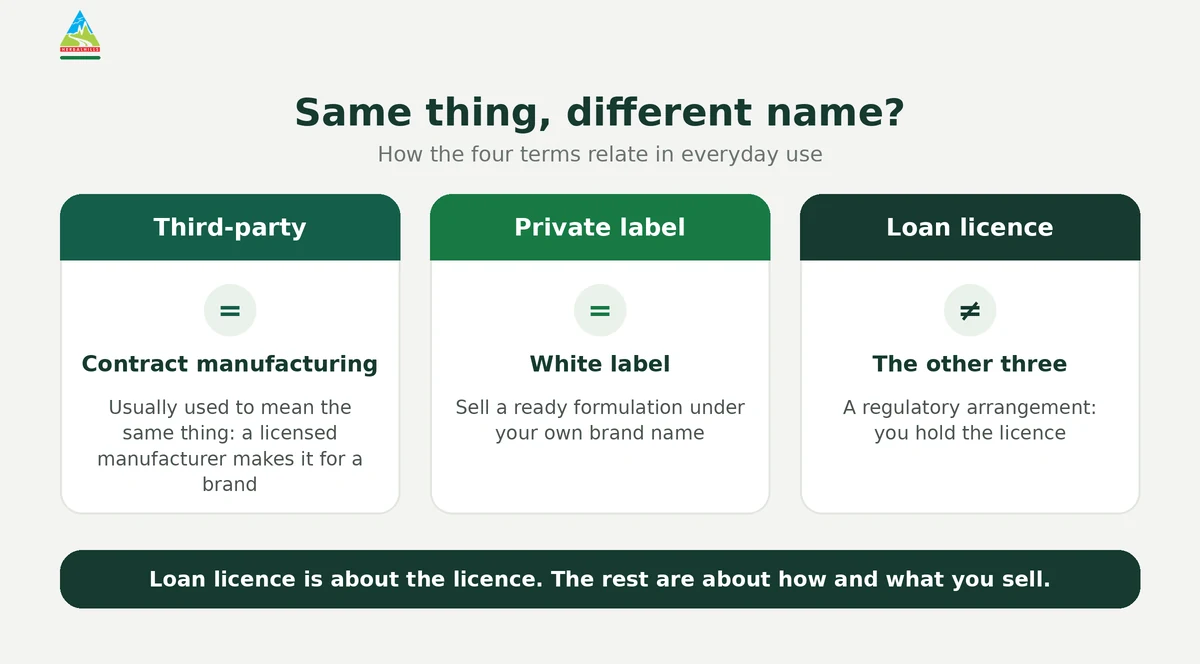
In third-party manufacturing, a licensed manufacturer makes the product and a separate company, the brand, markets and sells it. Contract manufacturing is the same idea described from the contract’s side: the manufacturer produces to an agreed specification under a written agreement. In day-to-day business both terms usually describe a manufacturer that holds the licence and makes the product for a brand.
The subtle difference is one of emphasis. “Third-party” stresses that the maker and the seller are different companies. “Contract” stresses the written agreement, which often covers specifications, quality, confidentiality, ownership and customized formulations. The Drugs Rules themselves do not define either term as a separate licence type, which is one more reason to put the arrangement in writing.
What Is Private Label?
Private label (also called white label) means selling a manufacturer’s existing, ready formulation under your own brand name, label and packaging. It is the fastest and lowest-investment route, because the formula, licence and manufacturing process already exist. You carry out the branding, marketing and sales, while the manufacturer makes and tests every batch.
Private label is delivered through third-party or contract manufacturing, so the two are not alternatives. The practical difference is about the formula: in private label you choose from ready products, while a customized contract arrangement means developing a formula with the manufacturer’s R&D team. At Herbal Hills, an existing formulation stays the property of Herbal Hills, and a customized formula that you create and pay for belongs to you. Read the details in our guide on who owns the formula.
How Do They Compare Side by Side?
| Loan Licensing | Third-Party / Contract Manufacturing | Private Label | |
|---|---|---|---|
| What it is | A regulatory arrangement | A commercial outsourcing arrangement | A branding model |
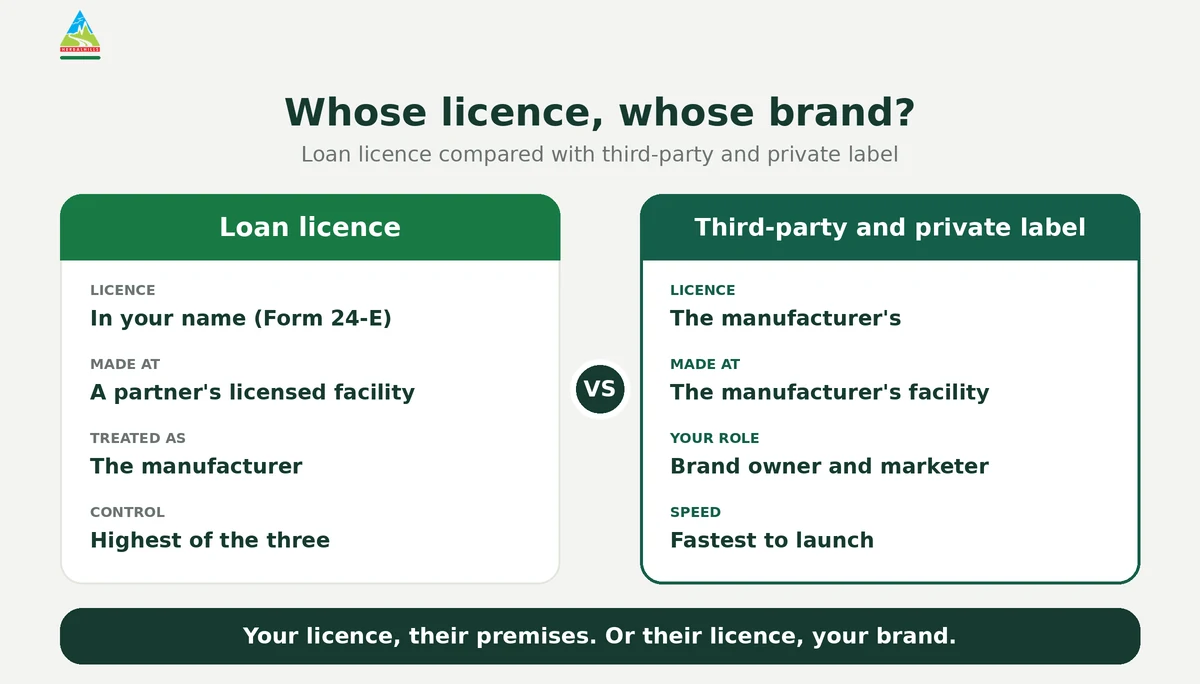
| Who holds the manufacturing licence | You, under a loan licence (Form 24-E) | The manufacturer | The manufacturer |
| Where the product is made | A partner’s licensed, GMP-compliant facility | The manufacturer’s facility | The manufacturer’s facility |
| Who owns the formula | Usually you, as set out in your agreement | Depends on the agreement: yours if you commission and pay for it | Usually the manufacturer, since it is an existing formulation |
| Who is responsible for compliance | You as licence holder, with the partner facility | The manufacturer for production; you for marketing and claims | The manufacturer for production; you for marketing and claims |
| Control over production | Highest of the three | Shared, set by the contract | Lowest: you choose the product and the label |
| Speed to launch | Slower: your own licence and approvals first | Medium, longer for custom formulas | Fastest |
| Typical starting quantity | Set by the partner facility | Higher for custom products | Lowest |
| Best for | Brands that want their own licence without a factory | Brands with their own formulation ideas | New brands, doctors, creators and sellers |
The last rows are general patterns, not rules. Exact responsibilities and ownership depend on your agreement and on your state’s licensing requirements.
Whose Name Goes on the Label?
Under Rule 161, the label of an Ayurvedic drug must carry the manufacturing licence number, batch number and the dates of manufacture and expiry, among other details. What appears beyond that depends on the arrangement. In a loan licence arrangement, the loan licensee is treated as the manufacturer and the label identifies the premises where the product was made. In third-party or private label manufacturing, labels typically show the manufacturer’s details and indicate that the product is marketed by your brand. Your brand name, logo and product name are always yours. Confirm the exact label wording with the manufacturer and, where needed, with your State Licensing Authority.
Your licence, their premises
You hold the licence and are treated as the manufacturer, which gives you control and carries compliance duties.
Their licence, your brand
The manufacturer holds the licence and makes the product, while you build and sell the brand.
Which One Should You Choose?
| Your Situation | Likely Fit | Why |
|---|---|---|
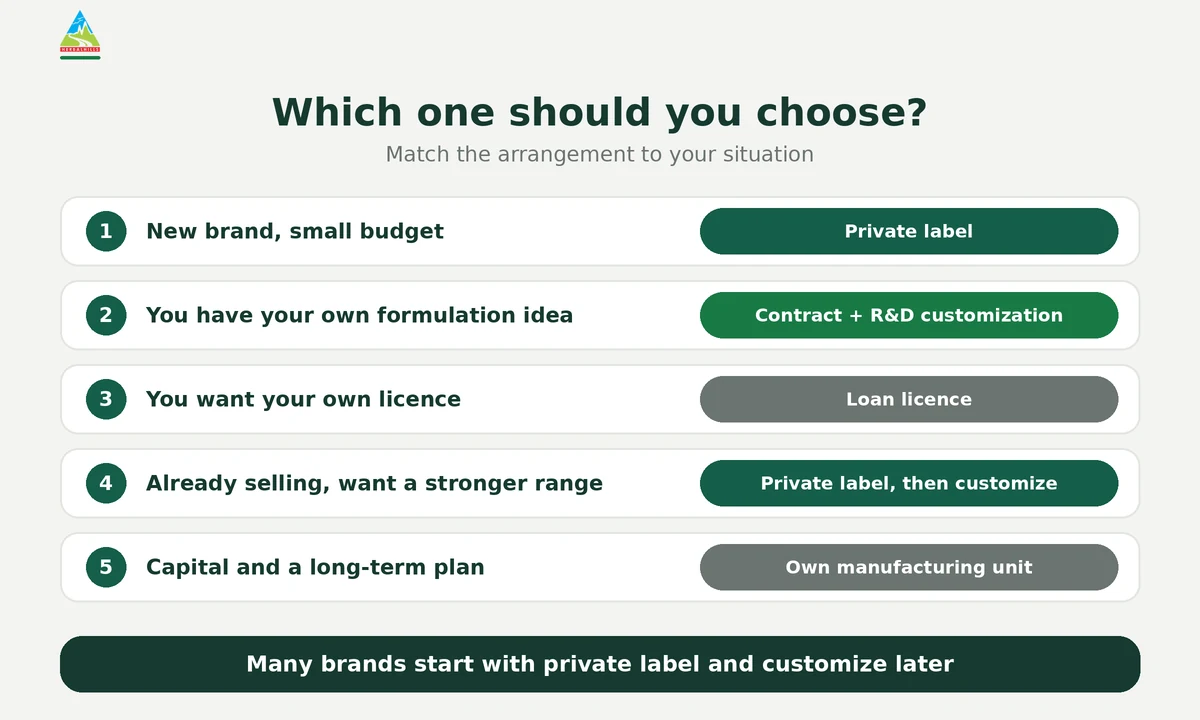
| New brand, first products, small budget | Private label | Ready formulas, low starting quantities and the fastest launch |
| You have your own formulation idea | Contract manufacturing with R&D customization | A formula developed with R&D that you own once you commission and pay for it |
| You want to hold your own licence and be treated as the manufacturer | Loan licence | Regulatory control without building a factory |
| You already sell and want a stronger range | Private label first, then customize | Prove demand with ready products, then invest in owned formulas |
| You have capital and a long-term plan | Own manufacturing unit | Full control, with full responsibility |
Many brands start with private label, learn what sells, and move to customized contract manufacturing for their hero products. For the full picture of starting out, read our guide on how to start an Ayurvedic medicine business in India.
Questions to Ask Before You Choose
- Who holds the manufacturing licence for the product that will carry my brand?
- Is the product an existing formulation or a customized one, and who owns the formula?
- What will the label say about the manufacturer and about my brand?
- What are the minimum order quantities and the lead times?
- Will I receive a Certificate of Analysis for every batch?
- What happens to my product if I change manufacturer later?
- Is a loan licence arrangement possible, and what would it require from me?
- Which documents will I need to provide, and which will you provide?
Our guide to the documents a private label manufacturer needs from you and our explanation of minimum order quantities help you prepare for these conversations.
How Does Herbal Hills Work With Brands?
Herbal Hills is a GMP and ISO-certified manufacturer in Lonavala, Maharashtra, with more than 25 years of experience. It works with brands in the ways most new founders need:
Frequently Asked Questions
Is third-party manufacturing the same as contract manufacturing?
In everyday Indian business use, yes. Both describe a licensed manufacturer making a product for a brand that sells it. “Third-party” emphasises that the manufacturer and the seller are different companies, while “contract” emphasises the written agreement between them.
What is the difference between private label and contract manufacturing?
Private label is a branding model: you sell a manufacturer’s existing formulation under your own name. Contract manufacturing is the arrangement under which it is made. Private label is delivered through contract or third-party manufacturing, and contract manufacturing can also mean a customized formula developed to your brief.
What is a loan licence in Ayurvedic manufacturing?
A loan licence is a licence granted to an applicant who does not have their own manufacturing arrangements but wants to use the facilities of a licensed manufacturer. For Ayurvedic drugs it is applied for on Form 24-E under Rule 153A, and the licensee is treated as the manufacturer.
Is private label the same as white label?
Yes, the two terms are used interchangeably. Both mean selling a manufacturer’s product under your own brand.
Who is responsible for compliance in each arrangement?
With a loan licence, you are responsible as the licence holder, together with the partner facility. With third-party or private label manufacturing, the manufacturer is responsible for production and quality, and you are responsible for your marketing, claims and labelling content. Your agreement should say so in writing.
Who owns the formula in private label?
Usually the manufacturer, because you are using an existing formulation. At Herbal Hills, existing formulations belong to Herbal Hills, while a customized formula that you create with R&D and pay for belongs to you. Put the position in your agreement.
Which option is fastest and cheapest to start?
Private label, because the formula, licence and manufacturing already exist. Selected QuickLabel™ products at Herbal Hills start from about 50 pieces, and other private label orders start from 500 units.
Can I start with private label and move to my own licence later?
Yes. Many brands prove demand with ready products first, then customize formulations, and consider a loan licence or their own facility once volumes justify it.
Know the Difference Before You Sign
The real difference comes down to three questions: whose licence covers the manufacturing, who owns the formula, and whose name stands behind the product. A loan licence answers the first by putting the licence in your name. Third-party and contract manufacturing answer it by relying on the manufacturer’s licence, and private label answers the formula question by using the manufacturer’s ready products. According to Herbal Hills, the brands that avoid costly surprises are the ones that write these answers into the agreement before the first batch is made. Share your plans with the team to find the arrangement that fits your brand.
Explore Private Label & Contract Manufacturing →
Sources
Government of NCT of Delhi, Directorate of AYUSH, Drug Control Cell, on Forms 24-D, 24-E and 24-E-I and the e-AUSHADHI portal. Drugs and Cosmetics Rules, 1945, Rule 153A (loan licence) and Rule 161 (labelling of Ayurvedic drugs). Pharmexcil, Guidance document for import of drugs and pharmaceuticals from India, on loan licence manufacturing. Herbal Hills product and ownership information.