

Blog
Who Owns the Formula? Formulation Rights in Ayurvedic Contract Manufacturing

“Who owns the formula?” is one of the first questions serious brand owners and investors ask a contract manufacturer, and one of the most important. The answer decides what your brand is really building, what you can take with you, and how much your business is worth to a buyer or investor.
This guide gives the plain-language answer for Herbal Hills, explains the difference between owning a formula, a trademark and a licence, and lists what a good contract manufacturing agreement should say. It is general information, not legal advice; take independent legal advice before signing any agreement.
The Short Answer: Two Kinds of Formulation, Two Kinds of Owner
| Existing Herbal Hills Formulation | Customized Formulation | |
|---|---|---|
| Who created it | Herbal Hills R&D | Your brand, jointly with Herbal Hills R&D |
| Who owns the formula | Herbal Hills | Your brand |
| Who pays for development | Herbal Hills (already done) | Your brand pays the R&D charges |
| Product licence | Herbal Hills’ existing product licence | A separate product licence for the new formula |
| Your product name, trademark and packaging | Yours | Yours |
| Can other brands use the same formula? | Yes: existing formulations can be supplied to more than one brand | No, it is your formula |
| Study data | Available on selected formulations | Must be built for the new formula |
Existing Formulations: Who Owns Them and What Do You Own?
Herbal Hills’ research team, including MD (Ayurveda) doctors, has developed a large range of formulations over more than 25 years, and Herbal Hills has sponsored clinical studies on eight of them. When you choose one of these existing formulations and launch it under your brand, the formula remains the property of Herbal Hills. It was developed, licensed and, in some cases, clinically studied at Herbal Hills’ own cost.
That does not mean you own nothing. Everything that makes the product yours in the market belongs to you:
Why do most brands start with an existing formulation?
Roughly 8 in 10 Herbal Hills customers choose existing formulations. They want to play safe: the formula is already licensed and manufactured at scale, its quality is proven in production, and several formulations have clinical studies behind them. That means a faster, lower-cost and lower-risk launch, with no development time or R&D charges.
Study data describes what was observed in a specific study; it is not a guarantee of results for every customer. It should be described accurately, and a study on a Herbal Hills brand formulation may be used on another brand’s label or in its advertising only with the required regulatory approvals. See the Herbal Hills clinical research page.
Customized Formulations: Why the Formula Belongs to You
Some brands have their own ideas, or a formulation they have already developed or want to develop. For them, Herbal Hills’ R&D team works jointly with the brand to create a customized formulation. Customization can mean adding or removing ingredients, changing the ratio, changing the dosage form or format, or any other change made together with R&D.
When customization is complete, the new formula is treated as a separate product and a separate product licence is taken for it. Because the customized formula is the brand’s creation, and the brand pays the R&D charges for developing it, that formula belongs to the brand. Herbal Hills’ R&D team supports the work and is paid for that support; the ownership of the result stays with you.
The same applies if you bring your own formulation to Herbal Hills to manufacture: a formula you developed remains yours.
What does Herbal Hills’ R&D support include?
- Recommending a base formulation and suggesting improvements
- Checking every ingredient is permitted, compatible and available
- Pilot batches, testing and stability studies
- Preparing the product licence application for the customized formula
- Label and claim review for compliance
For the full step-by-step process, read our guide to how formula customization works.
Formula, Trademark and Licence: What Exactly Do You Own?
Ownership questions often get confused because three different things are involved. They are owned and protected in different ways.
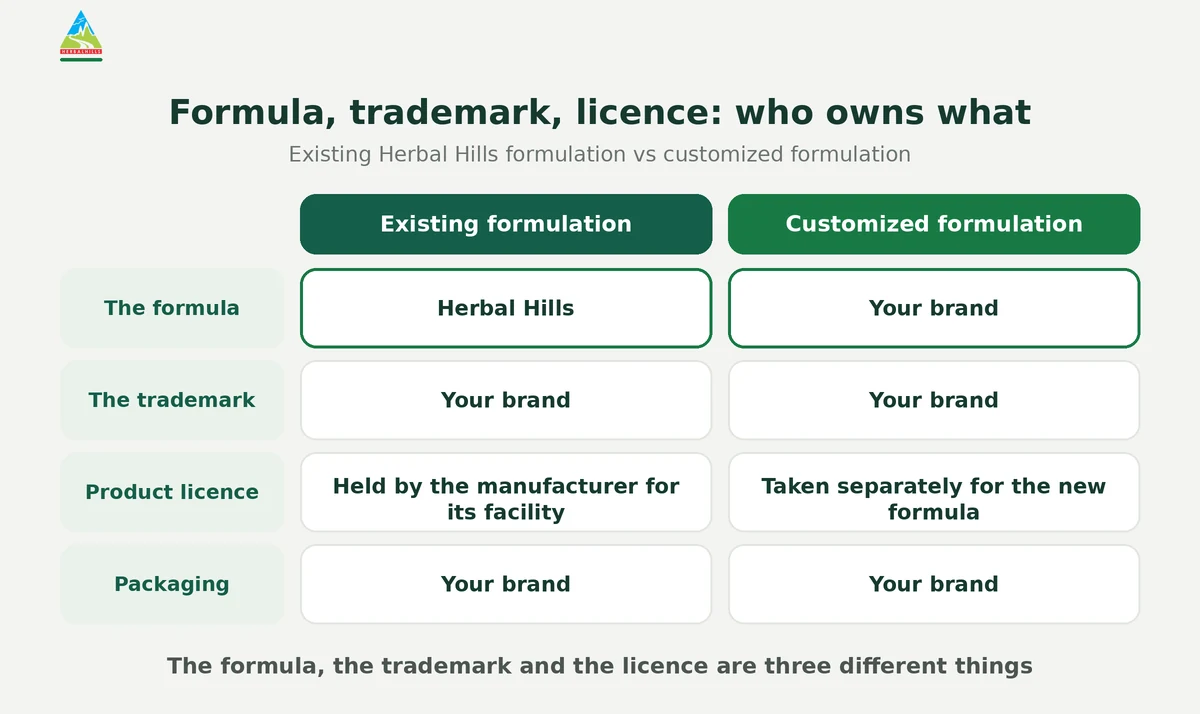
| What It Is | What It Covers | Existing Formulation | Customized Formulation |
|---|---|---|---|
| The formula | The ingredients, proportions, process and specifications | Herbal Hills | Your brand |
| The trademark | Your brand and product names and logos | Your brand | Your brand |
| The product licence | Permission from the State Licensing Authority to manufacture that product at a specific facility | Held by the manufacturer for its facility | Taken separately for the new formula |
| Packaging and artwork | Label design, copy and brand identity | Your brand | Your brand |
A manufacturing licence for an Ayurvedic product is granted for a specific product made at a specific licensed facility. So owning a formula and holding the licence to manufacture it are not the same thing. If a brand ever moves production of its own customized formula to another facility, that manufacturer would need its own licence for the product.
What is the difference between third-party manufacturing and a loan licence?
In third-party manufacturing, the manufacturer holds the manufacturing licence and makes the product for your brand. Under a loan licence, the brand itself obtains a licence to manufacture its product using another company’s licensed facility, equipment and staff. A loan licence gives the brand more regulatory control but also more responsibility for compliance. Ask any manufacturer which of these models it offers.
Can an Ayurvedic formula be patented?
Usually not. India’s Patents Act excludes inventions that are, in effect, traditional knowledge, and India’s Traditional Knowledge Digital Library exists partly to stop patents being granted on known Ayurvedic preparations. Most Ayurvedic brands protect their formulas instead through confidentiality: keeping the exact formula and process as confidential know-how, backed by a written agreement, together with a registered trademark for the product name.
What Should a Contract Manufacturing Agreement Say About Ownership?
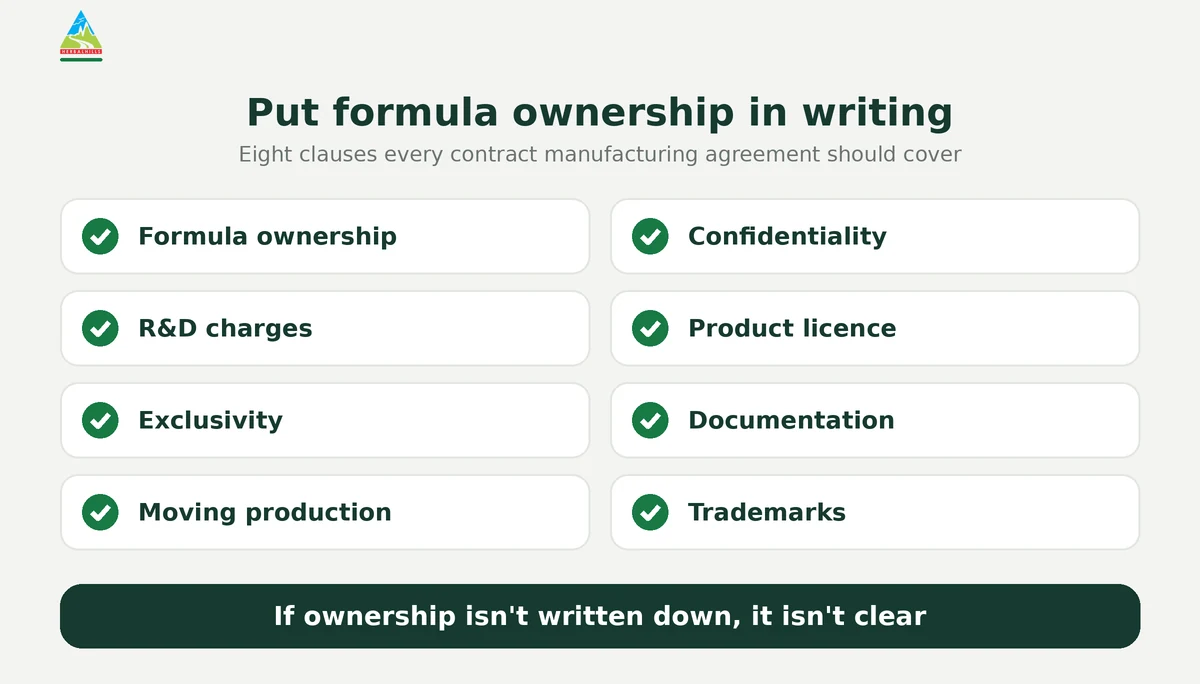
Clear ownership terms are a sign of a trustworthy manufacturer. Before you start, make sure your contract manufacturing agreement covers these points in plain language:
| Clause | What It Should Cover | Herbal Hills Position |
|---|---|---|
| Formula ownership | Who owns existing and customized formulas | Existing: Herbal Hills. Customized and paid for by the brand: the brand |
| Confidentiality | Both parties keep each other’s formulas, pricing and plans confidential | A non-disclosure agreement is signed before custom formulation work |
| R&D charges | What development costs, and what you get for it | Confirmed per project after the brief |
| Product licence | Who applies for and holds the product licence | A separate licence is taken for the customized formula; Herbal Hills prepares the application |
| Exclusivity | Whether an existing formula can be sold to other brands; whether your customized formula is made only for you | Existing formulas can be supplied to more than one brand; a customized formula belongs to the brand that paid for it |
| Documentation | Which documents you receive: formula, specifications, Certificates of Analysis, stability data | Confirmed in the agreement before development starts |
| Moving production | What happens to your customized formula if you change manufacturer | Confirmed in the agreement before development starts |
| Trademarks | Confirmation that your brand names and artwork remain yours | Always the brand’s |
Why Do Investors Care Who Owns the Formula?
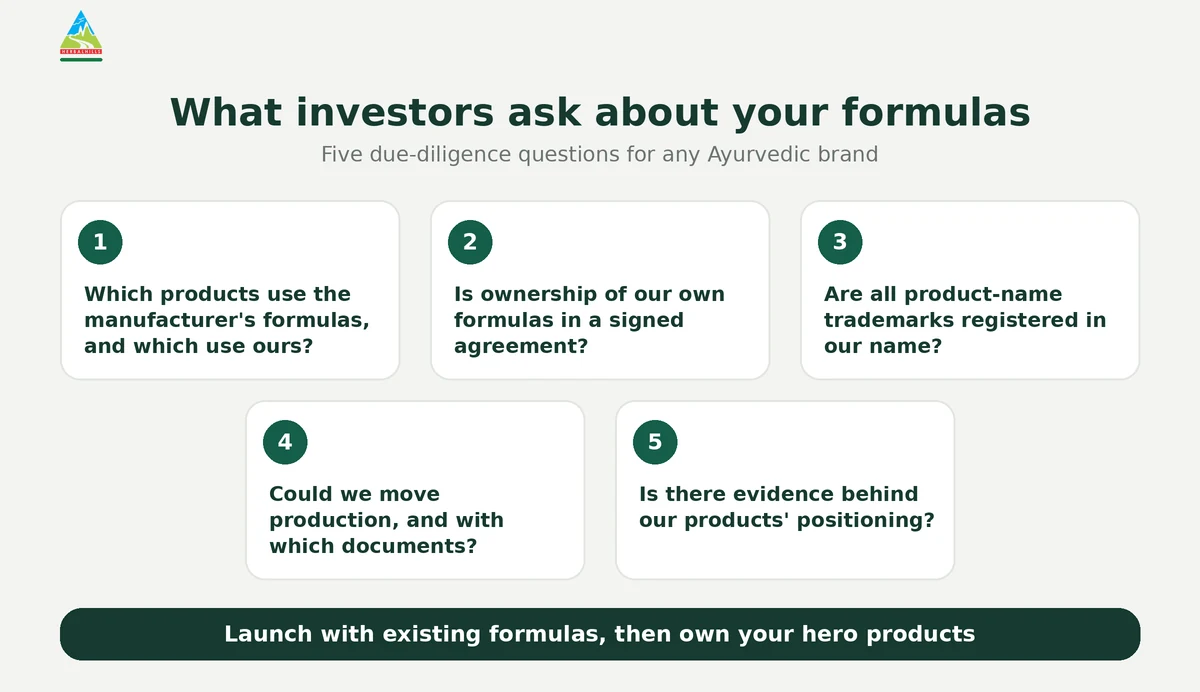
For an investor-backed brand, formulas are part of what the business is worth. During due diligence, investors and acquirers typically ask:
A common, healthy path is to launch with existing formulations to prove demand, then invest in customized formulations for the hero products. That way the brand moves fast early and builds owned assets as it grows.
Existing or Customized: Which Is Right for Your Brand?
You want speed and low risk
You want to launch quickly with the lowest risk, you value study data already on file, you want no development time or R&D charges, or you are testing a new category or market.
You want an owned asset
You want a product no other brand can sell, you want to own the formula as a long-term asset, you have your own ingredient ideas or an existing formula, or you are building a hero product for investors or a premium range.
Frequently Asked Questions
Who owns the formula in Ayurvedic contract manufacturing?
It depends on who created it. At Herbal Hills, existing formulations developed by its R&D team belong to Herbal Hills. A customized formulation created jointly with the brand, where the brand pays the R&D charges, belongs to the brand.
If I launch a Herbal Hills formulation under my brand, what do I own?
You own your brand name, product name, registered trademarks, label and packaging design, marketing and customer relationships. The underlying formula remains the property of Herbal Hills, which developed and licensed it.
When does a customized formula belong to my brand?
When it is created for you by changing an existing formulation, such as adding ingredients or changing the ratio, form or format, together with the Herbal Hills R&D team, and you pay the R&D charges. A separate product licence is then taken for it.
Do I need a new licence for a customized formulation?
Yes. A customized formula is a new product, so a separate product licence is taken from the State Licensing Authority before commercial production. Herbal Hills prepares the application.
Can other brands sell the same formulation as me?
Existing Herbal Hills formulations can be supplied to more than one brand, each under its own brand name. A customized formula belongs to the brand that created and paid for it.
Can an Ayurvedic formula be patented?
Usually not, because Indian patent law excludes traditional knowledge. Brands normally protect their formulas through confidentiality agreements and protect their product names with registered trademarks.
What is a loan licence in Ayurvedic manufacturing?
A loan licence lets a brand hold its own licence to manufacture a product at another company’s licensed facility. In standard third-party manufacturing, the manufacturer holds the licence and makes the product for the brand.
Why do most brands choose existing formulations?
About 8 in 10 Herbal Hills customers choose existing formulations because they are already licensed, proven in production and, in several cases, clinically studied. That makes the launch faster, cheaper and lower-risk.
Clear Ownership, From the First Conversation
The answer to “who owns the formula?” should never be a surprise. At Herbal Hills, it is simple: existing formulations belong to Herbal Hills, and a customized formulation you create with our R&D team and pay for belongs to you, with its own product licence. Your brand, trademarks and packaging are always yours. According to Herbal Hills, most brands start with an existing formulation to launch safely, and invest in customized formulations once they are ready to build owned assets. With more than 25 years of GMP and ISO-certified manufacturing and in-house MD (Ayurveda) R&D in Lonavala, Maharashtra, Herbal Hills supports both routes.
Discuss a Custom Formulation →
Or browse existing formulations