

Blog
What Makes a Truly Authentic Ayurvedic Joint Oil?

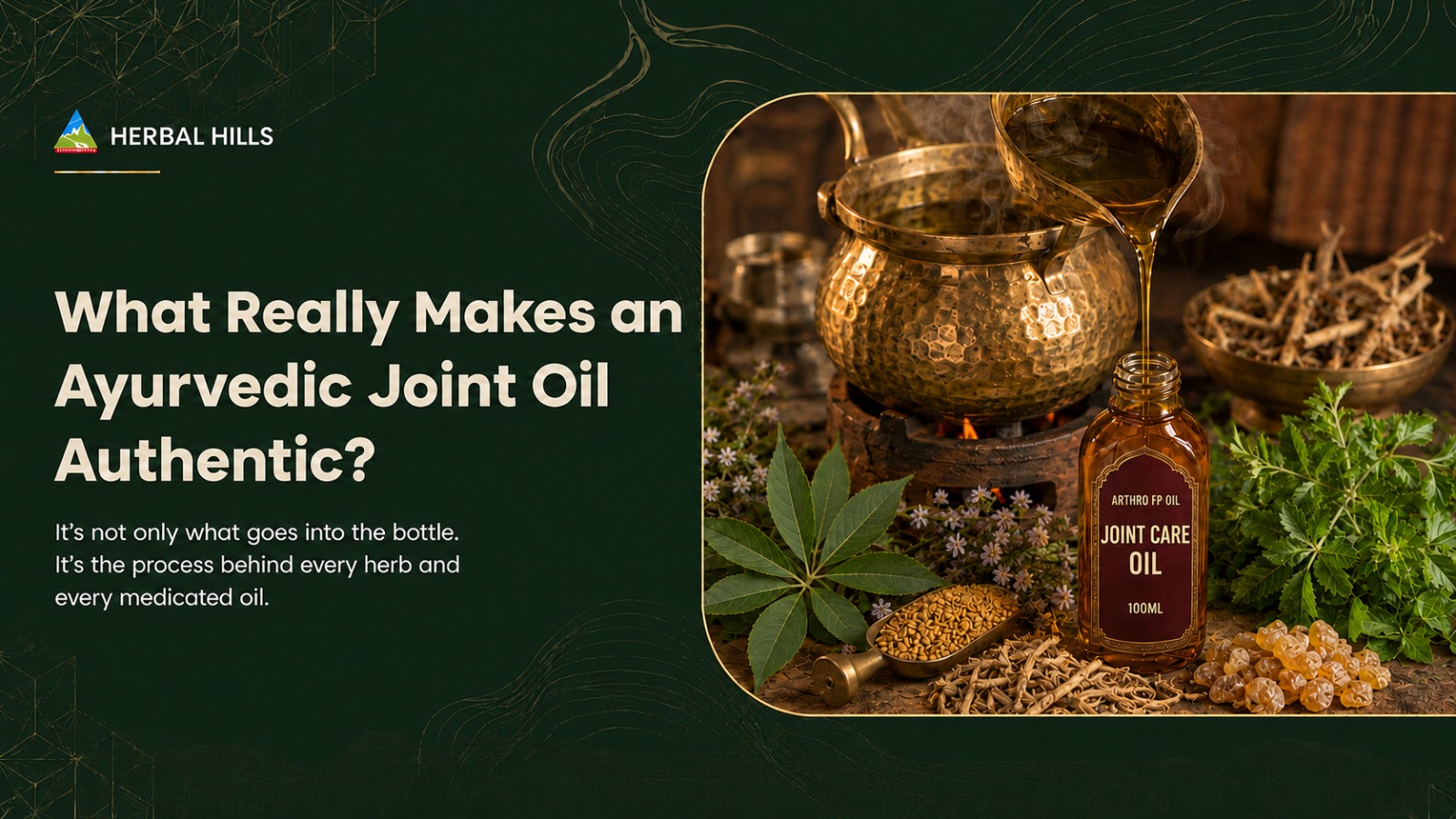
Not Every Ayurvedic Oil Tells the Same Story
Walk into any pharmacy or browse online, and you’ll find countless Ayurvedic joint oils. Most proudly display a long list of herbs on the label — Nirgundi, Nilgiri, Kalonji, Erand, Lemongrass, Dhatura and many more.
At first glance, they may all appear similar. But have you ever wondered how those herbs actually become an Ayurvedic oil?
Are they simply mixed together? Are pre-made herbal extracts added to a base oil? Or is there a traditional process behind every bottle?
This philosophy inspired the creation of ArthroHill Oil. Rather than following the quickest route, Herbal Hills follows a carefully designed process rooted in classical Ayurvedic wisdom and supported by disciplined modern manufacturing practices. This is the story behind that journey.
Authentic Ayurveda Begins Long Before Manufacturing
Every quality product starts with quality ingredients. But in Ayurveda, quality begins even earlier — it begins with respect for nature.
Fresh herbs possess their own aroma, texture, vitality, and natural phytochemicals. The way they are cultivated, harvested, cleaned, and handled plays an important role in preserving their natural characteristics before they ever enter the manufacturing process.
Fresh herbs are carefully selected, harvested at the appropriate stage, cleaned, and prepared before entering the traditional medicated oil process — because authentic Ayurveda believes that excellence starts at the source.
The Ayurvedic Art of Medicated Oils
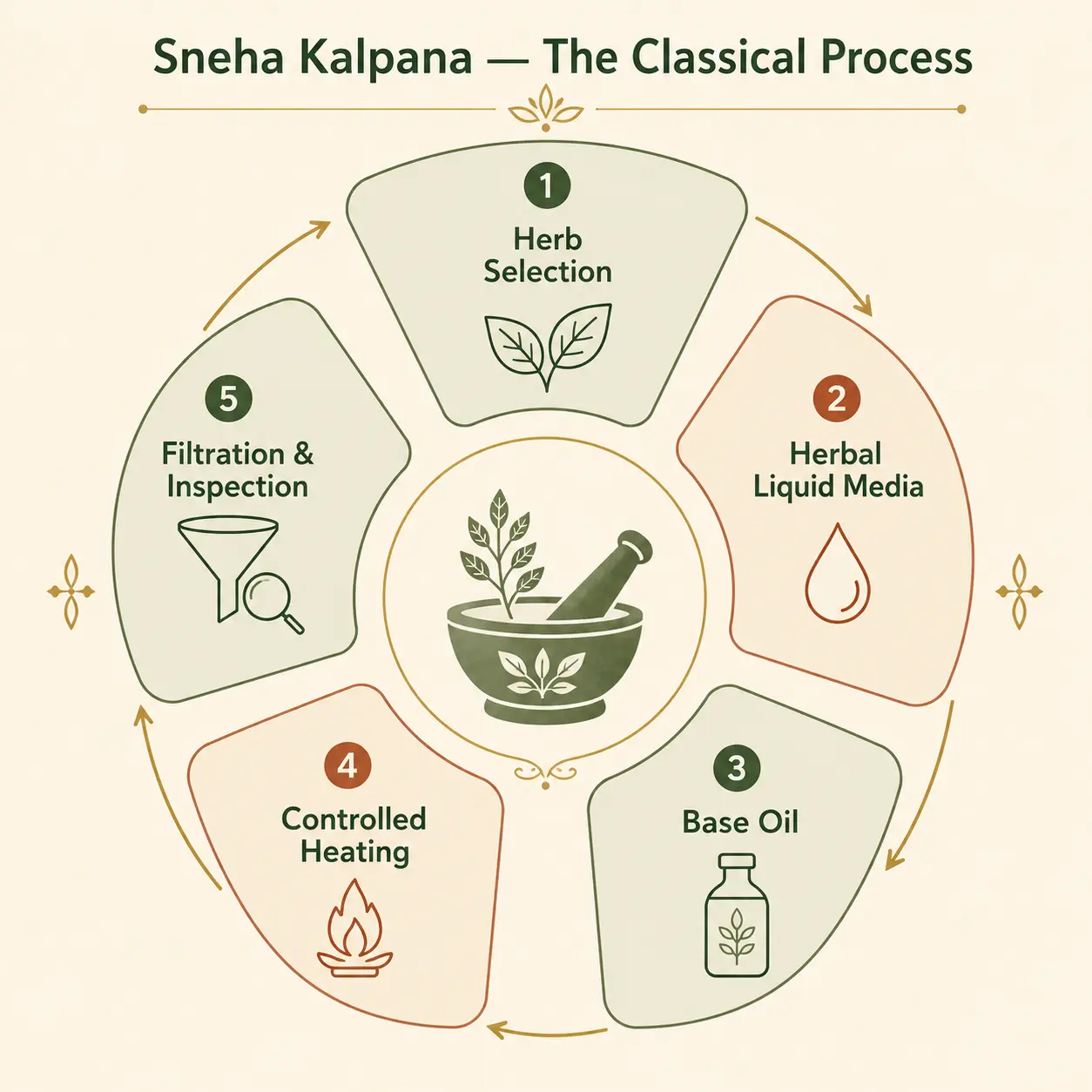
Ayurveda has described the preparation of medicated oils for centuries through a process known as Sneha Kalpana.
Unlike simple oil blending, this method carefully combines herbs, herbal liquids, and base oils under controlled heating so that the qualities of the herbs are gradually transferred into the oil.
Every stage requires observation, experience, and care. Traditional Ayurvedic practitioners understood that the preparation method itself contributes to the quality of the final medicated oil — a timeless philosophy that continues to inspire modern Ayurvedic manufacturing today.
The Journey from Farm to ArthroHill
Every bottle of ArthroHill follows a journey that is both traditional and disciplined:
Preparation↓
Traditional Medicated Oil Process↓
Quality Checks↓
Final Blending↓
ArthroHill Oil
Behind this simple flow lies countless hours of careful work, attention to detail, and respect for Ayurvedic principles. Fresh herbs are harvested, cleaned and prepared. Different herbs undergo their respective traditional preparation processes. Individual medicated oils are carefully prepared, filtered and inspected. Quality checks are performed. Only then are the selected medicated oils brought together to create the final ArthroHill Oil.
Seven Medicated Oils. One Purpose.
This is where ArthroHill takes a distinctive approach. Many formulations prepare a single oil containing multiple herbs. Herbal Hills follows a different philosophy — instead of preparing one large herbal mixture, seven individual medicated oils are first prepared separately, each using carefully selected herbs and traditional processing methods.
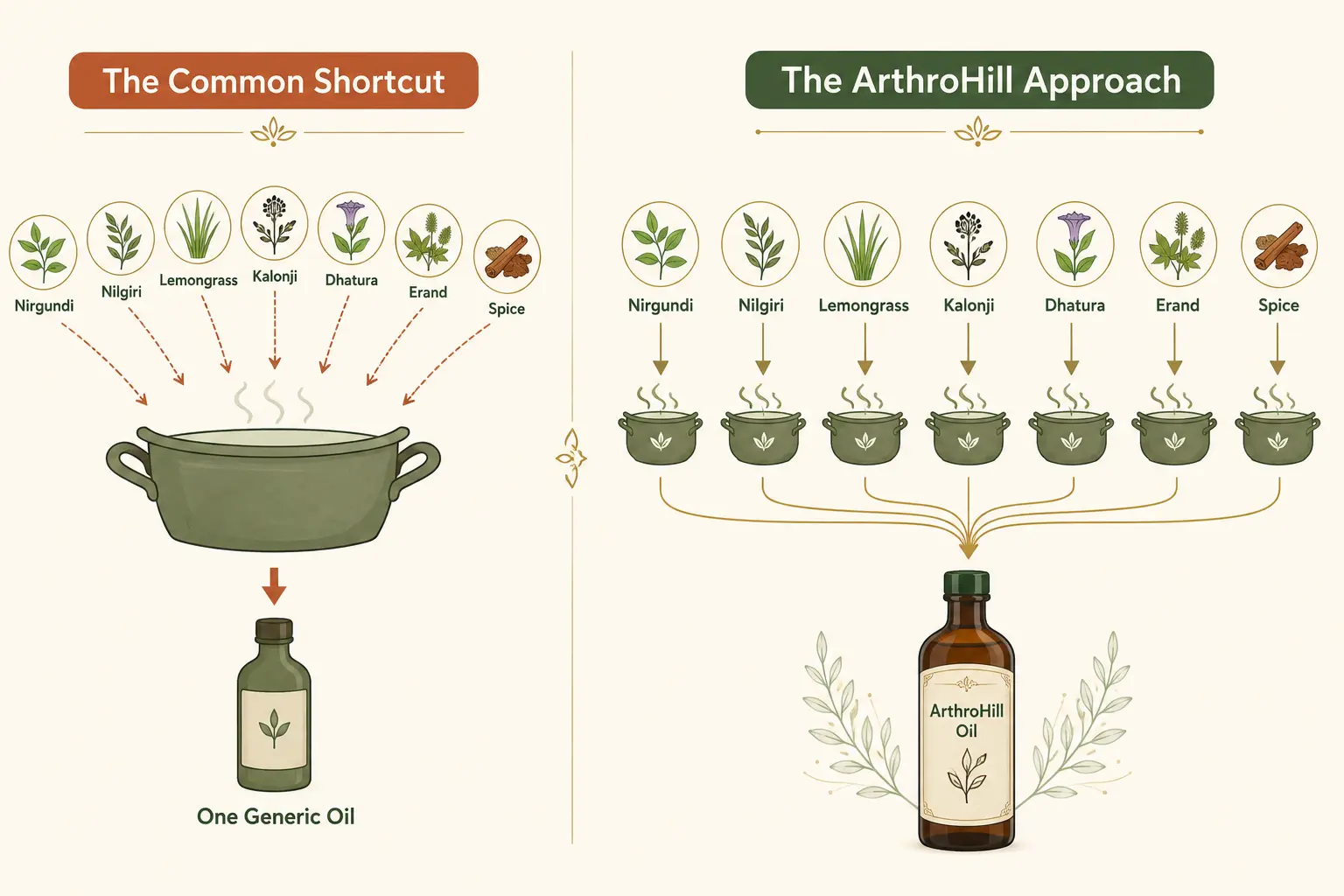
Each medicated oil undergoes its own preparation journey before becoming part of the final formulation. Only after these individual oils are prepared are they carefully blended into ArthroHill Oil.
This approach requires more planning, more time, and greater manufacturing discipline — but it reflects the philosophy that authentic craftsmanship cannot be rushed.
Where Ancient Wisdom Meets Modern Manufacturing
Traditional knowledge becomes even more meaningful when supported by consistent manufacturing practices. Every stage of production should follow clearly defined procedures, hygienic handling, process documentation, quality inspections, and batch consistency.
At Herbal Hills, traditional principles are respected while modern process discipline helps maintain quality and reproducibility. This balance between heritage and quality defines our manufacturing philosophy.
Why the Process Matters
When choosing an Ayurvedic joint oil, most people naturally look at the ingredient list. But equally important questions are:
- How was this oil prepared?
- Where were the herbs sourced?
- Were fresh herbs used?
- Was the preparation carried out according to Ayurvedic principles?
- Was sufficient care taken during manufacturing?
- Was quality maintained consistently?
These questions help us appreciate that in Ayurveda, the journey of the ingredients is just as important as the ingredients themselves.
Conclusion
In Ayurveda, authenticity is never defined by a long ingredient list alone. It is reflected in the thought behind the formulation, the respect shown to every herb, the patience invested during preparation, and the commitment to preserving traditional wisdom with modern quality standards.
Every bottle of ArthroHill Oil represents more than a combination of herbs. It represents a journey — from fresh herbs to seven individually prepared medicated oils, and finally to one carefully crafted formulation inspired by the timeless principles of Ayurveda.

Related Reading
Frequently Asked Questions
Why are fresh herbs important?
Fresh herbs retain their natural characteristics and are valued in many traditional Ayurvedic preparations. Appropriate handling after harvesting helps preserve their quality.
What is a medicated oil?
A medicated oil is prepared by processing herbs with a suitable base oil using traditional Ayurvedic methods so that the properties of the herbs are transferred into the oil.
Why prepare seven separate medicated oils?
Each medicated oil follows its own preparation process before becoming part of the final formulation, reflecting a philosophy of dedicated craftsmanship rather than simple blending.
What is Sneha Kalpana?
Sneha Kalpana is the classical Ayurvedic method of preparing medicated oils and ghee through controlled processing of herbs with lipid media.
Why is sesame oil commonly used in Ayurveda?
Sesame oil has traditionally been regarded as an excellent base for many Ayurvedic medicated oils because of its stability and compatibility with herbal preparations.
Does traditional preparation take longer?
Yes. Traditional methods generally involve multiple preparation stages and careful process control rather than rapid mixing.
Key Points for Judging an Ayurvedic Joint Oil
- An Ayurvedic joint oil should list its base oil and the herbs used
- Ask how the Ayurvedic joint oil is prepared, cooked and tested
- Check the label of any Ayurvedic joint oil for honest, general wording
Related reading: see the joint care ayurvedic medicine catalogue, the certifications Herbal Hills holds, or contact our team. For background on the tradition, see this overview of Ayurveda.
Quick Answers on Ayurvedic Joint Oil
What makes an Ayurvedic joint oil authentic?
A traditional preparation method, a disclosed ingredient list, controlled manufacturing and honest labelling.
What is the usual base oil?
Classically often sesame oil, though it varies by preparation.
How can I check quality?
Look for a clear ingredient list, GMP manufacturing, batch testing and the licence appropriate to the product category.
Should I patch test first?
A small patch test is sensible general practice for any topical product.