

Blog
How to Start an Ayurvedic Medicine Business in India

Ayurveda is one of the few traditional systems with a large, growing market and a clear legal framework for new businesses. Founders ask the same questions at the start: do I need a factory, which licence do I need, how much does it cost, and how fast can I launch? The honest answer is that it depends on the route you choose, and the routes are very different in cost and speed.
This guide explains the three business models, the licences and registrations involved, a step-by-step launch plan and the mistakes new founders make. It is general information, not legal advice; licensing details can differ between states, so confirm them with your State Licensing Authority before you act.
Is Ayurveda a Good Business to Start in India?
The market data points the same way. Redseer Strategy Consultants estimates that India’s health supplements market was worth about $5.3 billion in FY26 and could reach $8.5–10 billion by FY31, with Ayurvedic, botanical and traditional products growing at about 14% a year. Exports of Ayush and herbal products rose 6.11% to US$688.89 million in 2024–25, according to the Ministry of Commerce and Industry. And in India itself, specialist outlets still matter: Mordor Intelligence reports that Ayurveda and homeopathy pharmacies held 32.1% of the AYUSH and alternative medicine market in 2025, while online and direct-to-consumer channels are the fastest growing.
Demand is only half the story. The brands that last are the ones that choose the right business model, stay compliant and build trust with customers, which is what the rest of this guide covers.
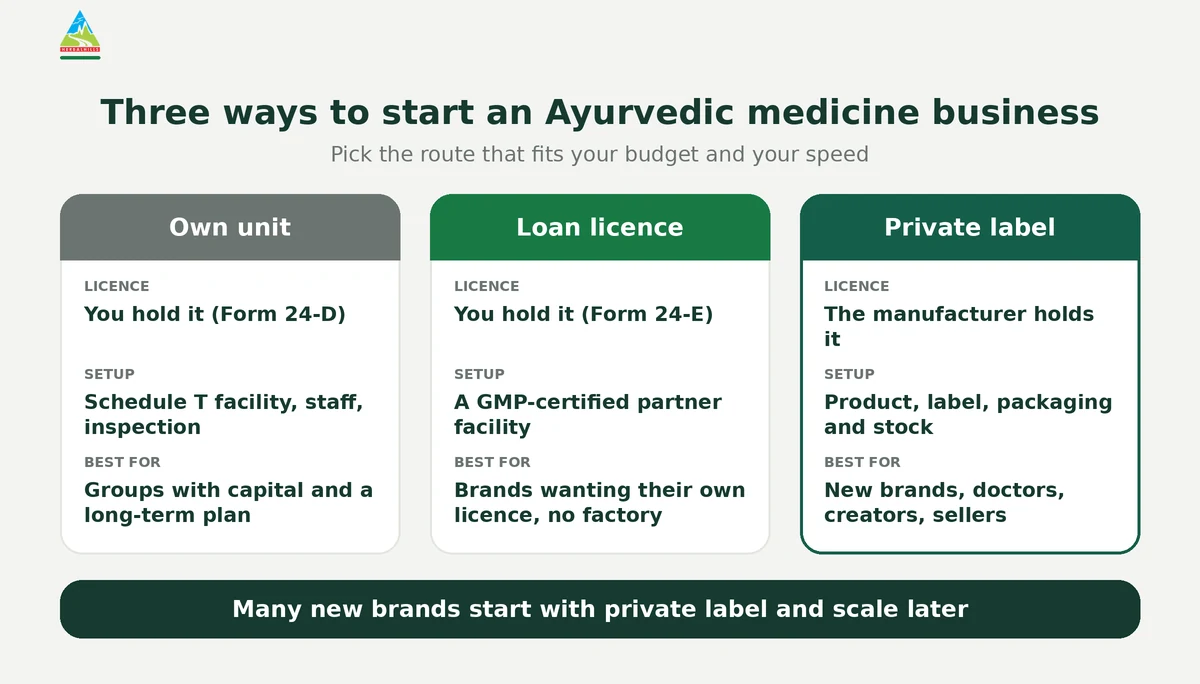
What Are the Three Ways to Start an Ayurvedic Medicine Business?
| Route | Who Holds the Manufacturing Licence | Investment and Setup | Control | Best For |
|---|---|---|---|---|
| Own manufacturing unit | You (Form 24-D, Rule 153) | Highest: land, Schedule T facility, equipment, qualified staff, GMP certificate and inspection | Complete | Established groups with capital and a long-term manufacturing plan |
| Loan licence | You, to manufacture at another licensed facility (Form 24-E, Rule 153A) | Moderate: a GMP-certified partner facility, your own licence application and product approvals | High | Brands that want their own licence but not their own factory |
| Private label or third-party manufacturing | The manufacturer | Lowest: product, label, packaging and stock | You control the brand, the manufacturer controls production | New brands, doctors, distributors, creators and online sellers |
Form numbers and rules are as listed by the Delhi government’s Drug Control Cell. Procedures, fees and timelines can differ by state, so check with your own State Licensing Authority.
What Licences and Registrations Do You Need?
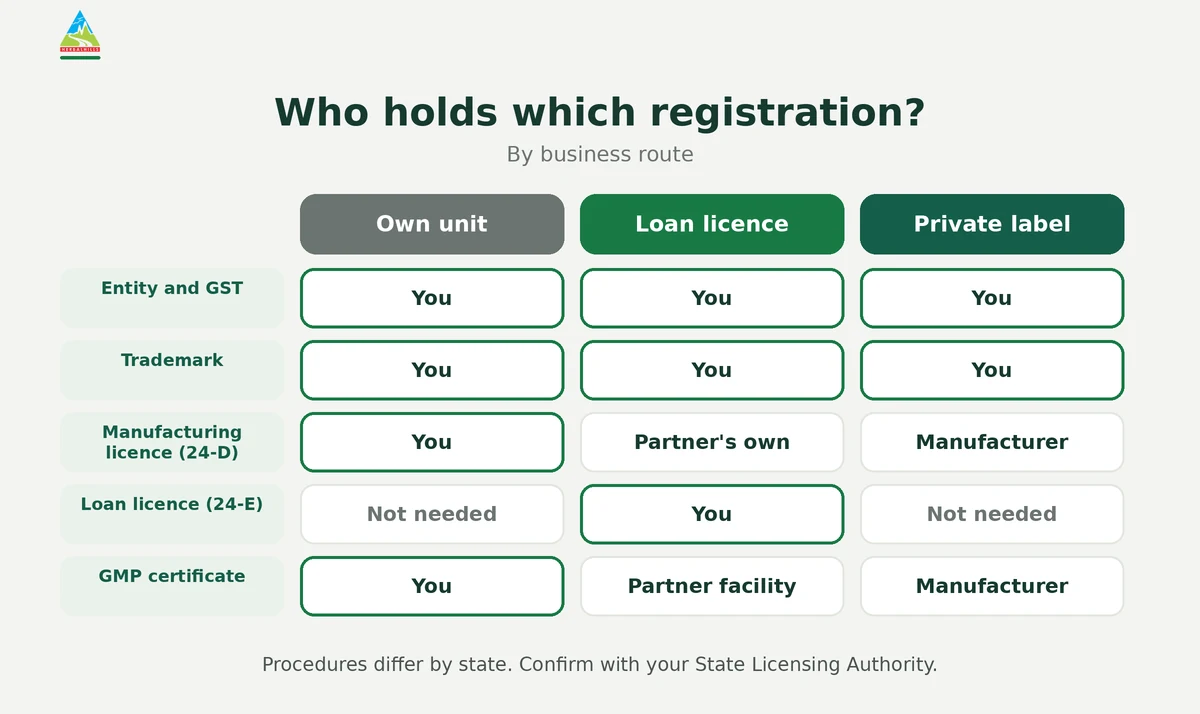
Which of these apply to you depends on the route. In private label manufacturing the manufacturer holds the manufacturing licence and GMP certificate, so you do not apply for them yourself.
| Registration | What It Is | Do You Need It? |
|---|---|---|
| Business entity | Proprietorship, partnership, LLP or private limited company | Yes, for every route |
| GST registration | Tax registration for selling goods | Yes, for most businesses selling products |
| Trademark | Registration of your brand and product names | Strongly recommended for every route |
| Ayurvedic manufacturing licence (Form 24-D) | Licence from the State Licensing Authority to manufacture Ayurvedic drugs | Own unit only; a private label manufacturer holds it for you |
| Loan licence (Form 24-E) | Licence to manufacture your products at another licensed facility | Loan licence route only |
| GMP certificate (Form 24-E-I) | Certificate that the unit follows Schedule T Good Manufacturing Practice | For manufacturing units; check that your manufacturer holds it |
| FSSAI licence | Food safety licence for food-category products such as supplements and teas | Only if your product is positioned as food, not as an Ayurvedic medicine |
| Product permission or approval | Approval for each medicine, with proof of safety and effectiveness for proprietary products | Handled with your manufacturer; see our guide on classical vs proprietary |
Ayurvedic drug licences are granted by the State Licensing Authority, and in Delhi applications are processed online through the e-AUSHADHI portal. The Delhi Drug Control Cell lists the manufacturing licence as perpetual and the GMP certificate as valid for five years. Selling requirements for Ayurvedic drugs can also differ by state, so confirm what applies where you will sell.
Ayurvedic medicine
Made under an Ayurvedic drug licence and Schedule T GMP, with classical or proprietary formulations and Ayurvedic labelling.
Ayurveda Aahara or food supplement
Positioned as food and cleared under FSSAI instead, which changes the label, the claims and the licence.
How Do You Start, Step by Step?
🎯Choose Your Customer and Niche
Decide who you serve: women’s wellness, joint care, digestion, immunity, hair and skin, fitness, or a clinic’s patients.
🧭Pick Your Business Model
Own unit, loan licence or private label, based on your budget, speed and appetite for compliance work.
🏢Register Your Business and Brand
Set up your entity and GST, then register your trademark before you spend on packaging and marketing.
🌿Choose Your Products
Start with a small range of ready formulations, classical or proprietary, then customize once demand is proven.
🏭Select a Licensed Manufacturer
Check licences, GMP, batch testing and samples before you commit to any partner.
🏷️Finalise Label and Packaging
Create compliant labels and attractive packaging, with claims reviewed for the Drugs and Magic Remedies Act.
🛒Choose Your Sales Channels
Decide between chemists and distributors, clinics, your own website, marketplaces or a mix.
🚀Launch, Learn and Reorder
Start with small batches, track reorders and reviews, and add products as customers ask for them.
Should You Build Your Own Unit or Use a Manufacturer?
Owning a factory gives you full control, but it also makes you responsible for building a Schedule T-compliant facility, equipping it, hiring qualified technical staff, passing inspection and keeping up GMP compliance, long before your first sale. Many new brands do not need that. A licensed private label manufacturer has already done it, so your capital goes into your brand, your formulation choices and your customers.
Speed
A private label launch can start with samples and a first order, while a new unit needs facility build, inspection and licensing first.
Capital
Private label needs stock, packaging and design, not land, equipment and a plant. No single cost figure fits every founder.
Risk
You can test a few products with small orders before you commit larger amounts or build your own capacity.
Many founders start with private label, prove their products and their customers, and only then consider a loan licence or their own plant. For details on starting quantities, read our guide to minimum order quantities for private label Ayurvedic products.
Classical or Proprietary: Which Products Should You Launch First?
A classical (Shastrokta) medicine follows a text formula and carries the text’s name, so it is easy to license but easy to compare on price. A proprietary medicine uses classical ingredients in a new formula and carries your own product name, which gives you more room to stand out and to set your price. Many brands launch with proprietary formulations to build the brand and add classical products for practitioner and pharmacy demand. Read the full comparison in our guide to classical vs proprietary Ayurvedic formulations.
How Do You Choose a Licensed Manufacturer?
- Ask for the Ayurvedic manufacturing licence and the GMP certificate for the facility that will make your product.
- Ask whether the manufacturer makes ready formulations you can launch immediately, and whether R&D can customize them.
- Ask for free trial samples and a Certificate of Analysis for the batch you will receive.
- Ask who owns the formula and the trademark, and make sure it is written into your agreement.
- Ask about minimum order quantities, lead times and label designing support.
- Visit the facility if you can, or arrange an audit before larger orders.
Our guide to the documents a private label manufacturer needs from you lists what to prepare before you start, and our article on who owns the formula explains ownership in plain language.
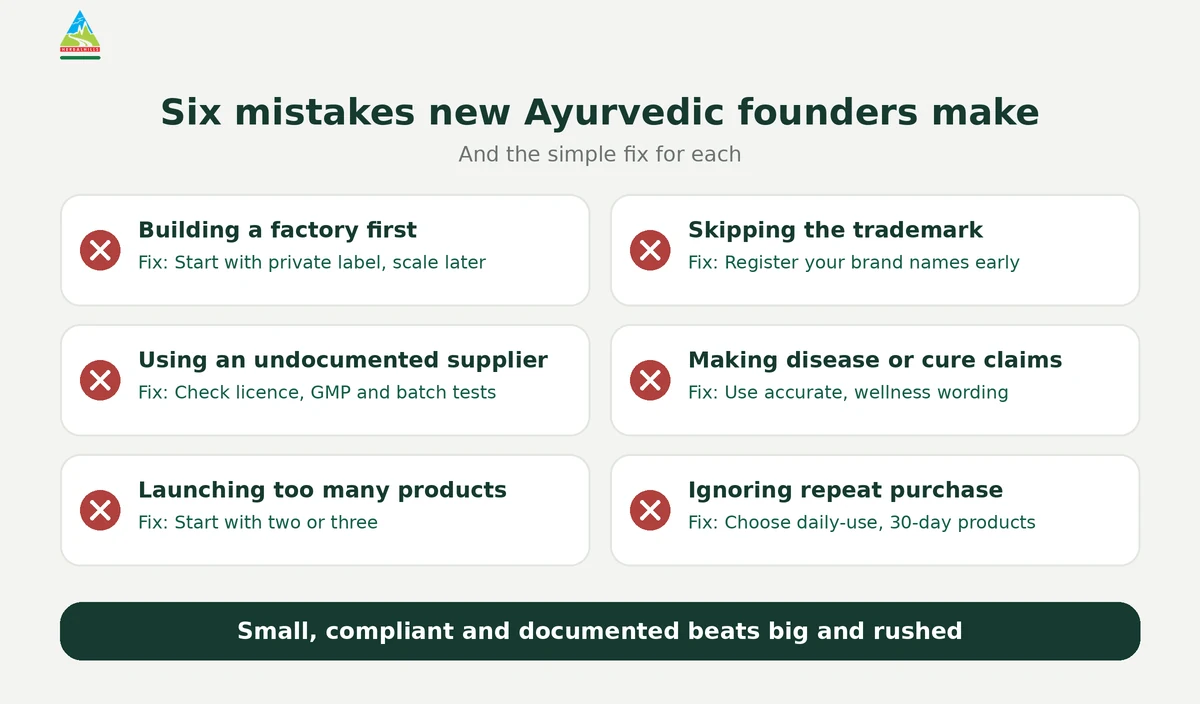
What Mistakes Do New Ayurvedic Founders Make?
| Mistake | Why It Hurts | How to Avoid It |
|---|---|---|
| Building a factory before proving demand | Locks up capital and time before a single customer has bought | Start with private label and scale into your own capacity later |
| Skipping the trademark | Another brand can use or register a similar name | Register your brand and product names early |
| Choosing an unlicensed or undocumented supplier | Your product may be non-compliant, and so are you as the seller | Check licences, GMP and batch testing before you order |
| Making disease or cure claims | Violates the Drugs and Magic Remedies Act and damages trust | Use accurate, wellness-focused wording reviewed for compliance |
| Launching too many products at once | Spreads budget thin and slows learning | Launch two or three products, then add based on reorders |
| Ignoring repeat purchase | One-time buyers do not build a business | Choose daily-use products with a clear 30-day cycle |
How Does Herbal Hills Help You Start With Private Label?
Herbal Hills is a GMP and ISO-certified manufacturer in Lonavala, Maharashtra, with more than 25 years of experience, and it makes Ayurvedic products for brands that do not want to build their own factory. You bring the brand and the customer; Herbal Hills handles formulation, manufacturing, testing and documentation.
To see who else is launching this way, read our guide to who can launch an Ayurvedic brand with QuickLabel™.
Frequently Asked Questions
Do I need a licence to start an Ayurvedic medicine business?
If you manufacture, yes: an Ayurvedic manufacturing licence from your State Licensing Authority, plus Schedule T GMP. If you use a private label or third-party manufacturer, the manufacturer holds the licence. Requirements for selling can differ by state, so confirm them with your State Licensing Authority.
Do I need an Ayurveda degree to start this business?
You do not need a medical degree simply to own an Ayurvedic brand. Manufacturing, however, must meet the licensing rules, including qualified technical staff, which is one reason many founders use a licensed manufacturer.
What is a loan licence in Ayurvedic manufacturing?
A loan licence lets you obtain your own licence to manufacture your product at another company’s licensed, GMP-certified facility. It is applied for on Form 24-E under Rule 153A of the Drugs Rules, 1945, and gives more regulatory control but also more compliance responsibility.
How much does it cost to start an Ayurvedic business?
It varies widely. Your own compliant unit needs land, equipment, staff and approvals. A private label launch needs mainly product stock, packaging, label design and registrations. Ask for exact quantities and prices for your chosen products rather than relying on a single figure.
How long does it take to launch?
Building and licensing your own unit takes months. A private label launch can move much faster: with Herbal Hills, selected QuickLabel™ products can be ready in about seven working days after payment, label approvals and order confirmation.
Can I sell Ayurvedic products online?
Yes, but marketplaces and regulators expect compliant labels, accurate listings and the right licences. Read our guide for Amazon and Flipkart sellers for how to build a private label range for online sales.
Should I launch classical or proprietary medicines?
Many new brands launch with proprietary formulations to build a unique brand and add classical medicines for practitioner and pharmacy demand. Herbal Hills makes both, so you can test either route with one manufacturing partner.
What is the minimum order to start with Herbal Hills?
Selected QuickLabel™ formulations start from about 50 pieces, and other private label orders start from 500 units. The team confirms the exact minimum for each product before you order, and free trial samples are available first.
Start Small, Stay Compliant, Build a Brand That Lasts
Starting an Ayurvedic medicine business in India does not require building a factory. It requires a clear customer, the right business model, a licensed and GMP-certified manufacturer, a compliant label and a trademark you own. According to Herbal Hills, new brands do best when they launch with a few ready formulations, test them with trial samples and grow on real reorder data before investing in their own capacity. Request free samples and the private label catalogue to plan your first products.
Start With Ready Formulations →
Sources
Government of NCT of Delhi, Directorate of AYUSH, Drug Control Cell, on licence forms, e-AUSHADHI and validity. Lok Sabha replies on Schedule T GMP and the Ayush Mark scheme for Ayurvedic products. Redseer Strategy Consultants, as reported by Open Magazine, 19 November 2026. Press Information Bureau, Ayush Export Promotion Council observes 4th Establishment Anniversary, 4 January 2026. Mordor Intelligence, India AYUSH and Alternative Medicine Market. IMARC Engineering, how to obtain an AYUSH manufacturing licence in India.