
Blog
Can a Company Outside India Private Label With an Indian Ayurvedic Manufacturer? A Guide for Overseas Buyers

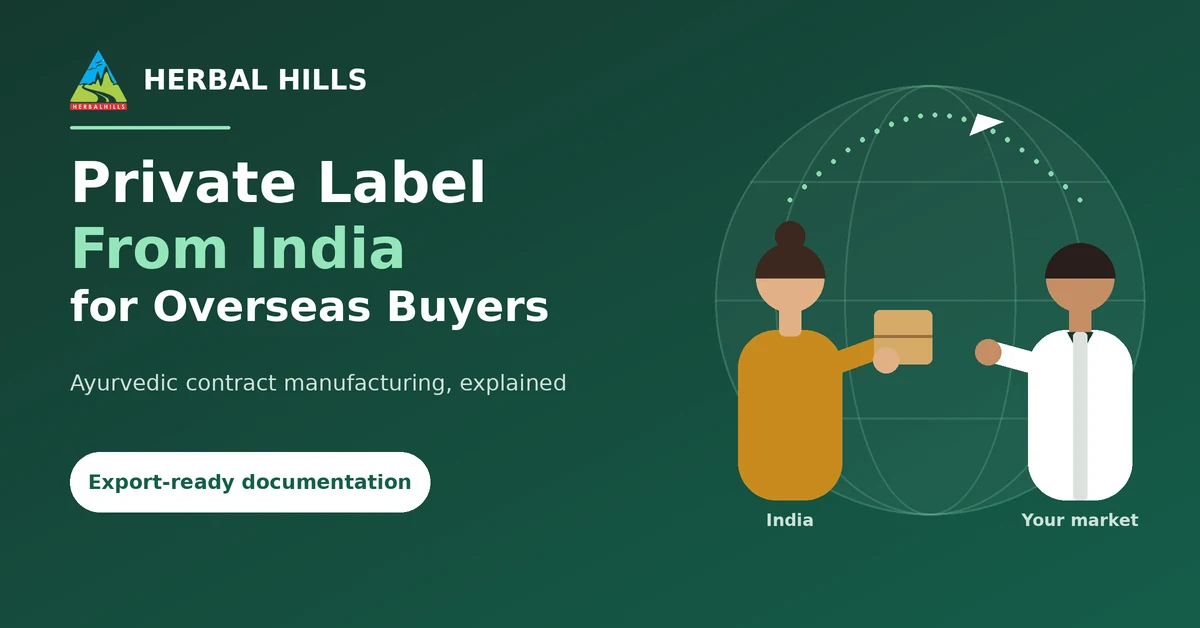
India is the home of Ayurveda, and its Ayush and herbal exports reached US$688.89 million in 2024–25. For a brand owner in the USA, Europe, the Middle East, Africa or Asia, an Indian contract manufacturer is a natural source of authentic Ayurvedic formulations. The questions that follow are practical: can we put our own brand on it, who handles the paperwork, and what do we have to do on our side of the border?
This guide answers those questions in plain language for overseas buyers. It covers how private label works, what the Indian manufacturer provides, what you must check in your own market, and what to ask before you sign. It is general information, not legal advice; always confirm the rules for your destination with a regulatory adviser.
Can an Overseas Company Really Private Label With an Indian Manufacturer?
Yes, and it is a common arrangement. In private label (also called white label) manufacturing, the manufacturer holds the manufacturing licence and makes the product to an agreed formulation. Your brand name, logo, packaging and label go on the finished product, and you sell it as your own. The manufacturer does not need to be visible to your customers.
What changes for an overseas buyer is the border. The product is made under Indian law, but it will be sold under the laws of the country where it is imported. Both sets of rules matter, and each side of the arrangement has its own job.
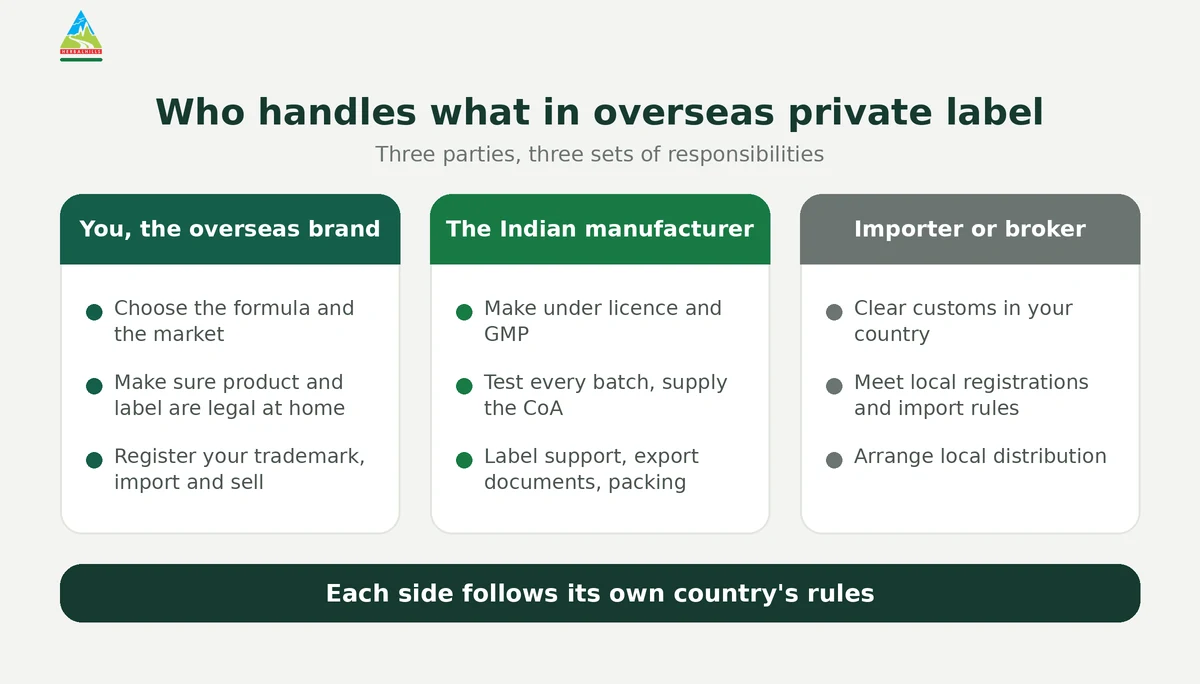
| Who | What They Are Responsible For |
|---|---|
| You, the overseas brand | Choosing the formulation and market, making sure the product and label are legal in your country, registering your trademark, importing and selling the product |
| The Indian manufacturer | Making the product under a valid licence and GMP, testing each batch, supplying a Certificate of Analysis, designing or adapting the label, preparing export documents and export-ready packaging |
| Your importer, customs broker or distributor | Clearing customs, meeting local import rules and registrations, and arranging local distribution |
How Does the Process Work, Step by Step?
🎯Define Your Market and Product
Decide the destination country, the product type and the claims you want to make, because these drive everything that follows.
🌿Choose the Formulation
Pick a ready formulation or ask the manufacturer’s R&D team to adapt one, checking that every ingredient is permitted in your market.
🧴Approve Samples
Test samples for quality, taste, texture and packaging before you commit to an order.
🏷️Finalise the Label
Create a label that follows your country’s rules for language, ingredients, claims and warnings.
🏭Produce and Test
The manufacturer produces the batch under GMP and tests it, with a Certificate of Analysis for every batch.
📄Prepare Export Documents
The manufacturer prepares the commercial paperwork and any certificates your importer requires.
🚢Ship, Clear and Launch
Agree the shipping terms, clear customs in your country and start selling under your brand.
What Does the Indian Manufacturer Need to Export?
Indian Ayurvedic manufacturers work under the Drugs and Cosmetics Act, with a manufacturing licence from the State Licensing Authority and Good Manufacturing Practice under Schedule T. For export, the paperwork depends on the product type and the destination country. These are the documents most often involved:
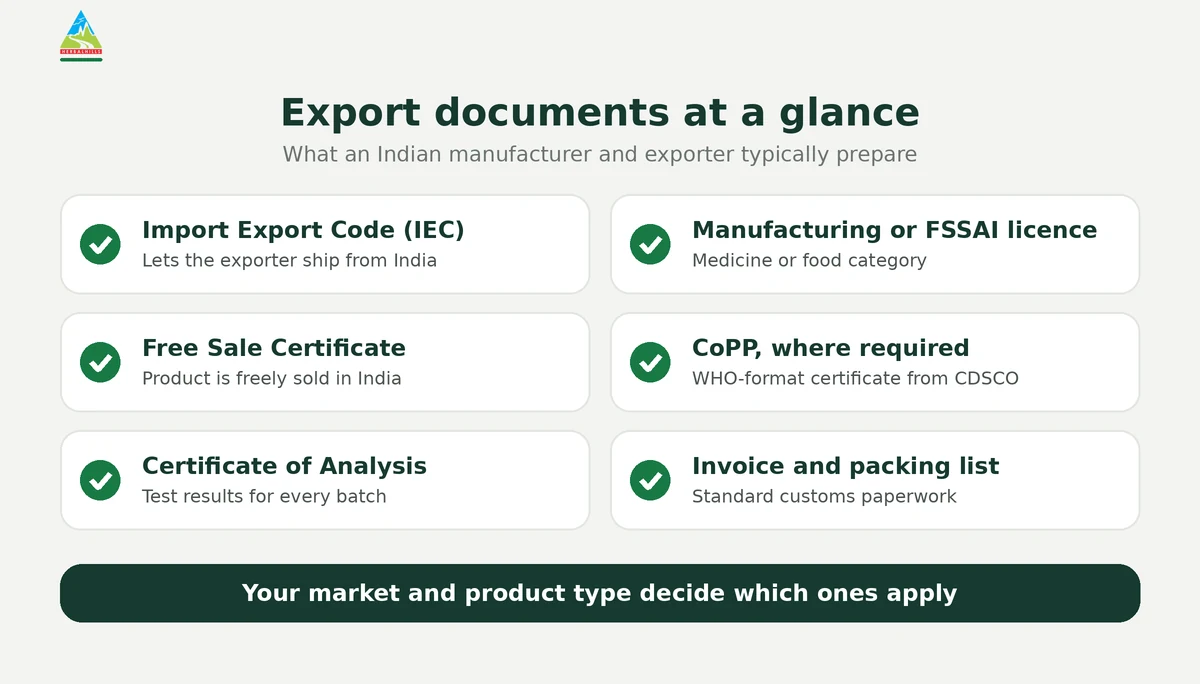
| Document | What It Is | When It Is Needed |
|---|---|---|
| Import Export Code (IEC) | Registration that allows a business to export from India | For the exporting party in India |
| Manufacturing licence | Licence to make Ayurvedic drugs at a specific facility | For medicine-category products made in India |
| FSSAI licence | Food safety licence for consumable products | For supplements, teas and other food-category products |
| Free Sale Certificate | Confirms the product is freely sold in India | Requested by many importers and authorities |
| Certificate of Pharmaceutical Product (CoPP) | WHO-format certificate issued by CDSCO for Ayurvedic products under the WHO-GMP scheme | Required by some importing countries for medicinal products |
| Certificate of Analysis (CoA) | Batch test results for identity and safety limits | For every shipment, and usually requested by importers |
| Commercial invoice, packing list and shipping documents | Standard export and customs paperwork | For every shipment |
Which of these apply to your order depends on the product category and the importing country. A parliamentary reply from the Ministry of Ayush notes that CDSCO issues the CoPP for Ayurvedic products based on a joint inspection, as part of the WHO-GMP certification scheme. Ask your manufacturer and your importer which documents your market expects before you order.
What Does the Overseas Company Need to Check at Home?
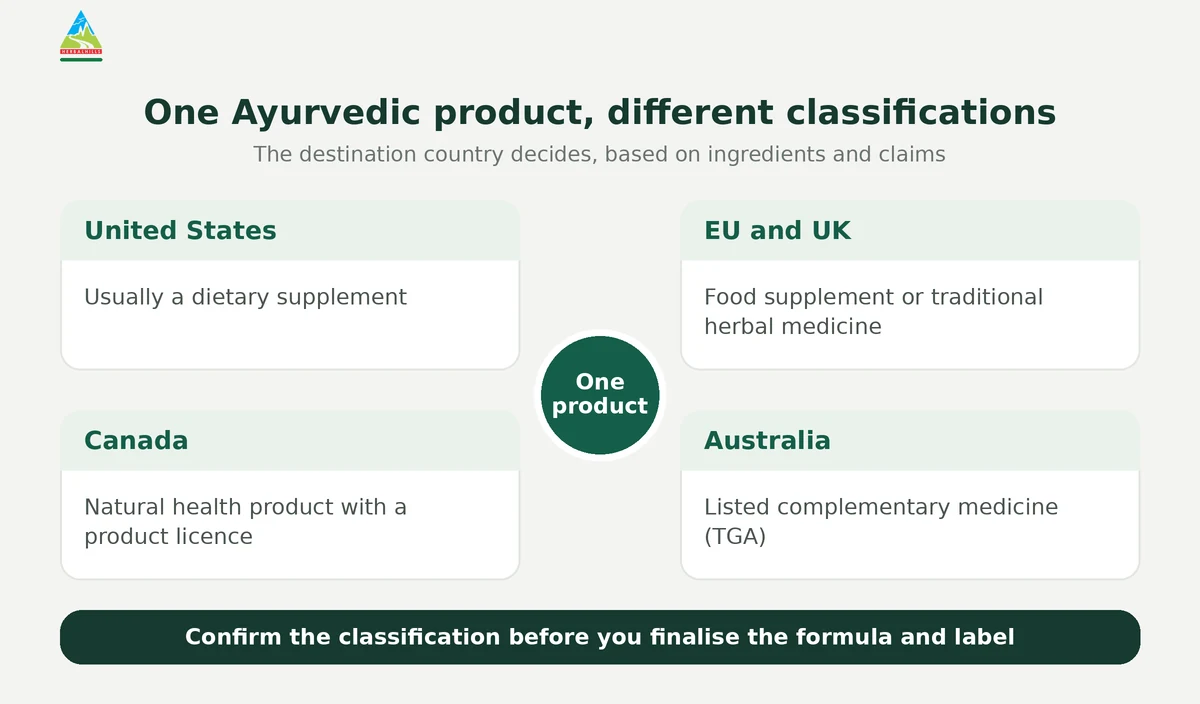
This is the part most buyers underestimate. Importing countries classify and regulate Ayurvedic products differently, and a product that is an Ayurvedic medicine in India may be sold as a dietary supplement, a food supplement, a natural health product or a traditional herbal medicine abroad. The classification depends on the ingredients and, very importantly, on the claims you make.
| Market | How Ayurvedic Products Are Typically Treated | What to Check |
|---|---|---|
| United States | Usually marketed as dietary supplements, with no pre-market approval but strict rules on labelling and claims | Ingredient status, label format, claims and importer obligations; the FDA itself advises seeking US food and drug law expertise |
| European Union | Either a food supplement or a traditional herbal medicine, depending on function and claims | Permitted ingredients, novel food status, notification in some member states, and authorisation if sold as a medicine |
| United Kingdom | Food supplement, or herbal medicine needing authorisation depending on claims | Claims wording and whether authorisation is required |
| Canada | Natural health products that need a product licence before sale | Product licence and approved claims |
| Australia | Listed complementary medicines regulated by the TGA | Listing requirements and permitted ingredients |
| UAE and Gulf countries | Often registered as herbal medicines or supplements under simplified pathways | Registration requirements with the local health authority |
The practical rule is simple: decide your destination and your claims first, check the rules there with a local regulatory adviser, and then brief your Indian manufacturer. A manufacturer that does this the other way round, starting from the Indian label, often has to redo the label and sometimes the formula.
Start from your market
Confirm how your destination classifies the product, which herbs are permitted, what claims are allowed and who must register or notify the product.
Assuming the Indian label works
Copying the Indian label, ingredient list or claims onto your pack without checking local rules, which can stop a shipment at customs.
Who Owns the Formula, the Trademark and the Label?
With Herbal Hills, ownership depends on who created the formula. An existing Herbal Hills formulation stays the property of Herbal Hills, while your brand name, trademark and packaging belong to you. A customized formulation that you create with the R&D team and pay for belongs to you. Read the full explanation in our guide on who owns the formula in Ayurvedic contract manufacturing, and get these positions written into your agreement.
As an overseas brand owner, also register your trademark in your own market before you launch. A registration in India does not protect your name in your destination country.
How Do You Check Quality From Another Country?
- Samples first: approve a sample batch before you place the first order.
- Batch testing: ask for a Certificate of Analysis for every batch, covering identity and safety limits such as microbial limits and contaminants.
- Certifications: ask for GMP and ISO certificates, and any certificates your importer requests.
- Traceability: ask where the raw materials come from and how batches are tracked.
- A plant visit or audit: if you can, visit the facility or arrange a third-party audit before committing to larger volumes.
- Retention samples and records: make sure the manufacturer keeps batch records and samples for traceability.
What Are the Common Mistakes Overseas Buyers Make?
| Mistake | Why It Causes Problems | How to Avoid It |
|---|---|---|
| Choosing the product before the market | An ingredient or claim may not be allowed in your country | Confirm destination rules before you finalise the formula |
| Using an Indian label abroad | Labels must follow the importing country’s rules | Design the label for your market from the start |
| No named importer or local registration | Shipments can be held or refused at customs | Appoint your importer and check registration needs early |
| Skipping samples and quality documents | You discover quality problems after a full order has shipped | Approve samples and require a Certificate of Analysis for every batch |
| Leaving ownership unwritten | It becomes unclear who owns the formula if you change supplier | Put formula and trademark ownership in the agreement |
Questions to Ask an Indian Ayurvedic Manufacturer Before You Sign
- Do you make products for overseas private label brands, and for which countries?
- Which certificates do you hold, and which will my importer accept?
- Will I receive a Certificate of Analysis with every batch?
- Can you adapt the formulation and label to my destination market’s rules?
- What is your minimum order, and how are samples handled?
- Which export documents do you prepare, and which does my importer prepare?
- Who owns the formula, and is that written into the agreement?
- Can I visit the facility, or arrange an audit?
How Does Herbal Hills Support Overseas Private Label Buyers?
Herbal Hills manufactures at its own facility in Lonavala, Maharashtra, with part of its raw material grown on its own organic farm in the Sahyadri range, and welcomes buyers to see the plant before committing. Its export page lists certifications including GMP, ISO, USFDA, EU, Halal, USDA and Onecert. Certifications like these support your importer’s due diligence, but they do not replace registration or notification of your product in your own country, which remains your responsibility.
To plan your first order, share your destination country, product idea and claims, and the team will tell you what to prepare. You can read more on the Herbal Hills export experience page. For a detailed look at one market, read our importer’s guide for the USA.
Frequently Asked Questions
Can a foreign company private label Ayurvedic products made in India?
Yes. An Indian manufacturer can produce Ayurvedic products under your brand name and label and export them to you. You remain responsible for selling the product legally in your own country.
Who is responsible for compliance in my country?
You are, as the brand owner and seller, together with your importer. The Indian manufacturer follows Indian law and can adapt the label and documents, but each importing country has its own rules for classification, ingredients, labelling and claims.
Is an Ayurvedic product sold as medicine or supplement abroad?
It depends on the destination. The same product may be a dietary supplement in one country and a traditional herbal medicine in another, depending on ingredients and claims. Confirm the classification with a local regulatory adviser before you finalise the product.
What export documents does an Indian manufacturer provide?
Typically a commercial invoice, packing list, shipping documents and a Certificate of Analysis. Some importers also ask for a Free Sale Certificate or a Certificate of Pharmaceutical Product. Herbal Hills provides export documentation support and a Certificate of Analysis with every batch.
Who owns the formula if I private label?
At Herbal Hills, an existing formulation belongs to Herbal Hills, while your brand name, trademark and packaging are yours. A customized formulation created with the R&D team and paid for by you belongs to you. Ownership should be written into your agreement.
Can the label be designed for my country?
Yes. Herbal Hills offers free label designing for private label clients and can adapt the layout and information to your market. You should still confirm the final label wording with your local regulatory adviser.
What is the minimum order for an overseas buyer?
Private label and third-party orders at Herbal Hills start from 500 units. The team confirms the exact minimum for your product and format when you share your brief.
Can I visit the facility before ordering?
Yes. Buyers are welcome to visit the Herbal Hills plant in Lonavala, Maharashtra, before committing, and you can also arrange a third-party audit.
Start With Your Market, Then Build Your Brand
Overseas brands can and do private label with Indian Ayurvedic manufacturers, and India’s growing Ayush exports show how established the route has become. The brands that do it well treat their own country’s rules as the starting point, choose a manufacturer that documents every batch and supports export paperwork, and write ownership into the agreement. According to Herbal Hills, orders run most smoothly when the destination country, label language and importer documents are clear before production starts. Share your market and product idea with the team to plan your first export order.
Request the Private Label Catalogue →
Sources
Press Information Bureau, Ministry of Commerce and Industry, Ayush Export Promotion Council observes 4th Establishment Anniversary, 4 January 2026. Lok Sabha parliamentary reply on Ayurvedic products and the CDSCO Certificate of Pharmaceutical Product under the WHO-GMP scheme. U.S. FDA, FDA India Office Addresses Herbal and Ayurvedic Products. Sapere Research Group for the New Zealand Ministry of Health, International Approaches to Natural Health Product Regulations. CBI (Netherlands), Entering the European market for Ayurvedic ingredients for health products. Herbal Hills export experience page.