

Blog
Top Indian Ayurvedic Churna Powder & Herbal Powders, Wholesale

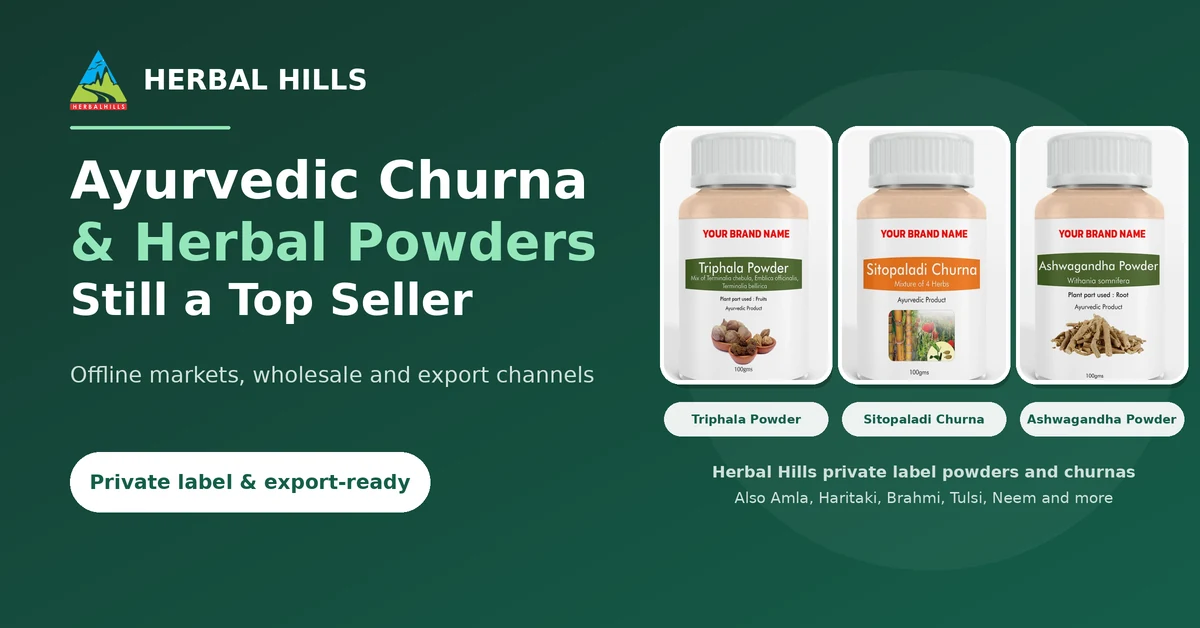
When people talk about growth in Ayurveda, the conversation usually jumps to protein shakes, gummies and online-first brands. Yet a very large part of Ayurvedic sales still happens at the chemist’s counter, the Ayurvedic store and the practitioner’s clinic, and a growing part happens across borders. In both places, the traditional churna and herbal powder remains one of the most familiar products on the shelf.
This guide looks at what the data says about offline and export channels, why traditional powders fit them, what makes it hard to stand out with a classical churna, and how a brand can launch a churna and powder range with Herbal Hills. Figures are as reported by the sources named in each section, as of November 2026.
Why Does Offline Still Matter for Ayurvedic Products?
Online growth gets the headlines, but the numbers show how much of the market is still offline. A Redseer Strategy Consultants report on India’s health supplements estimates that online accounted for roughly 24% of supplement sales in FY26. That means about three-quarters of sales happened elsewhere. Even by FY31, when online penetration is projected to reach 46–50%, around half of the market would still be offline.
Source: Redseer Strategy Consultants, as reported by Open Magazine, 19 November 2026. The offline share is the remainder after the online share. FY31 bar shows the upper end of the projected range.
Which channels lead Ayurvedic sales?
For Ayurvedic and traditional products specifically, specialist outlets lead. Mordor Intelligence reports that Ayurveda and homeopathy pharmacies accounted for 32.1% of India’s AYUSH and alternative medicine market in 2025, while e-commerce and direct-to-consumer platforms are the fastest-growing channel, at about 15.7% a year. Persistence Market Research similarly expects pharmacies and drug stores to account for roughly 35% of Ayurvedic medicine revenue in 2026, citing the trust and advice customers get at the counter.
The practical takeaway is that a brand selling traditional Ayurvedic powders has two good reasons to care about offline: that is where the largest share of sales happens, and that is where customers still ask a pharmacist or practitioner for a familiar name.
Why Do Churnas and Herbal Powders Fit Offline Markets?
Churna is one of the oldest dosage forms in Ayurveda: a fine powder of one or more herbs, taken with water, honey, ghee or buttermilk as traditionally directed. Powders suit offline selling for several practical reasons:
Familiar Classical Names
Triphala, Sitopaladi and Avipattikar churna are names that pharmacists, practitioners and customers already recognise, so they need little explanation at the counter.
Accessible Price Points
Powders are simple to produce and pack, which keeps shelf prices accessible and supports frequent, repeat purchases through the same shop.
Practitioner-Friendly
Ayurvedic doctors prescribe and dispense classical powders, so a trusted brand can build volume through clinics and chemists, not only through advertising.
| Classical Churna | Main Ingredients | Traditional Association |
|---|---|---|
| Triphala Churna | Haritaki, Bibhitaki, Amalaki | Digestive support and general wellness in classical use |
| Sitopaladi Churna | A classical multi-herb blend with sugar candy | A classical respiratory-wellness churna |
| Avipattikar Churna | Trikatu, Triphala, Musta and other herbs | Digestive support in classical use |
| Ashwagandha Churna | Ashwagandha root powder | Strength and vitality in classical use |
These are traditional associations from classical Ayurvedic practice, not claims that a finished product treats any condition.
What Is the Catch? Sameness and Price
A classical churna is, by definition, made to a text formula, so every manufacturer’s Triphala Churna carries the same name and the same ingredients. B2B supplier directories show many manufacturers listing the same classical churnas, so for the customer the easy way to choose is price. This is the same dynamic we describe in our guide to classical vs proprietary Ayurvedic formulations.
That does not make churnas a bad choice. It means a new brand should compete where it can actually be different:
- Quality you can show: consistent raw material, fine and uniform powder, batch testing and a Certificate of Analysis.
- Packaging that protects and sells: moisture-barrier packs, tamper-evident seals, clear labels and sensible pack sizes for retail and for clinics.
- Trust at the counter: a recognisable brand name, batch and expiry details and consistent availability for chemists and distributors.
- Modern formats from the same formula: the same herbs can also be offered as tablets, capsules or syrups, which suits customers who dislike taking powders.
- A broader range: single-herb powders alongside classical blends, so a store can stock one supplier for many needs.
How Big Is the Export Opportunity for Traditional Powders?
Exports are the second big channel. According to a Press Information Bureau release from the Ministry of Commerce and Industry, exports of Ayush and herbal products rose 6.11%, from US$649.2 million in 2023–24 to US$688.89 million in 2024–25. The Ayush Export Promotion Council (AYUSHEXCIL), the nodal export promotion body for the sector, credits outreach, exporter capacity-building and compliance support for that growth.
The policy backdrop is also moving in exporters’ favour. The same release notes that traditional medicine is now recognised in dedicated annexes of the India–Oman CEPA and the India–New Zealand FTA, and that AYUSHEXCIL has been entrusted with the Ministry of Ayush’s Ayush Quality Mark programme, launched in December 2025 to strengthen quality assurance and global recognition. A syndicated industry report published by The Tribune estimates the global Ayurvedic market at about US$12.6 billion in 2025, with demand concentrated in North America, Europe and Southeast Asia.
Government export figures cover all Ayush and herbal products, not churna alone. Churnas and powders are one part of that basket, alongside tablets, capsules, extracts and oils.
What do export buyers expect from a powder supplier?
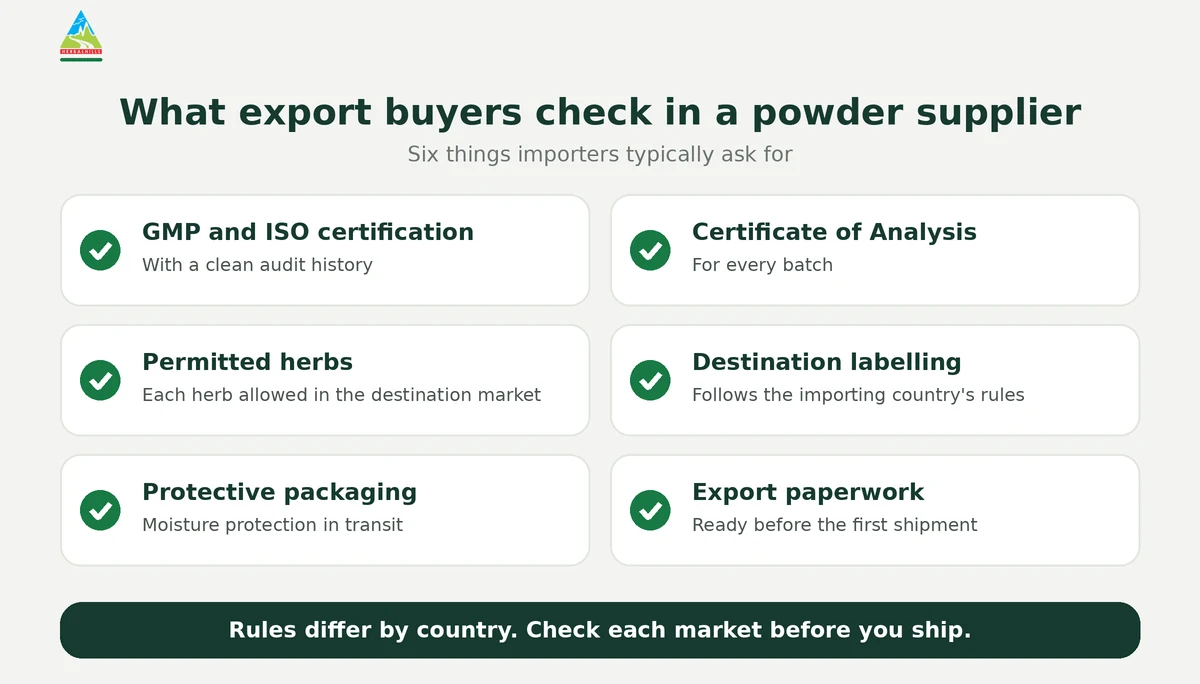
Export markets apply their own rules. In the United States, most Ayurvedic products are sold as dietary supplements under DSHEA, with Good Manufacturing Practice, precise labelling and traceable ingredient sourcing expected. European markets apply their own framework for traditional herbal products. Whatever the destination, importers typically look for the same things:
| What the Importer Checks | What the Manufacturer Should Provide |
|---|---|
| Manufacturing standard | GMP and ISO certification, with a clean audit history |
| Batch quality | A Certificate of Analysis for every batch, covering identity and safety limits |
| Ingredient rules | Confirmation that each herb is permitted in the destination market |
| Labelling | Label content that follows destination-country rules, not only Indian rules |
| Packaging and shelf life | Moisture-protective packaging suited to long transit and storage |
| Export paperwork | Export-ready documentation, ready before the first shipment |
For a detailed look at one market, read our importer’s guide to Ayurvedic supplements from India for the USA.
Which Indian Herbal Powders Are in Global Demand in 2026?
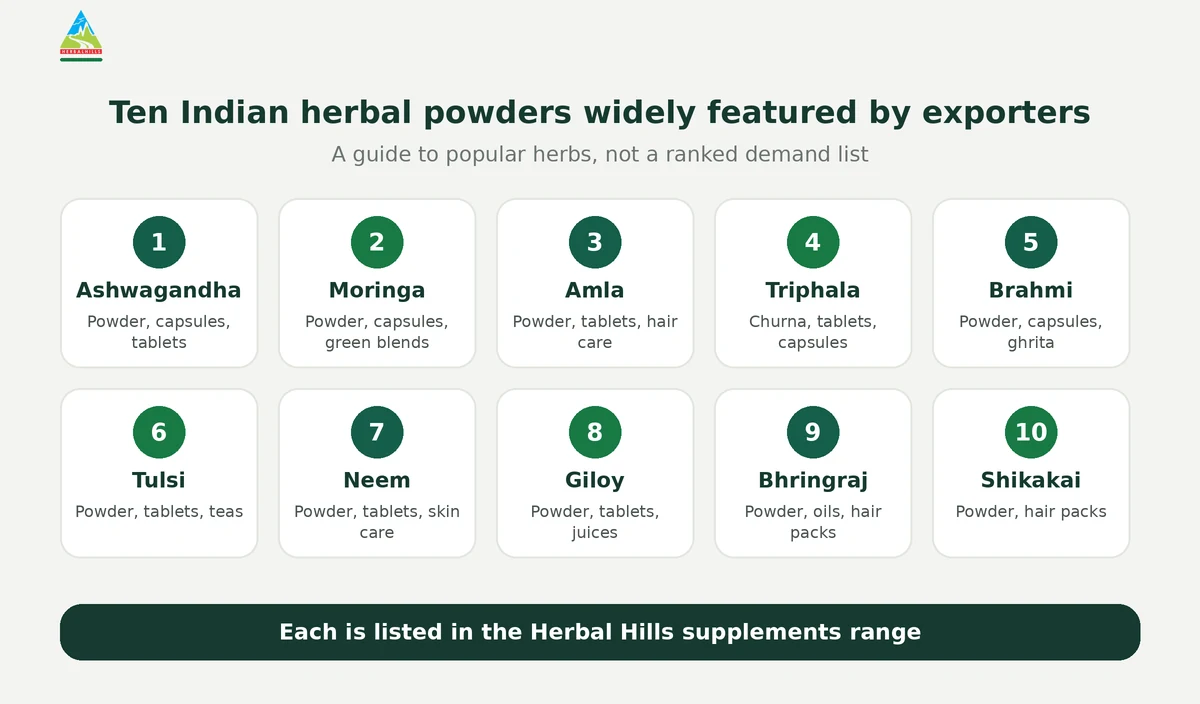
Anyone searching for the top Indian herbal powders in global demand wants to know which herbs international buyers ask for most. There is no official ranking of demand by powder, because trade statistics group herbs, extracts and finished products together, and demand differs from market to market. What exporters and brand owners do see is a recurring set of familiar herbs. The ten below are widely featured in Indian export catalogues and private label ranges, and Herbal Hills lists each of them in its supplements range.
| Herbal Powder | Traditional Association | Common Product Forms |
|---|---|---|
| Ashwagandha | Rasayana herb for strength, calm and vitality | Powder, capsules, tablets, protein blends |
| Moringa | Nutrient-rich leaf used in daily nutrition | Powder, capsules, green blends |
| Amla | Rasayana fruit and a Triphala ingredient | Powder, tablets, juices, hair care |
| Triphala | Classical three-fruit blend for digestive support | Churna, tablets, capsules |
| Brahmi | Medhya herb for memory, focus and calm | Powder, capsules, medicated ghee |
| Tulsi | Holy basil used in daily wellness | Powder, tablets, teas |
| Neem | Traditional herb for skin and purification | Powder, tablets, skin and hair care |
| Giloy | Rasayana stem used for immunity support in classical practice | Powder, tablets, juices |
| Bhringraj | Traditional hair-care herb | Powder, oils, herbal hair packs |
| Shikakai | Traditional natural hair cleanser | Powder, herbal hair packs |
This is a guide to widely featured herbs, not a ranked demand list. Traditional associations come from classical Ayurvedic practice and are not claims about a finished product. Some herbs are restricted or regulated differently in some countries, so check each destination market before you commit to a formula.
Offline, Export and Online: What Does Each Channel Reward?
| Channel | What Buyers Look For | What Your Brand Needs |
|---|---|---|
| Pharmacies and Ayurvedic stores | A trusted name, reliable supply and fair pricing | Consistent quality, clear packs, distributor support and steady availability |
| Practitioner clinics | Authentic classical formulations and dependable batches | Classical products with clear labelling, and the option of a clinic-branded range |
| Export buyers | Compliance, documentation and repeatable batches | GMP and ISO certification, Certificates of Analysis and destination-ready labels |
| Online marketplaces | Reviews, clear claims and comparison with other brands | Strong listings that match the label, plus a story that goes beyond price |
What about selling Ayurvedic churna powder online?
Shoppers who search for Ayurvedic churna powder on a marketplace see many near-identical listings with the same classical names, so price and reviews decide quickly. A new brand can still win online by showing batch quality, clear and accurate listings that match the label, and a range that goes beyond a single classical powder. Our guide for Amazon and Flipkart sellers explains how to build a private label range for marketplaces.
Herbal Powder Wholesalers or a Manufacturer: Which Do You Need?
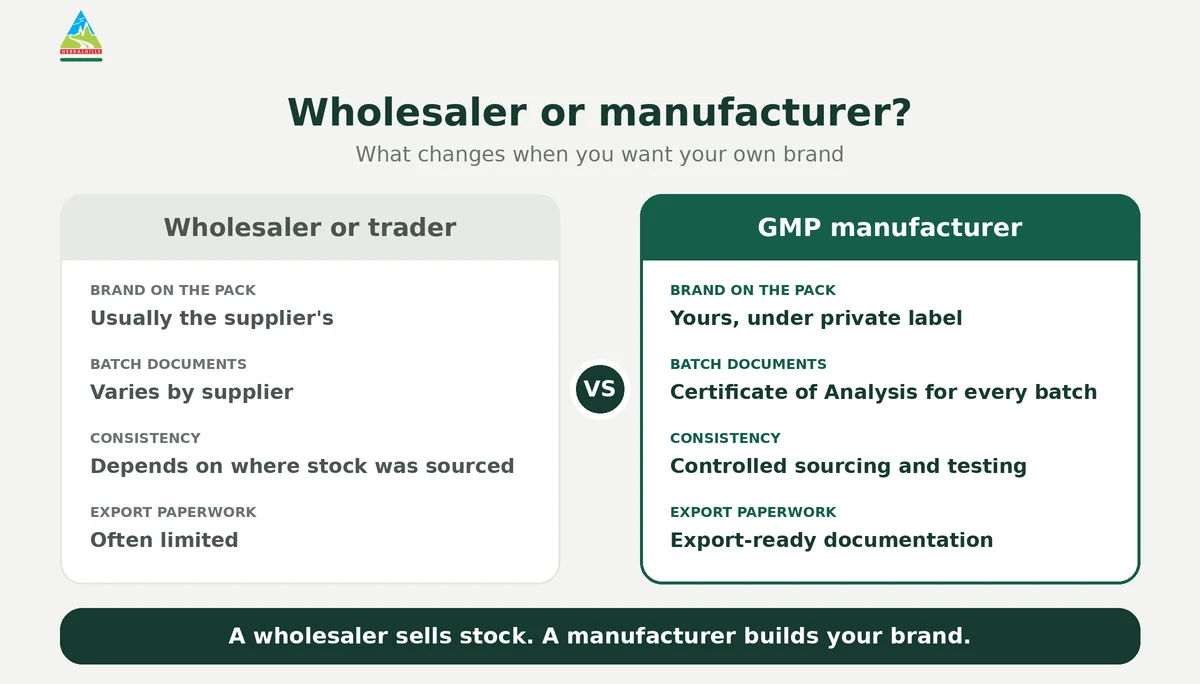
Searches such as “herbal powder wholesalers near me” usually lead to traders and local suppliers. Buying from a wholesaler is simple and quick, but you are normally buying the supplier’s stock under the supplier’s name. If you want your own brand, consistent batches and paperwork you can show to chemists, distributors or importers, you need a licensed manufacturer. The differences are worth understanding before you place a first order.
| Question | Wholesaler or Trader | GMP Manufacturer |
|---|---|---|
| Whose brand is on the pack? | Usually the supplier’s, or a generic pack | Yours, under private label |
| Batch documentation | Varies by supplier | Certificate of Analysis for every batch |
| Consistency between orders | Depends on where the stock was sourced | Controlled sourcing, processing and testing |
| Packs and formats | Mostly fixed packs | Your pack sizes, plus tablets, capsules or syrups from the same herbs |
| Export paperwork | Often limited | Export-ready documentation and packaging |
| Long-term brand value | Low: the same product is available to everyone | Higher: your label, your packaging, your customers |
- Ask for the manufacturing licence and GMP or ISO certificates, not only a business listing.
- Ask for a sample and a Certificate of Analysis for the batch you will receive.
- Ask whether the supplier can label and pack under your brand, and at what minimum quantity.
- Ask what export documentation is available if you plan to sell abroad.
Distributors and traders who want to move from reselling to owning a label can read about how Herbal Hills works with Ayurvedic distributors and about how it supports exporters.
Which Churna and Powder Range Can Herbal Hills Make for Your Brand?
Herbal Hills is a GMP and ISO-certified manufacturer in Lonavala, Maharashtra, with more than 25 years of experience, and its supplements range includes a wide set of single-herb powders and churnas that can be launched under your own label. Examples listed on the site include Triphala, Sitopaladi Churna, Haritaki Powder, Ashwagandha, Dashamoola, Gokshur and Manjishtha powders, among others.
Browse the full Ayurvedic medicine manufacturing range to see classical and proprietary options side by side.
How to Launch a Churna and Powder Range: Six Steps
🎯Choose Your Channels
Decide whether you are selling through chemists and distributors, clinics, exports, online, or a mix.
🌿Pick Your Core Products
Start with a few familiar classical churnas and single-herb powders, then add formats and blends.
🧴Approve Samples
Check powder fineness, aroma, colour and packaging before you commit to a batch.
🏷️Finalise Labels and Packs
Design labels with accurate traditional-use wording and, for export, destination-specific content.
📋Prepare Documentation
Collect Certificates of Analysis and, for exports, the paperwork your importer needs.
🚚Launch and Reorder
Start with core products, track repeat orders and add products as distributors and customers ask for them.
Who Should Launch a Churna and Powder Range?
| Business Type | Why It Fits |
|---|---|
| Ayurvedic distributors | Move from reselling other brands to owning the label, as covered in our guide for distributors becoming brand owners |
| Pharmacy owners and chains | A trusted in-house label on products customers already ask for, as described in our pharmacy owner guide |
| Ayurvedic doctors and clinics | A clinic-branded range of classical powders for patients |
| Exporters and importers | Traditional products with documentation ready for overseas buyers |
| Existing Ayurvedic brands | Add classical powders to a tablet and capsule range, or add modern formats to a powder range |
Frequently Asked Questions
Are churna and herbal powders still in demand?
Yes. Most Ayurvedic products are still bought through pharmacies, Ayurvedic stores and practitioners, and exports of Ayush and herbal products are growing. No public source reports churna sales separately, so brands should read demand through channel and export data and through their own distributors.
Why do traditional powders sell well in offline markets?
They are familiar classical names, simple to stock, accessible in price and easy for pharmacists and practitioners to recommend. Customers also buy them repeatedly from the same trusted shop.
How can a new brand stand out with a classical churna?
Because the name and formula are the same across manufacturers, stand out on quality, packaging, batch documentation, availability and brand trust. You can also offer the same herbs in modern formats such as tablets or capsules.
What is the difference between a classical churna and a proprietary powder?
A classical churna follows a text formula exactly and carries its classical name. A proprietary powder uses classical ingredients in a new formula with its own name. Our guide to classical vs proprietary Ayurvedic formulations explains the legal definitions and the trade-offs.
What do importers expect from a powder manufacturer?
Typically GMP and ISO certification, a Certificate of Analysis for every batch, confirmation that each herb is permitted in the destination market, compliant labelling and moisture-protective packaging. Herbal Hills provides export-ready documentation and packaging.
Which export markets matter most?
One industry report says demand is concentrated in North America, Europe and Southeast Asia. India’s recent trade agreements with Oman and New Zealand also include traditional medicine annexes. Rules differ by country, so check each market before shipping.
Can I launch with a small quantity?
Private label powders at Herbal Hills start from about 500 units, and the team confirms the exact minimum for each product before you order. Sample batches are shared for approval first.
Can the same formula be made as a tablet or capsule?
Often, yes. Herbal Hills makes powders and churnas alongside tablets, capsules and syrups, so a classical powder can be offered in a more convenient format. Format changes may need additional development and compliance checks.
Build a Traditional Range That Sells Where Ayurveda Is Still Bought
Online brands will keep growing, but a large share of Ayurvedic sales still happens at pharmacies, Ayurvedic stores, clinics and export counters, and traditional churnas and powders are at home in all of them. Because the names are classical and the same everywhere, the brands that win are the ones that prove quality, pack well, document properly and stay available. According to Herbal Hills, brands that start with a focused set of classical powders and grow into modern formats and export markets build the most dependable ranges. Request the Herbal Hills supplements catalogue to plan your churna and powder range.
Explore Churna & Powder Range →
Sources
Redseer Strategy Consultants, Health Supplements in India: From Medicine Cabinet to Daily Nutrition, as reported by Open Magazine, 19 November 2026. Mordor Intelligence, India AYUSH and Alternative Medicine Market. Persistence Market Research, Ayurvedic Medicine Market, 2026–2033. Press Information Bureau, Ministry of Commerce and Industry, Ayush Export Promotion Council observes 4th Establishment Anniversary, 4 January 2026. The Tribune (PTI syndicated feed), 28 May 2026, on the global Ayurvedic market.